Note: If an image ever fails to appear - refresh your page, it really is there
The Flags of Canada
The various "UnOfficial" red and blue ensigns shown on this page were unofficial only in so far as they were not recognized by the British Admiralty, which regulated the flags used to identify Commonwealth ships at sea. The Canadian government and population used them on land as a matter of course.
Cross of Saint George
|
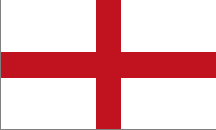
The Cross of Saint George c1277
This flag was in use in England since the Crusades and it was one of the national emblems of England as early as 1277. It continued to be the English national flag for almost 400 years.
The first European explorer to landing in what is now Canada were John and Sabastian Cabot, who landed somewhere on the coast of North America (probably Newfoundland or Cape Breton Island) in 1497 and claimed it for King Henry VII of England. The British failed to establish a settlement in Canada and allowed the French to settle Canada thirty years later. |
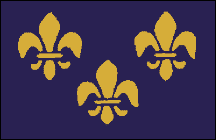
Blue Fleur de Lou of France
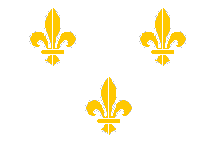
White Fleur de Lou of France
|
The French Royal Ensigns 1535-1763
The French first began to explore and set up colonies in what would eventually become Canada beginning with Jacques Cartier in 1534 when he landed at Gaspé and claimed what is now Quebec in the name of Francis I of France. He most likely carried the Blue fleur-de-lis as a symbol of French royalty.
Under Samuel de Champlain, the first French settlement was made in 1605 at Port-Royal (today's Annapolis Royal, Nova Scotia), and in 1609 the heart of New France, which later grew to be Quebec City, was established. Canada was then known as "New France."
Officially, the blue version of this flag was meant to fly over land, and the white version was a naval ensign. However, it is believed that the white Fleur de Lou flag of France flew over all or most of the French forts and settlements in America.
The French claimed Canada as their own, and 6,000 settlers arrived, settling along the St. Lawrence. |
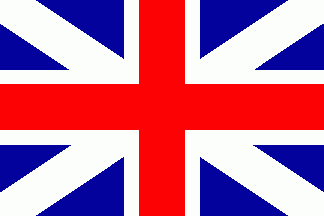
British Union Flag 1707
|
The British Union Flag 1707-1801
With King James I inheritance of the English throne in 1603, the Cross of Saint George was placed over the Scottish Cross of Saint Andrew to form the British Union Flag.
During this period of time, Britain and France repeatedly went to war and made their colonial empires into battlefields. In a series of four wars (Queen Anne's War, King George's War, The French and Indian War, and the Seven Years War) the British took control of Canada. With the signing of the Treaty of Paris in 1763, France ceded most of its remaining territory in North America to the British. The new British rulers left much of the religious, political and social culture of the French-speaking inhabitants alone. |
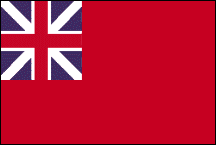
British Red Ensign 1707
|
The British Red Ensign 1707-1801
The British Red Ensign, also called the "Colonial Red Ensign" and the "Meteor" Flag, was adopted by Queen Anne (1702-1714) as the new flag for England and her colonies in 1707.
Although it was not first intended that the Red Ensign should be used on land, it seems that it became the "de facto" Royal flag used in most of the English colonies for that purpose. |
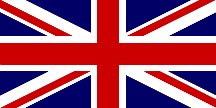
British Union Flag 1801
|
The Royal Union Flag 1801
In 1801, the Cross of St. Patrick had been added to the British Union Flag when Ireland joined the Union. This cross was counterchanged with the Cross of St. Andrew.
The British Union Flag, known to the Canadians as "The Royal Union Flag," was considered the "official" flag of Canada, and so it remained for many years, all through World War I, when it was the flag of the Canadian forces.
To this very day, the Royal Union Flag still remains the "official" royal flag of Canada. In 1964, Parliament declared the flag should be flown to "show allegiance to the crown and as a symbol of Canadian membership in the Commonwealth." It is required to be flown at Canadian federal government facilities on Victoria Day (the anniversary of the Statute of Westminister), and Commonwealth day, but the national flag (maple leaf) can takes precedence in all cases except during a royal visit.
|

The British Red Ensign 1801
|
The British Red Ensign 1801
Although the British Red Ensign was originally designed to be the Merchant Flag used on non-military British ship while at sea, in Canada it was treated as the national flag on land as well. Since the British Union Flag was a semi-royal flag and only flown only on the very most important military buildings on land, the Red Ensign by default was commonly used on land in Canada as a national flag until 1868. After that the Canadians added shields on the red flys to indicate that it was the "Canadian Red Ensign."
|
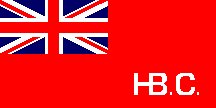
Hudson Bay Company
|
The Hudson Bay Company Ensign 1630-1970
Until 1867, the Hudson's Bay Company controlled most of the area of modern Canada west of Ontario. A flag much used in this territory was the British Red Ensign (a red flag with the Union Flag on the canton) with the capital letters H B C in white on the fly: the letters H and B are joined together in a monogram arrangement. One of these flags is displayed in Christ Church Cathedral, in Victoria, British Columbia. The Hudson's Bay Company Ensign continued in use until the company's tercentenary in 1970, at which point it was retired. HBC is the oldest commercial corporation in North America and is one of the oldest in the world. This flag was probably the prototype for the Canadian Red Ensign and several provincial flags. |
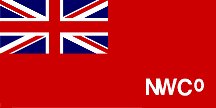
North West Company
|
The North West Company Ensign 1779-1821, 1987
The North West Company was a fur-trading business started in 1779 in Montreal. After operating for 40 years in the Canadian North-West, it merged with the Hudson Bay Company in 1821. In 1987, a group of investors (including 415 employees) purchased the Northern Stores Division from the Hudson Bay Company and took back its historical name and flag. With 300 years of history under its belt as a provider of food and everyday products and services to remote communities across northern Canada and Alaska, the North West Company is now the oldest retailer on the continent. |
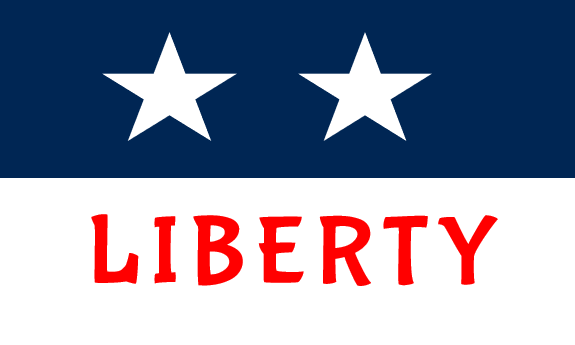
The Patriotes Flag 1837
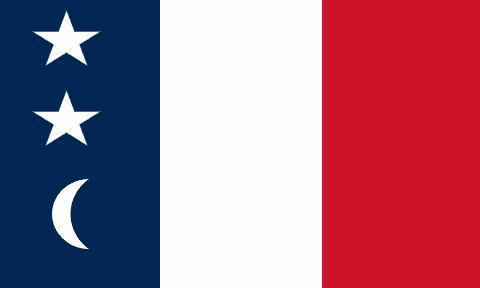
Republic of Canada 1838
|
The Rebellions of 1837-1838
There were two armed uprisings in Lower and Upper Canada (Quebec and Ontario) called the Rebellions of 1837-1838. They were motivated by frustration over the lack of republican political reform. In 1837 open violence between "The Sons of Liberty," the militant wing of the Patriotes movement headed by Louis Joseph Papineau, and pro-British elements broke out in Montreal. This would spread, being fueled by deep rooted dissatisfaction between the British and French communities in the area. In late 1838 William Mackenzie and a small group of his followers retreated from Toronto to Navy Island on the Niagara River. The rebels declared it the Republic of Canada in December of 1838. The whole affair ended when the Canadian militia captured and destroyed the American supply steamer Caroline which had been supplying those on the island, and then drove the rebels off the island. This all eventually led to the famous Lord Durham's Report calling for the establishment of responsible English government in the colonies.
During these uprisings two different flags were reported. One was a blue and white horizontal bicolor with two white stars representing Upper and Lower Canada on the blue stripe and "Liberty" in red on the white stripe. The second was a French Tricolor defaced with two white stars and a crescent moon stacked on the blue vertical stripe. The crescent moon was a symbol favored by secretive local hunter groups in the area. Since we only have written descriptions of these flags that didn't indicate either size or placement of the embellishments, these illustrations are only speculative. |
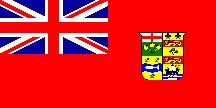
UnOfficial Flag 1868
Made Official 1892
|
The First Canadian Red Ensign 1868-1922
In 1868 a royal warrant created the Great Seal of Canada. The first Canadian Red Ensign was created shortly after this (without formal authority) and flown over the Canadian Parliament. This flag was made official in 1892 (after a personal intervention with the British Admiralty, which had the final say on such matters until 1931, by Governor General Stanley (the donor of the Stanley Cup for hockey), and remained so until 1922.
In 1917, during World War I, the Canadian Expeditionary Force raised this Canadian Red Ensign (popularly known at that time as the "Canadian Flag") on Vimy Ridge, not the Union Jack, even though all Commonwealth forces were technically British during the War. Canada was also signatories of the Versailles Treaty and charter members of the League of Nations, both under this Canadian Red Ensign. Through out this period, widespread use of this flag on land continued on Canadian government buildings.
( For an more information on the shield used - Click here ) |
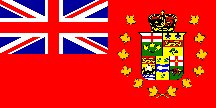
1. UnOfficial Flag 1870
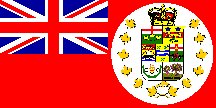
2. UnOfficial Flag 1873
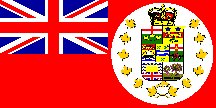
3. Conjectural Design 1896
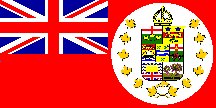
4. UnOfficial Flag 1901
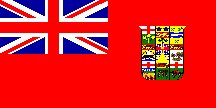
5. UnOfficial Flag 1907
(Type 1)
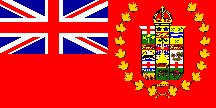
UnOfficial Flag 1907
(Type 2) |
"UnOfficial" Canadian Red Ensigns 1870-1924
As Canada grew and new territories and provinces were establish, the official versions of the national arms seemed to lag behind reality. The various "UnOfficial" ensigns were unofficial only in so far as they were not recognized by the Admiralty, which regulated the flags to be used to identify ships at sea. While the Canadian Parliament waited for royal approval of updated versions of the national arms, Canadian flag makers didn't. They produced a series of "UnOfficial flags" that the Canadians proudly used on land as a matter of course.
( For more information about this subject - Click Here )
1. Canadian Red Ensign (not official) 1870-1873
The addition of the Province of Manitoba to Canada prompted another unofficial change to the red ensign.
( For more information about the shield used - Click Here )
2. Canadian Red Ensign (not official) 1873-1901
In 1873 the Confederation of Prince Edward Island was added to the Canadian arms. The coat of arms was very similar to the present coat-of-arms, except that the motto "parva sub ingenti" was an integral part of the design. Most Canadian flag makers continued making the flag with symbols for all the provinces.
( For more information about the shield used - Click Here )
3. Canadian Red Ensign (conjectural) 1896-1901
In 1896, British Columbia adopted a new seal designed by Canon Beanlands, and according to urban legend a new Red Ensign was born. The legend claims that the flag fell victum to a governmental conspiracy after the new seal for British Colombia was rejected by the College of Heralds because it showed "the sun setting on the British Empire." This is, of course, total nonsense. Most evidence indicates that this red ensign design was simply a conjectural one made by a flag maker and the flag was never actually manufactured. Although the Beanlands version of the British Columbia coat-of-arms was used for various purposes prior to the 1906 Grant of Arms from the College of Heralds, it does not seem to have ever been used on a red ensign.
( For more information about the Beanland shield - Click Here )
4. Canadian Red Ensign (not official) 1901-1907
As these aberrant ensigns bore a crown, they underwent a change in 1901. During the Victorian era, the Saint Edward's crown (with the depressed arches) had been used, but upon the accession of Edward VII, in 1901, the (Tudor) crown with raised arches was adopted.
( For more information about the shield used - Click Here )
5. Canadian Red Ensign (not official) 1907-1924
In 1905 with the creation of Saskatchewan and Alberta from part of the North-West Territories, Canadian flag makers created yet another couple of "UnOfficial version of the Canadian Red Ensign.
( For more information about the shield used - Click Here ) |
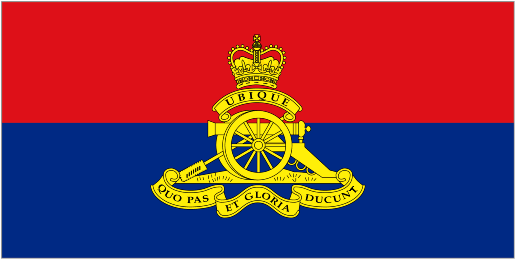
CF-RCA Ensign
|
Royal Canadian Artillery 1871
The Royal Regiment of Canadian Artillery (RCA) is the artillery branch of the Canadian Forces (CF). The first artillery company in Canada was formed in the province of Quebec in 1871 and comprised of two garrison batteries named respectively Batteries A and B. They are still active today as part of the 1st Regiment, Royal Canadian Horse Artillery (RCHA).
The Royal Canadian Artillery has participated in most major conflicts in Canada's history and their flag is almost identical to the Royal United Kingdom Artillery except in the gold coloring of the badge. The two slogans that appear on the flag are "Ubique" (top) meaning "Everywhere" and "Quo Fas Et Gloria Ducunt" (bottom) meaning "Where Right and Glory Lead." |
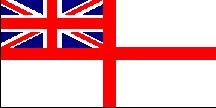
Royal Canadian Navy Ensign
|
The Royal Canadian Navy Ensign 1910-1964
When the Royal Canadian Navy (RCN) was established in 1910, there was some dispute as to what ensign and jack Canadian warships should fly. Eventually it was decided that the White Ensign of the British Royal Navy (RN) would be the Canadian naval ensign, and that the Canadian Blue Ensign (already in use as the government ensign) would be the Canadian naval jack. This arrangement, however, was not entirely satisfactory. Since the jack was not flown underway, RCN ships at sea could not be distinguished from those of the RN. During World War I, therefore, Canadian warships began to display a green maple leaf on either side of the forward funnel. This informal insignia was later made official.
|
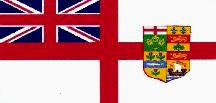
Proposed Naval Ensign
|
Proposed Royal Canadian Navy Ensign 1910
This flag was proposed as the Royal Canadian Navy Ensign, but wasn't approved or put into use. When the Naval Service of Canada was established in 1910, the government wanted to adopt the British White Ensign defaced with the Canadian shield as the naval ensign, but the British Admiralty, which had the final say in such matters at that time, would not hear of it.
The funny thing is that some fifty years later, at the time of the Vietnam War, the Admiralty demanded that Australia and New Zealand cease using the undifferentiated White Ensign on their warships. I guess the Canadians asked too soon.
|
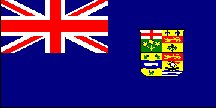
Canadian Naval Jack 1910
|
The Royal Canadian Navy Jack/Ensign 1910-1922
As the Royal Canadian Navy Jack between 1910-1922, this was the official flag for all government owned vessels (both federal and provincial). This would have included the armed vessels which were transferred to the Naval Service of Canada by the Department of Marine and Fisheries (Canadian Coast Guard) in 1910.
The Canadian Blue Ensign was used as jacks on RCN warships, but used as ensigns on all government owned vessels, both federal and provincial, other than those which belonged to the RCN. ( For more information about the shield used - Click Here ) |
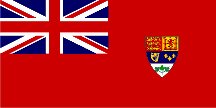
Canadian Red Ensign 1922
|
The Canadian Red Ensign 1922-1957
In 1921 a royal proclamation made Royal Arms of Canada into their present form. In 1924 a Canadian Order in Council was passed authorizing the Red Ensign to be flown for limited use over all Government buildings abroad, and that was because the diplomatic service needed to have some flag to fly over Canadian Embassies that was not the Union Jack. In 1945 a Canadian Order in Council made the Canadian Red Ensign the de facto national flag decreeing that until such time as action is taken by Parliament for the formal adoption of a national flag, the Red Ensign may be flown wherever place or occasion may make it desirable to fly a distinctive Canadian flag. ( For more information about the shield used - Click Here )
|
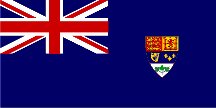
Canadian Blue Jack 1922
|
The Royal Canadian Navy Jack/Ensign 1922-1957
The Royal Canadian Blue Jack was the official flag for all government owned vessels from 1922 to 1957. The Canadian Blue Ensign was also used as jacks on RCN warships.
( For more information about the shield used - Click Here )
The Canadian Blue Ensign was used as jacks on RCN warships, but used as ensigns on all government owned vessels, both federal and provincial, other than those which belonged to the RCN. |
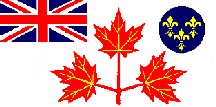
Battle Flag of Canada
|
The Canadian Active Service Force Flag 1939-1944
Canadian Army Battle and Command Flag
In the Second World War, which Canada entered after Britain declared war on Germany, they used the Canadian Red Ensign as their national flag, but also in use was this lesser known battle flag. Canada wanted its army to be distinguishable among the great mass of British troops, and so provided it with, not the Canadian Red Ensign, but this new battle flag.
Designed by Colonel Archer Fortescue Duguid, Director of the Historical Section of the National Defence Headquarters in Ottawa, the flag of the Canadian Active Service Force, generally known as the "Battle Flag of Canada," was approved by the War Cabinet in December of 1939. No other command flag was authorized for use until the Force Mobile Command Flag in 1989. |
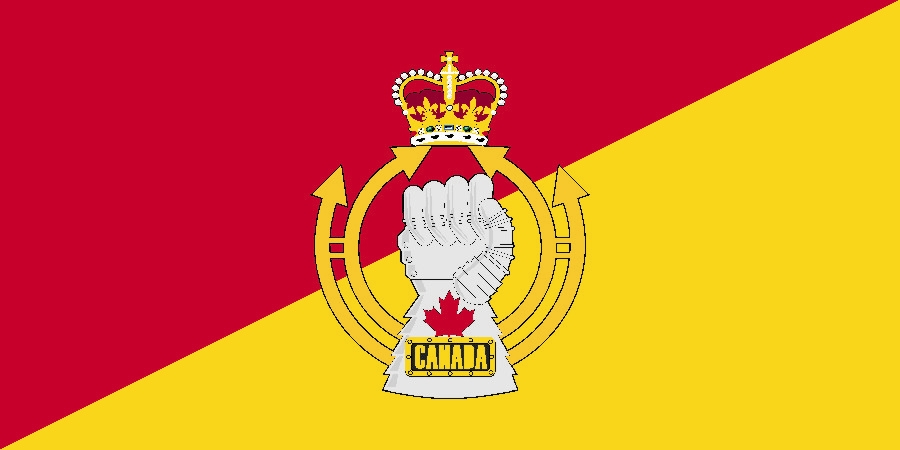
RCAC Flag
|
Royal Canadian Armour Corps 1945
Beginning in 1936, Canadian armoured regiments were created to replace the dated horse cavalry with more modern "tank" regiments. Thus, the Royal Canadian Armour Corps (RCAC) was officially formed in 1940, first as the Canadian Armoured Corps (CAC), which in turn, traced its lineage back to the Canadian Tank Corps (CTC) of the First World I.
The royal designation was added in 1945. |
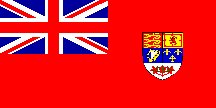
Canadian Red Ensign 1957
|
The Canadian Red Ensign 1957-1965
In 1957 a slight modification was made to the approved artistic interpretation of Canada's arms changing the maple leaves on the Canadian Red Ensign from green to red. The Canadian Red Ensign would continue to be both the Merchant Naval Ensign and defacto national land flag until it was replaced by the Maple Leaf Flag in 1964. ( For more information about the shield used - Click Here ) |
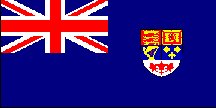
Canadian Naval Jack/Ensign 1957
|
The Royal Canadian Navy Jack 1957-1964
This was the Royal Canadian Blue Jack for all government owned vessels from 1957 to 1964, replacing the 1922-1957 pattern Canadian Blue Ensign.
( For more information about the shield used - Click Here )
The Canadian Blue Ensign was used as jacks on RCN warships, but used as ensigns on all government owned vessels, both federal and provincial, other than those which belonged to the RCN. |
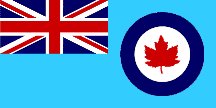
Canadian Air Force Ensign
|
The Royal Canadian Air Force (RCAF) Ensign 1941-1968
The ensign of the Royal Canadian Air Force was based on the ensign of the British Royal Air Force (RAF), a light (sky) blue ensign, but with the Canadian Maple Leaf placed within the roundel. Until the Second World War the RAF ensign was used by the RCAF; the RCAF ensign with the maple leaf roundel began to be used in 1941.
The outbreak of the Second World War the RCAF had 15 permanent operational squadrons (12 for homeland defence, three for overseas service). However, only 29 were front-line fighter and bomber aircraft. By the end of the war, the RCAF would be the fourth largest allied air force. The Royal Canadian Air Force (RCAF) was the air force of Canada from 1924 until 1968 when the three branches of the Canadian military were merged into the Canadian Forces. |
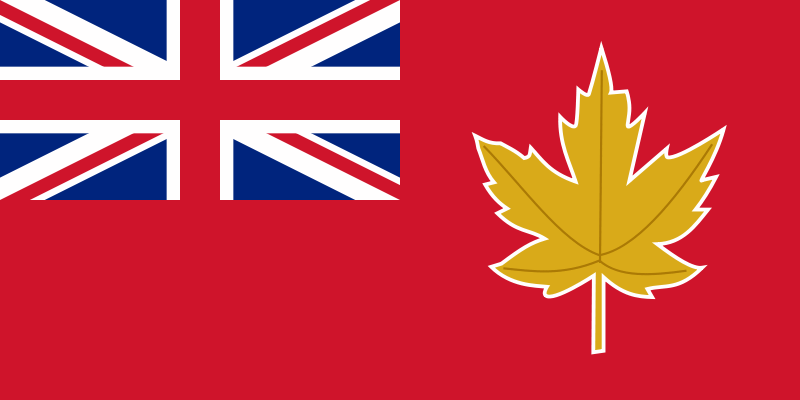
Proposed National Flag 1946
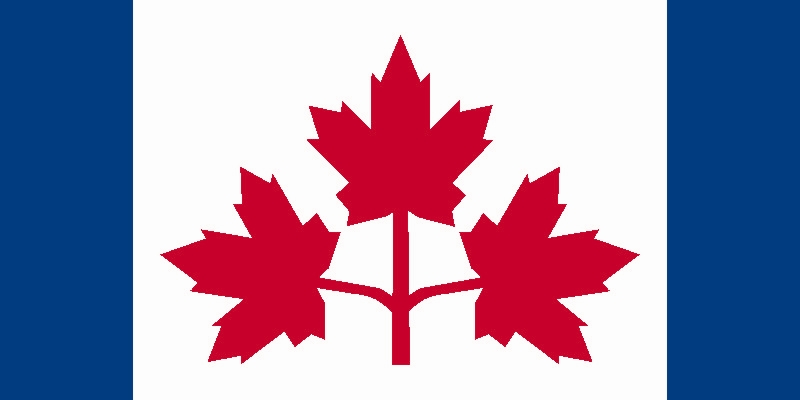
Pearson Proposal 1963
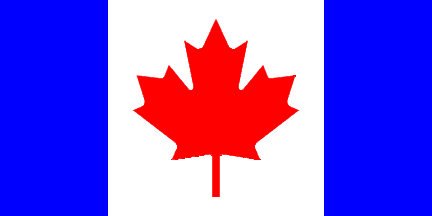
Scott's Proposal 1963
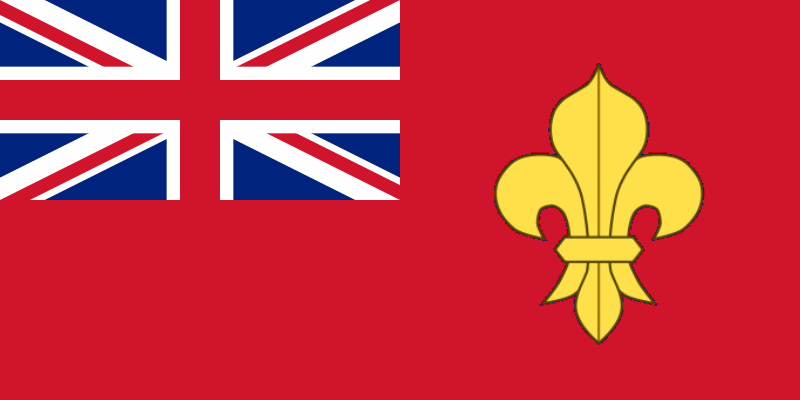
fleur-de-lys Proposal 1963
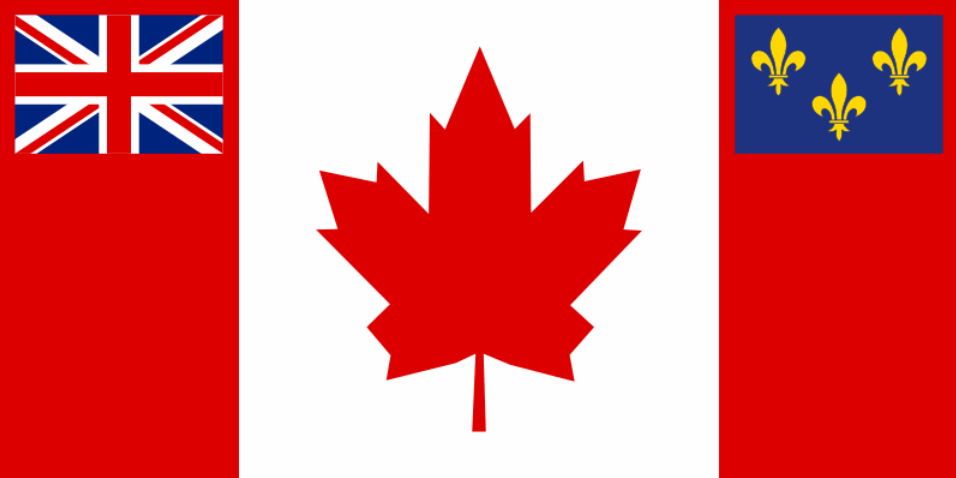
Beddoe Compromise Proposal 1963
|
Proposed Canadian National Flags 1946-1963
For much of its post-Confederation history, Canada used both the Royal Union Flag (Union Jack) and the Canadian Red Ensign as its national flag. One of the first attempts to change that was during World War II in 1946, but failed. During the election campaign of 1963, Lester Pearson and the Liberal Party promised that Canada would have a new flag within two years of his election. His selection committee, after having eliminated many designs, had it down to four: a traditional British Red Ensign with a gold Maple Leaf on the fly, the three-leaf design favored by Pearson, Scott's proposal of a single red maple leaf on the white stripe on a blue flag, another traditional British Red Ensign with the fleur-de-lys on the fly, and a compromise design by Alan Beddoe.
Pearson's Proposed Flag 1963
Pearson's preferred choice for a new flag has been nicknamed "the Pearson Pennant," which featured the three maple leaves on a blue background. he preferred this choice, as the blue bars reflected Canada's motto, "From Sea to Sea". The flag was never officially recognized, although it led to the adoption of the current Maple Leaf Flag in 1965.
Scott's Proposed Flag 1963
In an attempt to satisfy Lester Pearson's wish to have a flag representing a united Canada from "From Sea to Sea," (between two blue bands of water) the original graphic artist, George F.G. Stanley, later reduced the three maple leaves one and widened the bands slightly, in a design supported by Committee member Reid Scott. Naturally enough the Maple Leaf with blue borders seems to be the preferred design among French Canadians.
Proposed fleur-de-lys Flag 1963
The fourth proposed flag considered by the committee was the traditional British Red Ensign with a fleur-de-lys added to the fly. The design also closely resembled the concept that the 1946 special joint committee's had recommended as a national flag design. However, the Red Ensign with the Union Jack was unpopular in Quebec, a base of support for Pearson's Liberal Party, but naturally the Red Ensign was strongly favored by English Canada.
Beddoe Compromise Flag 1963
This fifth proposed flag was a compromise idea created by Alan Beddoe, who wanted to appease the Royalists and the French population. Somewhere in the elimination process the compromise design was rejected, both traditional red ensign ideas were also eliminated, along with the Pearson Pennant, in favor of Scott's design, with one committee change, the blue stripes were changed to red, keeping the red maple leaf in the center of the white stripe. In the end, it was this simple red and white maple leaf design that was adopted by the Committee in October of 1964 and today has become one of the most recognizable flags in the world.
|

The Maple Leaf Flag
|
The Maple Leaf Flag 1965
A royal proclamation established the National Flag of Canada in 1964 as the Maple Leaf Flag, which was first officially flown in January of 1965. The use of the Canadian Red and Blue Ensigns, as well as the Royal Canadian Navy White Ensign stopped at this time.
The Maple Leaf flag was supported by the Liberal government. The (Conservative) opposition leader at the time, John Diefenbaker (also a former Prime Minister), requested at his death in 1979 that his casket be covered with both the Maple Leaf and the Red Ensign. |

Canadian Confederation's
100th Anniversary Flag

Canadian Confederation's
100th (type #2)
 Canadian Confederation's Canadian Confederation's
100th (type #3)
Canadian Confederation's
100th (type #4)
|
Canadian Centennial Flag/Expo 67 Flags 1967
On July 1, 1967, Canada marked its Centennial Anniversary (100 years) since the forming of the Canadian Confederation, in which the British colonies of Canada, Nova Scotia, and New Brunswick were united into
the Dominion of Canada in 1867.
Activities were planned all across the country. Since some of the organizers were concerned that centennial festivities would be upstaged by the 1967 World's Fair (Expo 67) being held in Montreal, Canada, the two events were linked. The official Expo 67 guide devoted several pages to the Centennial celebrations. This tradition of multiple colored fields for these flags would be continued in the Sesquicentennial (150) celebrations held 50 years later in 2017.
|
|
|
Canadian Confederation's
100th (type #5) |
|
Canadian Confederation's
100th (type #6) |
|
|
|
Canadian Confederation's
100th (type #7) |
|
Montreal Expo 67 Flag
"friendship around the world" |
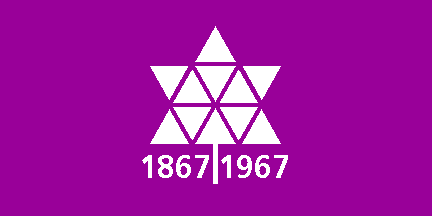
Stuart Ash designed the Canadian Confederation Centennial logo in 1966, a maple leaf comprised of 11 equilateral triangles to represent the 10 Canadian provinces and the territories at the time. The Expo 67 theme was "Man and His World" and its logo was designed by Montreal artist Julien Hébert. The icon, an ancient symbol of man, was repeated in a circular arrangement to represent "friendship around the world."
It is not surprising that the red fielded centennial flag was most common version displayed across Canada since it reflected the colors of the new national flag of Canada, the "Maple Leaf" Flag, just adopted two years previously in 1964. |
CF Flag
|
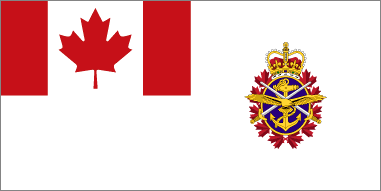
Canadian Forces Ensign 1968
The Canadian Forces (CF), or the Canadian Armed Forces, are the unified armed forces of Canada, as first constituted by the National Defence Act of 1922. The Canadian Forces Reorganization Act amended the National Defence Act in 1968 and established the united Canadian Forces as they are today. They include all three main branches of the Canadian military; the Maritime Command (MARCOM), Land Force Command (LFC), and Air Command (AIRCOM). At the top of the Canadian Forces command structure is the Commander-in-Chief (the reigning Canadian monarch), represented by the Governor General.
This flag is flown at all Canadian Forces Bases and used as the rank flag of the Chief of the Defence Staff. |
CF-FMC Flag
|
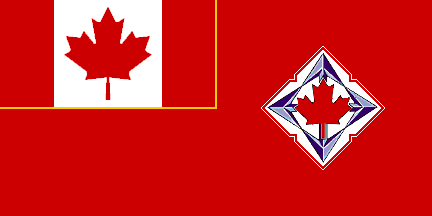
Canadian Forces - Force Mobile Command Flag 1968-1998
Upon the unification of the three branches of the Canadian military into the Canadian Forces in 1968, this Force Mobile Command flag was used by all three branches until adoption of the Land Force Command flag in 1998. Strangely in 1966, all the strike bomber aircraft were transferred from the Air Defence Command to the new Force Mobile Command. Stranger yet, the Force Mobile Command flag continued to be unofficially referred to as the "Canadian Army" flag by the general public.
The misplaced reality of not placing the strike bombers under the Air Defence Command was finally acknowledged in 1997 when the "Army" command was renamed the "Land" Force Command, and the control of the strike bombers turned back over to the Air Defense Command once again. |
CF-LFC Ensign
|
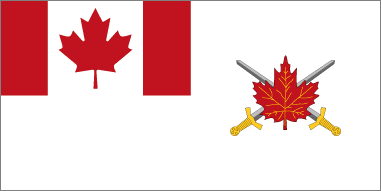
Canadian Forces - Land Force Command 1998-2013*
(*by simple default this flag "unofficially" remained in use until 2016)
The Flag of the Canadian Armed Land Forces (LFC) during this period (1998-2013) was white with the national flag in the canton. On the fly, there are two crossed swords, partially covered by a red maple leaf.
With the renaming of the Mobile Command in 1998 to the Land Force Command this flag was acknowledge defacto as the Army Command flag, although it wasn't until 2011 that the name "Canadian Army Command" would become officially recognized. It would be an additional three years until a new red replacement Canadian Army Command flag appeared 2016. |
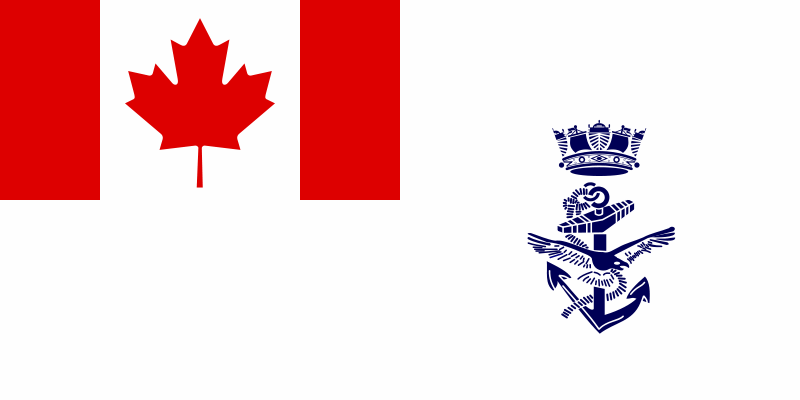
CF-MARCOM Jack
RCN Ensign since 2013
|
Canadian Forces - Maritime Command Jack 1968-2013
Royal Canadian Navy Ensign 2013-present
The Royal Canadian Navy (RCN) has been the navy of Canada since 1910 and used the White Ensign of the British Royal Navy (RN) until 1968 when the three Canadian armed services were unified to form the "Canadian Forces." Between 1968 and 2013, the Canadian navy used this flag as a jack, but used the National Maple Leaf Flag as their ensign on warships.
In 2013, however, once again renamed the "Royal Canadian Navy," they officially reverted to using this flag as the ensign, and began using the Canadian National Flag as their Jack, basically reversing the positions of the flags. |
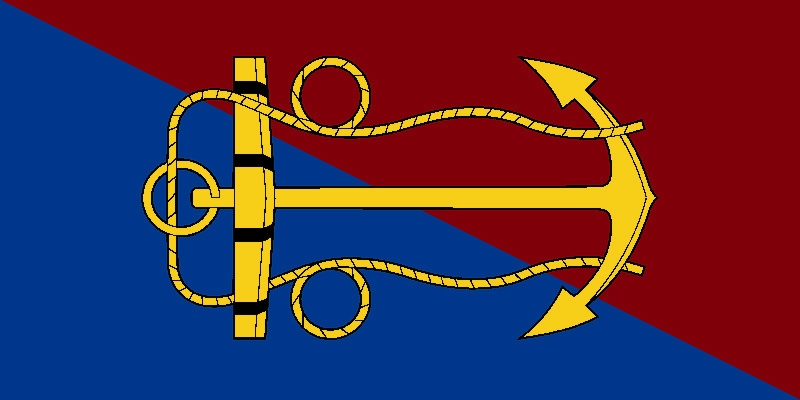
CF-MARCOM Naval Board
|
Canadian Forces - MARCOM Naval Board
The Canadian Navy Board is comprised of flag officers (Commodores and above) and meets every few months to discuss operations and fleet policies. The fleet is roughly evenly split between the Atlantic and Pacific commands with the Atlantic housing the larger of the two fleets. MARCOM participates in NATO exercises, and ships are deployed all over the world in support of the Canadian military and in conjunction with multinational deployments.
When meeting the Navy Board flag flies in place of the senior officer's flag. The flag is divided diagonally descending crimson over blue with a gold horizontal fouled anchor. |
CCG Jack
|
The Canadian Coast Guard Jack 1962
The Canadian Coast Guard (CCG) was created in 1962 to address the need to provide services to mariners in Canadian waters. The Canadian Coast Guard owns and operates the federal government's civilian fleet, and provides necessary maritime services to Canadians. The Canadian Coast Guard vessels wear the Maple Leaf as an ensign and the Canadian Coast Guard flag as a jack. |

CF-AIRCOM Ensign
|
The Canadian Air Command Ensign 1975
After 1968, the RCAF was merged with the Canadian Army and the Royal Canadian Navy to form the Canadian Forces, and air force functions were under this new command. However, in 1975 Canada's military air services was re-organized into a single command: Canadian Forces Air Command. (AIRCOM)
Although the modern Canadian air force is known as the Canadian Forces Air Command, it is still known as the "Air Force" and maintains many of the traditions of the RCAF. |
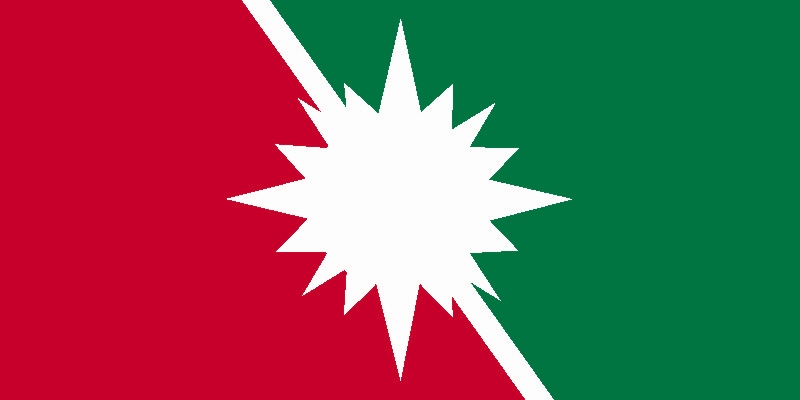
CF-Int Flag
|
Canadian Forces Intelligence Force
The Intelligence (Int) Branch is the branch of the Canadian Forces (CF) that is charged with providing intelligence information to enable CF commanders to make decisions.
The Int branch works in a variety of areas, both at home and abroad, to meet the needs of commanders and operational planners of the Canadian Forces at all levels, be it on overseas missions like Bosnia and Herzegovina, Haiti, Somalia, Rwanda, East Timor, and Afghanistan, or at home like the ice storms in Quebec, floods in Winnipeg, and fires in British Columbia. |
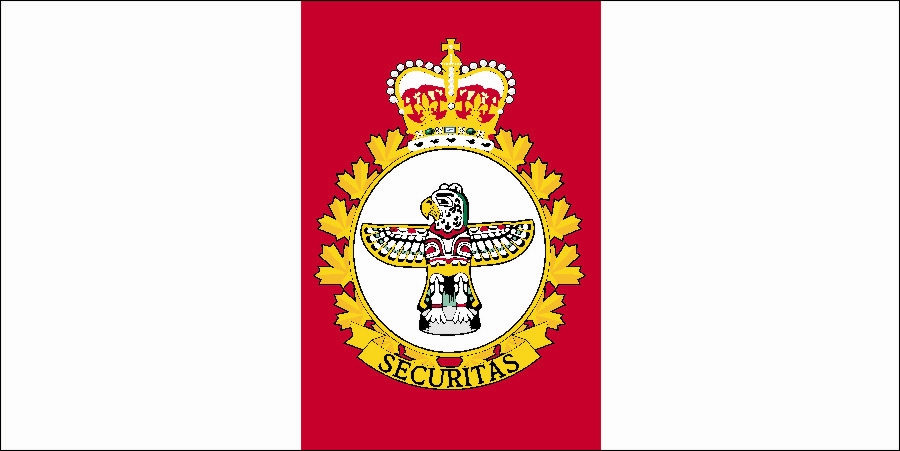
CF-MP Flag
|
Canadian Forces Military Police
The Canadian Forces Military Police (CFMP) provide security and military policing services to all Canadian Forces (CF). The Canadian Military Police are a bit unusual because they are classified as regular Peace Officers in the Criminal Code of Canada, which gives them the same powers as civilian law enforcement personnel. Although Military Police jurisdiction is on military establishments across Canada and throughout the world, any civilian accessing these areas falls under their jurisdiction and are dealt with in the same manner as any civilian policing agency.
The CFMP flag is a vertical white-red-white tricolor with the Canadian Forces Military Police badge centered on the red stripe. |
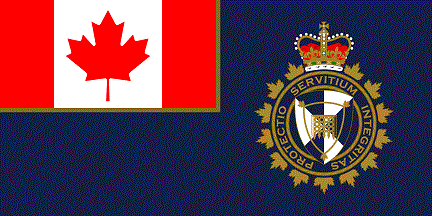
CBSA Flag
|
Canadian Border Services Agency 2003
The Canadian Border Services Agency was established in 2003 and is charged with ensuring "Canada's security and prosperity by managing the access of people and goods to and from Canada." The CBSA is Canada's all-in-one border security, customs, and immigration agency.
The flag has a dark blue field with the Canadian flag in the canton, fimbriated from the blue field with gold. In the fly is the CBSA heraldic badge. |
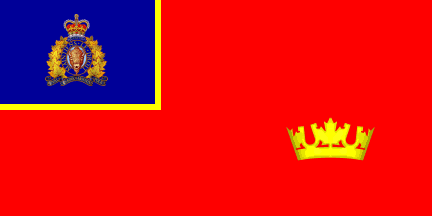
RC-MP Headquarters Flag
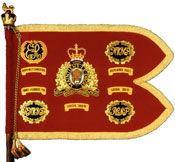
RCMP Guidon
|
Royal Canadian Mounted Police
The Royal Canadian Mounted Police (popularly known as the "Mounties") is the Canadian national police service and an agency of the Ministry of Public Safety Canada. The RCMP is unique in the world since it is a national, federal, provincial and municipal policing body. They provide a total federal policing service to all Canadians and policing services under contract to the three territories, eight provinces (except Ontario and Quebec), more than 190 municipalities, 184 Aboriginal communities and three international airports.
The RCMP was formed in 1920 when the Northwest Mounted Police (NWMP, founded 1873) merged with the Dominion Police (founded 1868). The NWMP were given the Royal prefix by King Edward VII in 1904, and many of the present-day Mounties' traditions date back to the RNWMP, including the distinctive red uniforms, its paramilitary heritage, and its identity as a frontier law enforcement force.
The Guidon of the Royal Canadian Mounted Police serves as a unique Standard for the Force and follows the regimental tradition of cavalry regiments deriving from the British Army. The first RCMP Guidon dates back to 1935. It was retired in 1973 when a new Guidon was given on the 100th Anniversary of the RCMP by Her Majesty Queen Elizabeth. |
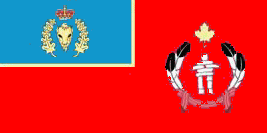
NAPS Flag
|
National Aboriginal Policing Services Ensign 2012
The National Aboriginal Policing Services, a division of the Royal Canadian Mounted Police, is responsible for planning, developing and managing the RCMP's strategies when working with Aboriginal groups. It is closely align with the First Nations Policing Program (FNPP) and gives First Nations communities the opportunity to participate with the federal and provincial or territorial governments in providing dedicated policing services in their communities. Under the FNPP, the RCMP currently provides policing services to a number of First Nation communities through a contingent of First Nations police officers working within the RCMP.
The ensign incorporates symbols representing the three Aboriginal cultures the RCMP serves – eagle feathers for the First Nations, Inuksuk for the Inuit and the Assumption sash for the Métis. The maple leaf symbolizes the national mandate of RCMP Aboriginal Policing Services. |
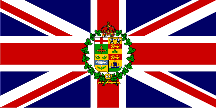
Governor-General's Flag 1901
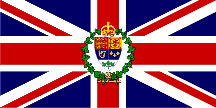
Governor-General's Flag 1921
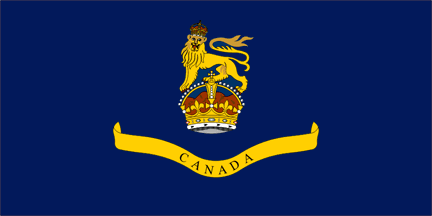
Governor-General's Flag 1931
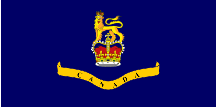
Governor-General's Flag 1953
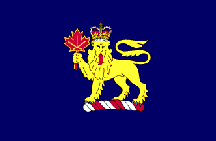
Governor-General's Flag 1981
|
The Governor-General of Canada Flag 1901
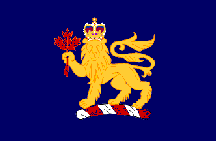
The Governor-General (GG) is the the Queen's deputy and carries out the functions of the Crown in her absence. Queen Elizabeth is legally and constitutionally the Head of State of the Dominion of Canada. This box shows the changes in the design of the flag of the Governor-General of Canada since in 1901. In 1869, the crown authorized that Royal Governors of all ranks use a British Union flag defaced with the arms or badge of their colony. In Canada, the Governor-General's flag bore a St. Edward's crown over the badge of Canada. In 1901, the crown was changed to a Tudor crown after Edward VII became King, as shown in the 1901 version here.
In 1921, the badge on the Governor-General's standard was changed to the newest approved coat-of-arms of Canada.
In 1931, a completely new design, first proposed in 1928, became official. The new flag showed the crest from the royal arms on a blue field with a scroll bearing the word "CANADA" placed below it. At first the lion stood on a Tudor crown, but in 1953 a change was made to the design at Queen Elizabeth II request and the Tudor crown was replaced by the St. Edward crown.
In 1981, the Governor-General's flag went through its last major change when the crest of the arms of Canada became the central emblem of the flag. This crest is a crowned lion holding a red maple leaf in its paw, standing on a wreath of the official red and white colors of Canada, on the blue background of the flag.
In 1998, the lion on the Governor-General's flag lost his tongue and claws at the insistence of the Right Honourable Roméo LeBlanc, who was Governor General from 1995 to 1999. He wanted the lion made more "friendly." When the Right Honourable Adrienne Clarkson replaced LeBlanc, she quietly changed the flag back to what it had been previous to 1998.
|
|
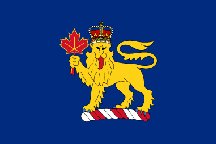 > |
Governor-General's Flag 1998 |
|
Governor-General's Flag since 1999 |
This flag is flown from the Governor-General's car, the Governor-General's official residences, and any other building the Governor-General is visiting. On overseas visits, the National Maple Leaf Flag is used more commonly, as it is a more recognizable Canadian symbol. ( Click here for more information about the Canadian government )
|
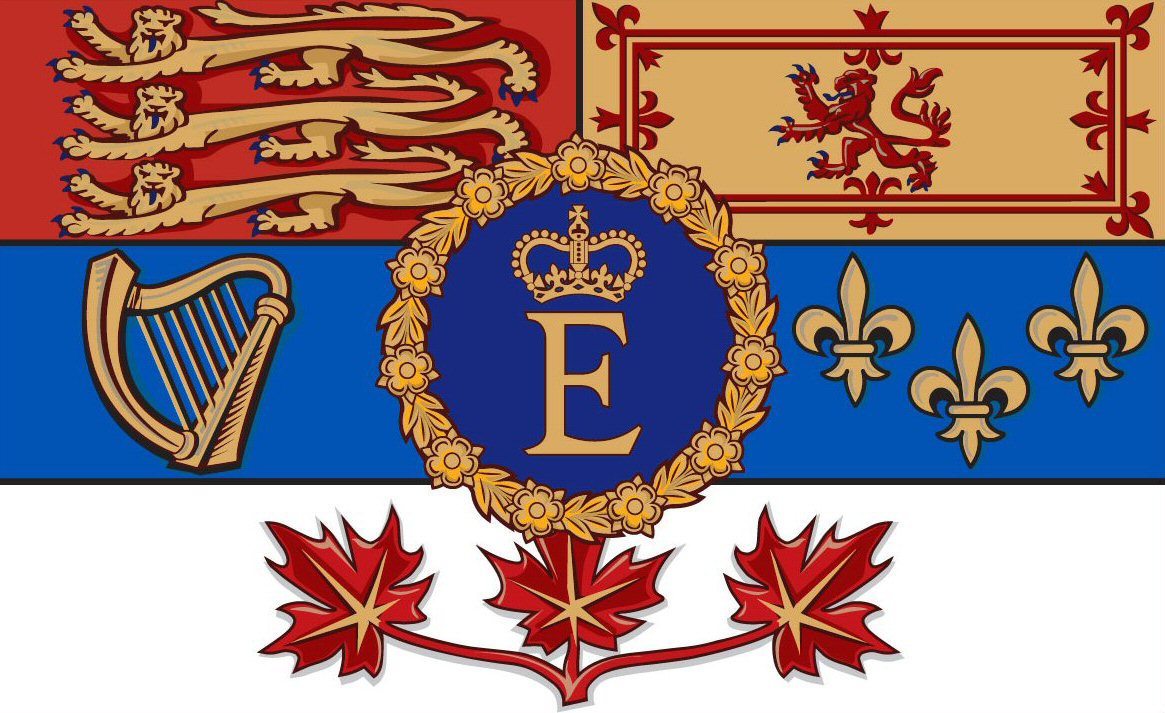
Canadian Royal Standard
Queen Elizabeth II
|
The Canadian Royal Standard for the Queen
This flag of Her Majesty The Queen is flown for her when she visits her Dominion of Canada. Her title in Canada is "Her Majesty, the Queen of Canada" and she is legally and constitutionally the Head of State of the Dominion of Canada. In her absence the Governor-General (GG) is the Canadian head of state and the Prime Minister (PM) is head of her government.
The flag bears a blue roundel within a wreath of roses in gold. The centre features her Cypher, composed of the letter "E" (Queen Elizabeth) with the Royal Crown above it, also in gold.
( For some more information about this subject - Click Here )
|
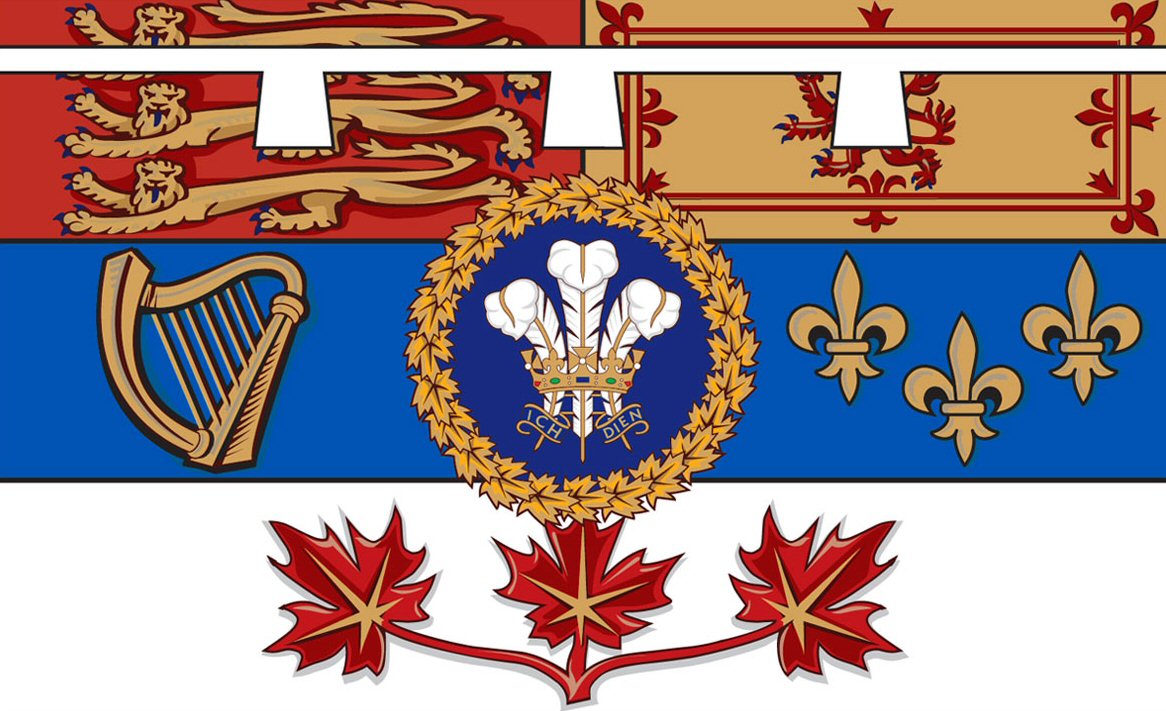
Canadian Royal Standard
Prince Charles
|
The Canadian Royal Standard for the Prince of Wales
This Personal Standard is flown for Prince of Wales when he visits the Dominion of Canada.
The flag bears a blue roundel within a wreath of golden maple leaves for Canada. The center features the badge commonly known as The Prince of Wales’s feathers, used by the heir apparent to the Sovereign. Near the top of the flag is the traditional heraldic mark of an eldest male child, the three-point white label. |
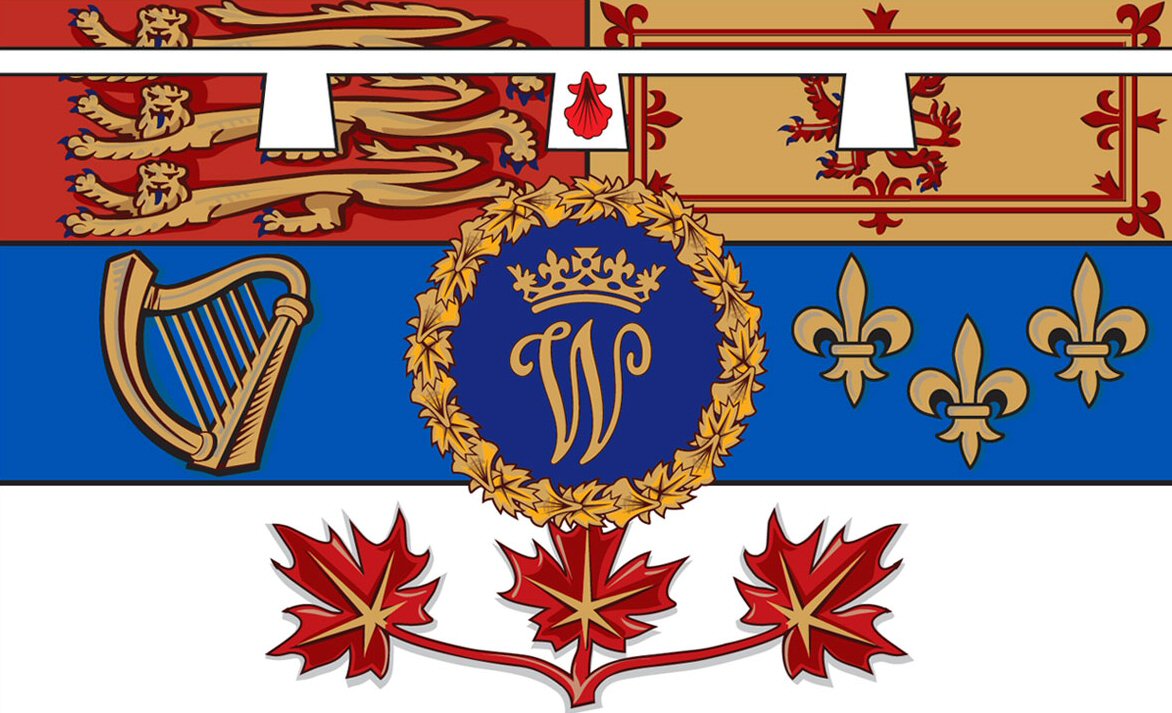
Canadian Royal Standard
Prince William
|
The Canadian Royal Standard for the Duke of Cambridge
This personal standard is flown for the Duke of Cambridge when he visits the Dominion of Canada.
The flag bears a blue roundel within a wreath of golden maple leaves for Canada, and of shells, a symbol borrowed from his coat-of-arms. The center features his cypher, composed of the letter "W" (Prince William) with a coronet above it that indicates he is the child of the heir apparent to the Sovereign. Near the top of the flag is the personal three-point white label charged with a red shell, taken from his coat of arms.
|

CBC Flag
|
Canadian Broadcasting Company (CBC)
The Canadian Broadcasting Corporation, commonly known as CBC, is a Canadian crown corporation that serves as the national public radio and television broadcaster. Like the BBC (British Broadcasting Company), the CBC is the only national government-supported broadcasting company in Canada. Today there are also privately owned commercial broadcasting companies co-existing with the CBC such as CTV, Global, City, TVA, and APTN.
Considered one of Canada's greatest cultural institutions, the CBC began as a small private commercial radio station in 1922. By the late 1920s, however, many Canadian radio listeners were tuning their dials to American stations. Thus, in 1928, the Canadian federal government establish a royal commission "to counter the American influence and protect the Canadian culture." On January 1, 1941, the CBC News Service was formally opened and the Radio-Canada's News division created, all with national government support. By 1955, CBC/Radio-Canada's television services were available to 66 per cent of the Canadian population, which included a sister service broadcast in French called the SRC (Société Radio-Canada). |

Scottish Heritage Flag
|
Maple Leaf Tartan Flag c2014
The Maple Leaf Tartan, the cloth, not the flag, was created in 1964 by David Weiser to be used to help celebrate the 100th anniversary of Canada's confederation in 1967. The colours of the maple leaf, as seen through the changing seasons, were the basis for the tartan design now known as the Maple Leaf Tartan. The pattern incorporates "...the green of the leaves' summer foliage, the gold which appears in early autumn, the red which appears with the coming of the first frost, and the brown tones of the fallen leaves." The tartan was made an official symbol of Canada by ministerial declaration in 2011.
In 2014, the Maple Leaf Tartan became incorporated in this new flag design being sold in Canada. The idea of using the Maple Leaf Tartan as the field for a maple leaf, one of the most recognized symbols of Canada in the world today, should prove very popular in certain Canadian "clan" gatherings and neighborhoods. |
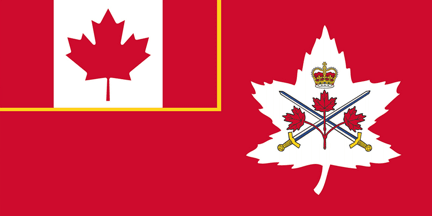
CF-CAC Flag
|
The Canadian Army Command Flag 2016
Although the The Canadian Forces - Land Force Command was established in 1968 it had always been more commonly referred to as simply the "Canadian Army." Between 1989 and 1998 its command flag had been a variant of Canadian Forces Ensign (CF) ensign, but with a different badge on the fly.
In August 2011, when the Land Force Command reverted to their pre-1968 title of the "Canadian Army", (still remaining a part of the Canadian Force Command) a new command flag was needed. For some reason the old command flag was decommissioned in 2013 without a new flag to replace it, and it would not be until 2016 that a new command flag appeared. Between that time (2013-2016) the Land Force Command flag by default continued unofficially be used by the army.
The new 2016 Canadian Army Command flag is red with a Canadian National flag bordered in gold in the canton and a new Army badge centered on the fly. This newly designed badge comprises of a crown above crossed swords and the traditional sprig of three red maple leaves (reminiscent of those used on the Canadian Active Service Force Flag of 1939) superimposed on the swords, all placed on a non-traditional white maple leaf silhouette. |

Canadian Confederation's
150th Anniversary Flag

Canadian Confederation's
150th Anniversary (type #2)
 Canadian Confederation's Canadian Confederation's
150th Anniversary (type #3)

Canadian Confederation's
150th Anniversary (type #4)
|
Canada's Sesquicentennial Anniversary of Confederation 2017
On July 1, 2017, Canada marks its Sesquicentennial Anniversary (150 years) since the forming of the Canadian Confederation, in which the British colonies of Canada, Nova Scotia, and New Brunswick were united into
the Dominion of Canada in 1867.
The "Canada 150" logo of a stylized maple leaf made up of multi-colored diamond shapes was designed in 2015 by Ariana Cuvin, a student at the University of Waterloo. Her winning design has resulted in a multitude of flags being manufactured to celebrate the event. The Public Works and Government Services Canada (PWGSC) request for different flags using the Cuvin design was answered by delighted Canadian flag makers who have flooded the market with a variety of colors and designs interpretations, it promises to be a very colorful celebration. This tradition of multiple colored fields for these centennial flags was well established in the Canadian Centennial celebrations held 50 years earlier.
The young designer explains her design saying "The maple leaf is the nation's most iconic symbol, and I used it...to represent Canada and its Confederation. The base of the leaf is made up of 4 diamonds...with nine more expanding outwards from them, meant to represent the four provinces that formed the Confederacy in 1867 eventually growing to the 13 provinces and territories. The repeated shape is meant to create a sense of unity, and the 13 shapes forming the leaf represents our togetherness as a country."
|
|
|
Canada's 150th (retro type #1) |
|
Canada's 150th (retro type #2) |
|
|
|
Canada's 150th (retro type #3) |
|
Canada's 150th (retro type #8) |
Also apparently in use are these "retro" Sesquicentennial design flags more closely reflecting those used for the Canadian Centennial/Expo 67 flags of 1967. |
- My thanks to Michael Halleran and Rob Raeside for their expertise on developing this page -
| Top of This Page | The Provincial and Territorial Flags of Canada |
|