Note: If an image ever fails to appear - refresh your page, it really is there
The Flags of the Poles and Poland - Part 1
900 to 1795
The History of the Poles is one of invasion, conquest, perseverance, and triumph over impossible odds. Poland, like the Near East is located at a crossroads of the east and west, and because of this has experienced waves of invasion from Asia in the east and Europe in the west, and through it all the Poles have survived again and again. This is their story told with the help of their banners and flags.
| Top of Page | Medieval Poland 900 to 1599 | 17th and 18th Century Poland 1600 to 1795 |
| Alliance of the Three Black Eagles (Poland Partitioned) 1795 to 1807 | Napoleonic Era and Poland 1807-1824 |
| The Congress of Vienna and its Aftermath 1820-1914 | World War I and the Parliamentary Democracy 1914 to 1926 |
| Second Republic of Poland (Sanacja) 1926 to 1939 | World War II (German and Soviet occupation) 1939 to 1945 |
| People's Polish Republic (Communist regime) 1945 to 1999 | Third Republic of Poland 1999 to present |
Flags and Banners of Medieval Poland 900-1599
During the 10th Century, the Polish nation was led by a series of rulers who converted their people to Christianity, created a strong kingdom and integrated Poland into the European culture. Internal in-fighting destroyed the kingdom in the 13th Century, but the slow process of rebuilding that took place in the 1300s laid the base for a new and powerful Kingdom of Poland.
Beginning with the Lithuanian Grand Duke Jogaila, the Jagiellon dynasty (1385–1569) formed the Polish-Lithuanian partnership that proved beneficial for the Poles and Lithuanians, who co-existed and cooperated to form one of the most powerful states in Europe for the next three centuries.
However, the Nihil Novi Act adopted by the Polish Sejm (parliament) in 1505, transferred most of the legislative power from the monarch to the Sejm. This marked the beginning of the period known as the "Golden Liberty," when the state was ruled by the "free and equal" Polish nobility. Of course, little attention was paid to the wishes of the common people. The Union of Lublin of 1569 formally established the Polish-Lithuanian Commonwealth which became an influential power in Europe and helped to spread Western Culture eastwards.
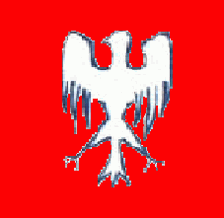
Poland Banner
(imaginary)
|
The White Eagle of Poland A.D. 966
The legend is that three Slavic chieftains were migrating west with their people from the vastness of the Eurasian steppe. They came to rest and camp on the plain just short of the River Odra (Oder), when one of the brothers, Lech, spotted the white eagle launching from the nest in the crown of the tree and against the red background of the sky at the sunset. He was so moved by this sight and made the decision to settled down in this area and to call the settlement "Gniezno" (the nest). Thus, the Polish symbol of a white eagle on a red field is explained. ( Click Here to learn more about the white eagle symbol )
The other brothers, Rus' and Czech, didn't share Lech's affection for this land. Rus resolved to turn back east, and Czech to turn left, to the south, to look for the greener pastures. Thus began the story of three great nations - Lechistan (Poland), Czechia (Bohemia) and Rus (Russia, Belarus and the Ukraine). |
The Piast Dynasty
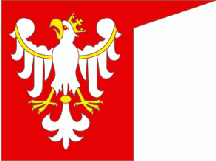
Banner of Przemysl II
|
Poland War Banner 1295
The first, documented, flag (war banner) comes from the time of the rule of the Piast King, Przemysl II (Premyslas-Premislaus), who was crowned in 1295. and then assassinated the next year in 1296. When Prince Przemyslaw II was crowned on June 26, 1295, he introduced the white eagle to the royal seal as an emblem of the united Kingdom of Poland, and according to the political and legal doctrine of the Middle Ages, the monarch symbolized the state. Consequently, the personal sign of the ruler became the symbol of the lands and people under his authority.
The attempts to reunify Poland's territories made by Przemyslaw II, no matter how short his actual reign, secured his personal sign of the the white eagle as the symbol of state unity. Przemyslaw II and those after him, Ladislaus the Short and Casimir the Great, would continue to placed their seals of a crowned eagle as a symbol of royal dignity. The feeling of national consciousness which was then taking shape helped to strengthen the role of the white eagle symbol. |
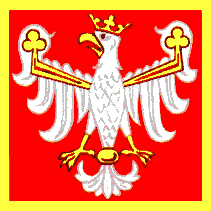
Banner of Wladyslaw Lokietek
|
Banner of Wladyslaw I Lokietek 1320-1333
Prince Wladyslaw IV (the Elbow-High) was the ruler of the Duchy of Kraków in central Poland between 1320-1333, who would reunify the Polish kingdom. When he became the king of Poland his royal title was changed to Wladyslaw I Lokietek (Ladislaus I the Short, or Ladislaus the "Elbow-high"). His rule is important because it ended nearly two centuries of civil wars. He is remembered as the restorer of a united Kingdom of Poland, and for his severe defeat of the Teutonic Knights at Plowce in 1331. He choose as his royal symbol another rendition of the crowned eagle, following the tradition established by Przemyslaw II.
The 12th and 13th centuries had proven times of adversity for Poland. In 1138, the kingdom, which had been growing in strength under the rule of the Piast dynasty, encountered an obstacle which impeded its development for the next two hundred years. In the will of King Boleslaw Krzywousty, Poland was divided into five provinces: Silesia, Mazovia, Greater Poland, Pomerania, and Lesser Poland. He did this to prevent his four sons from quarreling. Boleslaus granted one province to each of them, with the fifth one given to the eldest brother (he received two because he was the oldest). The reason for his decision was forestall a dynastic feud, and to prevent the disintegration of the kingdom, however, it started nearly two centuries of the constant fighting and disorder it had sought to counteract. |
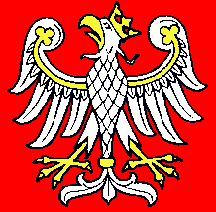
Banner of Kazimierz Wielki
|
Banner of Casimir III the Great (Kazimierz Wielki)
1310-1370
Casimir III the Great (1310-1370), was the last King of Poland from the Piast dynasty (1333–1370), was the son of King Wladyslaw I (the Elbow-high) and Hedwig of Kalisz. He was the most distinguished of Polish medieval kings, and is the only Polish king who both received and kept the title of "Great" in Polish history.
When he became king, the economy was ruined, and the country was depopulated and exhausted by war. Upon his death, he left a country doubled in size (mostly through the addition of land in today's Ukraine, then the Duchy of Halicz), prosperous, wealthy and with great prospects for the future. Although he is depicted as a peaceful king in children's books, he, in fact, waged many victorious wars and was readying for others just before he died.
|
The Andegavin Dynasty
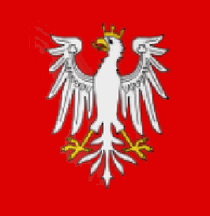
Banner of Ludwik and Hedwig Anjou
|
Banner of Ludwik and Jadwiga Anjou 1370-1399
This is the banner of the Ludwik and Jadwiga Andegavin (Hedwig Anjou). In one of those strange royal arrangements, King Casimir the Great had his nephew, King Ludwik of Hungary, succeed him on the Polish throne. When Ludwik died, his daughter Mary became the Queen of Hungary, but the Polish nobles didn't want Mary to also rule in Poland. Hedwig (Jadwiga), who was the younger sister of Mary, was instead "named" king. She became the King (Hedvig Rex Poloniæ). For a year she ruled alone and in 1385, at the insistence of the nobility, she married Wladyslaw Jogaila, the Grand Duke of Lithuania. She only agreed to marry the Grand Duke of Lithuania on the promise that not only would he would convert to Christianity, but that his entire nation, the last pagans of Europe, would also convert.
Jadwiga retained her title of King until her death in 1399, but she co-ruled the country with her husband. She devoted her attention to charity and education, spending her wealth on the restoration of the Cracow University, scholarships and helping the poor. She declared by the Vatican as the patron saint of the unified Europe.
|
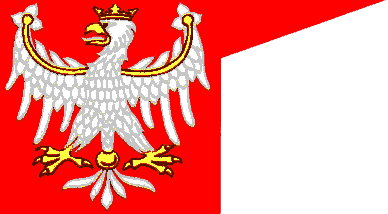
Royal Standard of
Wladyslaw Jagiello
|
Royal Standard of Wladyslaw II Jagiello 1386-1434
When the Pagan King Wladyslaw II (Jagiello) acquired the Polish throne by marrying the Christian Queen/King Jadwiga (see above), he was the last pagan ruler of Lithuania (he converted to Christianity to become King of Poland and she was later sainted). In 1385, the Union of Krewo was signed between Queen Jadwiga and Jagiello, who was at that time the Grand Duke of Lithuania. The act arranged for their marriage and constituted the beginning of the Polish-Lithuanian Union. The Union strengthened both nations in their shared opposition to the Teutonic Knights and the growing threat of the Grand Duchy of Moscow.
Wladslaw II is most remembered for his great victory over the Teutonic Knights of Prussia in 1410 at Grunwald (Tannenberg) where he secured the Polish and Lithuanian borders and marked the emergence of the Polish-Lithuanian alliance as a significant force in Europe. The reign of Wladyslaw II Jagiello extended Polish frontiers and is often considered the beginning of Poland's "Golden Age." The dynasty he established became one of the most influential dynasties in medieval Central and Eastern Europe. |
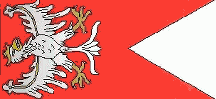
Royal Battle Banner of
Wladyslaw Jagiello
|
Royal Battle Banner of Wladyslaw Jagiello 1410
This was the personal battle flag of the King Wladyslaw of Poland, flown at his camp on the wooded hill at Tannenberg (Grunwald). While the Teutonic Knights and their allies, the flower of the European knighthood, took their battle positions on the hot field of Grunwald and baked in the sunshine in their heavy armor, the cunning Polish king took his time, not rushing to the battlefield and allowing his troops to relax on the tree-shaded hill.
Finally, the impatient Teutonic Grand Master sent his envoys to urge the Polish King to start the battle. They brought with them two fine swords as a gift of encouragement to start the fight. A very powerful knight named Zawisza Czarny the Black, who was standing next to the King, took these swords and broke them easily on his knee. The King thanked the envoys for the presents, but said he had better ones, and would soon meet the Germans down below to prove it. He did, and is most remembered for his great victory over the Teutonic Knights of Prussia on that hot afternoon in 1410. |
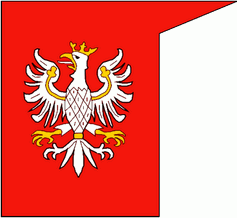
One of several Grunwald Battle Flags and banners
|
Battle Flag of the Battle of Grunwald 1410
This was another of the Battle flags of the Battle of Grunwald. It was flown into the battle, representing the King. Although, the Grand Master of the Teutonic Order took part personally in the actual battle (and got killed), Wladyslaw Jagiello, due to his advanced age, stayed behind on the hill, assessing the situation from the vantage point and dispatching battle orders. The Teutonic knights made the use of artillery for one of the first instances in Europe (if not the first). The new technology was brought to them by the traveling monks from China. It didn't them any good, as the artillery positions were soon overrun by the Tatars and Lithuanians and the cannons were turned against the troops of the Order.
A spectacular collection of the flags and banners from the Battle of Grunwald is featured by Adam Kromer on his "Banderia Prutenorum" page at: http://www.akromer.republika.pl/flagi_dlugosz1.html
The son of Wladyslaw Jagiello was Wladyslaw Warnenczyk III (Ladislaus Varnensis) who became the King of Poland in 1434, and Bohemia and Hungary in 1440. He was called "Varnensis" because he died young battling the Turks at Varna (now in Bulgaria) in 1444. He was killed during the charge on the ranks of the janizaries, who were protecting their sultan, and left no direct heir to his throne. |
The Jagiellonian Dynasty
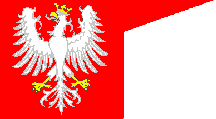
Banner of Kazimierz Jagiellonczyk
|
The Banner of Kazimierz IV Jagiellonczyk 1447-1492
The eventual successor to Warnenczyk III after a three-year interregnum was Kazimier IV (Casimir IV) who fought a long war with the Teutonic Knights and imposed on them the Peace of Thorn in 1466. This treaty resulted in Poland acquiring Malbork (Marienburg) and Gdansk (Danzig) and access to the sea. In 1471, he was able to vindicate his son's claim to the throne of Bohemia, to which the younger Wladyslaw IV later added Hungary. |
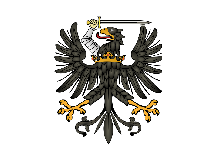
Royal Prussia Flag
|
Flag of Royal (Polish-Lithuanian) Prussia 1466-1772
Royal Prussia originally developed from the medieval Northern March of the Holy Roman Empire, passing to the House of Hohenzollern in 1415. The Duchy of Prussia was created in 1525 when the eastern lands of the Teutonic Knights were seized as a Polish fief by Albert of Brandenburg-Ansbach, a member of the Hohenzollern family. While Ducal Prussia was only a Polish fief, until it merged with Brandenburg to form the Kingdom of Prussia, Royal Prussia was a Polish province with substantial autonomy up to the time of the first partition in 1772, when it was taken by the new Kingdom of Prussia which had been just created when the Elector Frederick III assumed the title of Frederick I, King in Prussia, in 1701.
Administratively, it was part of the larger Great Poland Province, and after the Prussian takeover it became Province of West Prussia in 1773.
|
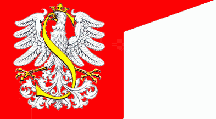
Banner of Sigismud the Old
|
Banner of Sigismud the Old 1506-1548
Sigismund I the Old (Zygmunt I Stary) was a highly respected, next to last,
Jagiellonian king of Poland. He did reform the fiscal system of the country and waged the successful wars against
the Muscovy and the Teutonic Order. He fought the Grand Master Albrecht (his nephew) to force him to pay
homage as the vassal of the Polish Crown. Albrecht converted to Lutheranism and secularized the order, becoming
the Duke of Prussia.
Sigismund was also the patron of the Arts and advanced the education. His second wife, Bona Sforza d'Aragon was also a great supporter of the Arts and introduced many new dishes and wines to the Polish and Lithuanian cuisine, most of all, the vegetables, which since that time are known in Polish as "wlosczyzna" (the Italian stuff).
His banner features a beautiful monogram "S" for his name, given to him in honor of his mother's maternal grandfather, the Holy Roman Emperor Sigismund |
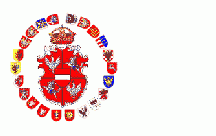
Banner of Zygmunt II August
|
Banner of Zygmunt II August 1548-1572
Last of the Great Jagiellonian Dynasty, Sigismund II August presided over the formal unification of Poland and Lithuania into one state. Under his rule Poland acquired the Duchy of Courland and Semigallia as the vassal state, a fief (today's Latvia), and thanks to that, and by extension, became later a "colonial power" as Courland colonized parts of West Africa (the Gambia) and the Caribbean island of Tobago.
The banner of Sigismund II August displayed the Arms of all the lands
and provinces around the coat-of-arms of the Commonwealth. |
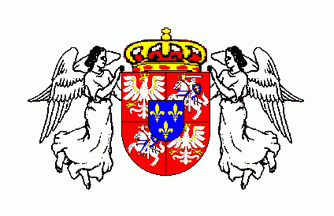
Banner of Henryk Walezy
|
Henryk Walezy (Henri de Valois) 1573-1574
The first elected king of the Commonwealth - and a total disaster. His mother wanted all of her sons on the thrones, any thrones. When her attempts to make Henry the king of Algeria failed, she took the opportunity to gather all possible support to get him elected the king of Poland, country equally exotic to the French
as was Algeria.
Polish gentry decided to choose him over other candidates, providing he will sign "pacta conventa" (Henrician Articles) which further yet restricted the royal powers in favor of the "Golden Liberties" of the gentry. When he arrived in Warsaw, in the middle of winter and shivering in cold, it became obvious he is not going to last long. Manicured, wigged, perfumed and with diamond earrings dangling from his ears, he looked like a feminized freak to the Polish red-necks. Himself, he hated the Poles, calling them "barbarians and bores" When only he got the news of his brother's death (Charles IX), he did secretly, at night, run away from Poland , abandoning his new realm. Soon, he became the king of France - Henri III. |
Banner of Báthory István
|
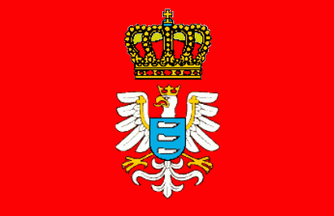
Stefan Batory (Báthory István) 1576-1586
The next elected king proved to be an excellent choice. He was the Hungarian Prince of Transylvania and appreciated the throne of the Commonwealth offered to him, although part of Polish gentry wanted to see the Habsburg Holy Roman Emperor, Maximillian II on it, and it almost came to the civil war.
Stefan (Stephen) Batory faced immediately the threat of the growing power in the East - Russia. Tsar Ivan the Terrible conquered large chunks of Polish and Lithuanian territory, including Livonia. Batory allied the Commonwealth with the Swedish king John and led the punitive expedition on Russia, recovering all the lost lands and more, and staving Russian expansion for the next 100 years. He also, decisively, put down the rebellion of Danzig burghers and prepared the country to face rapidly growing Turkish threats.
This is his royal banner, flown at Polotsk during the homage paid to him
by the Russian boyars (nobles).
|
Grand Duchy of Lithuania
|
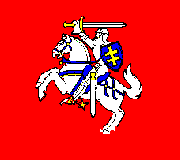
The Flag of the Grand Duchy of Lithuania
This is the flag of Wielkie Ksiestwo Litewskie (Grand Duchy of Lithuania). Lithuania was "dynastically" united with Poland in the late 14th century under the Jagiello family and the two states were "constitutionally" linked by the Union of Lublin in 1569.
This period of Polish and Lithuanian history is often referred to as the "Golden Age of Poland" as the Polish-Lithuanian alliance became one of the most influential and powerful in medieval Central and Eastern Europe. |
Elective (Elected) Kings
Banner of Zygmunt III Waza
|
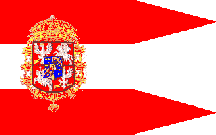
Banner of Zygmunt III Waza 1587-1632
Royal Flag of Poland 1605
Zygmunt III Waza (Sigismnund III Vasa of Sweden) was King of Poland and Grand Duke of Lithuania, ruler of the Polish-Lithuanian Commonwealth from 1587 to 1632, and the King of Sweden (where he was known simply as Sigismund) from 1592 until he was deposed in 1599. He is most remembered fot establishing the Uniate Church in 1596, whereby a large body of his Orthodox subjects accepted the supremacy of the Roman Catholic Church.
Sigismund remains a highly controversial figure in Poland. His long reign coincided with the apex of the Polish-Lithuanian Commonwealth's prestige, power and economic influence. On the other hand, it was also during his reign that the symptoms of decline that led to the Commonwealth's future demise surfaced. |
Royal Polish Military Standard
|
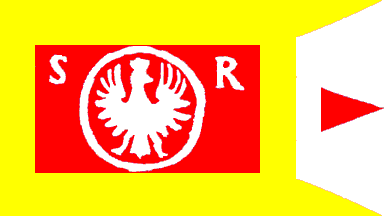
Captured Polish Military Standard 1601
In 1601, Prince Michael the Brave of Wallachia (Romania today), allied with the Imperial General Giorgio Basta of the Holy Roman Empire, and defeated the army of Prince Sigismund Báthory of Hungary and the Polish King Sigismund III, at Guraslau in Transylvania. The next day, Prince Michael sent to the Holy Roman Emperor Rudolph II, who was at Prague, 110 flags captured during the battle. This was one of those battle standards.
One can see that this military standard is clearly from the times of Sigismund III, as it bears the royal initials "SR" for "Sigismund Rex." It also appears in one of Hans von Aachen's allegoric paintings, representing the victory of the allied Imperial and Wallachian armies. |
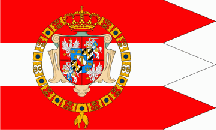
Commonwealth of Both Nations
|
Banner of Commonwealth of Both Nations 1587-1632
The Banner of Commonwealth of Both Nations 1569 is just another version of the banner of Zygmund III Waza (Sigismund III Vasa), featuring the combined Arms of the Commonwealth and Sweden (with the
sheaf of wheat of the Vasas as the heart shield) and surrounded by the chain of the "Order of the Golden Fleece."
The remnants of this banner are preserved in the Royal Armory in Stockholm. |
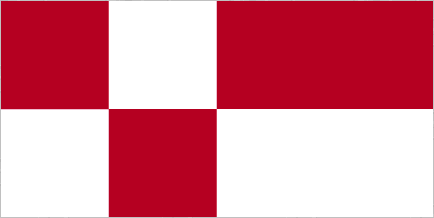
Courtland Merchant Flag 1650
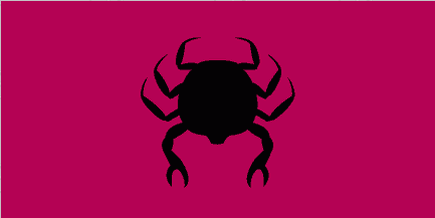
Courtland-Tobago Flag 1650
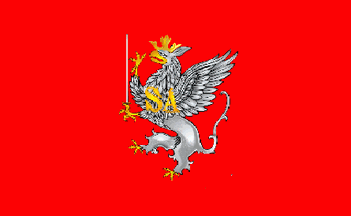
Duchy of Livonia Flag
|
Duchy of Courland and Semigallia 1562-1791
(Ksiestwo Kurlandii i Semigalii)
In 1562, the "Livonian Order of the Brothers of the Sword" was
secularized and the last Grand Master, Gotthardt Kettler became the Duke of Courland and Semigallia and the
vassal of the Polish King. The Duchy benefited greatly from its relations with the Commonwealth, being an important outlet for Polish and Lithuanian exports. The Polish rule was benevolent, with little interference into the local affairs.
In the middle of the 1600s, the Duchy became a major mercantile European power with the formidable fleet and the colonial ambitions. It established a colony at St. Andrews Island at the Gambia River and on the island of Tobago in the Caribbean. Sweden, and later Russia showed an intense interest in the Duchy, and in 1795 Russia prevailed in the acquisition of it in the conniving way, when the last Duke, Peter von Biron signed off his rights to the Russian Empress Catherine the Great at the time of the last partition of Poland.
The third flag was the Polish flag intended for this territory, as it was a Polish-Lithuanian fief (vasal state), and not an independent country. This flag with its coat-of-arms, was for the Duchy of Livonia, but what the Poles were commonly calling simply "Inflanty." Of course, its formal name was the "Duchy of Livonia" in English, "Ksiestwo Inflanckie" in Polish, and "Herzogtum Livland" in German.
|
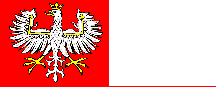
The Poland War Ensign
|
Polish Naval War Ensign c1600
A Polish Naval War Ensign from the end of 16th century pictured on the painting
of the ship "Okret Kosciola" (Ship of the Church) during the reign of Sigismund III Vasa (Zygmund III Waza) 1587-1632. |
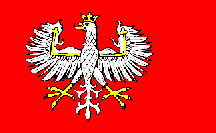
War Flag of Poland
|
War Flag of Poland during 16th Century
This was a war flag used in the capture of Moscow (the only successful occupation of the Kremlin in history (1610-12), in the "Deluge" (Swedish invasion) and in Khmielnitsky's Cossack Uprising, among many other campaigns.
In the history of Poland and Lithuania, the Deluge commonly refers to a series of wars in the mid-to-late seventeenth century which left the Polish–Lithuanian Commonwealth in ruins. The Swedish invasion and occupation of the Polish-Lithuanian Commonwealth was a part of the larger Second Northern War from 1655 to 1660, including the series of misfortunes beginning with the Khmelnytsky (Chmielnicki) Uprising in 1648 and ending with the with the Truce of Andrusovo (1667) that concluded the Russo-Polish War of 1654–1667. |
| Top of Page | Medieval Poland 900 to 1599 | 17th and 18th Century Poland 1600 to 1795 |
| Alliance of the Three Black Eagles (Poland Partitioned) 1795 to 1807 | Napoleonic Era and Poland 1807-1824 |
| The Congress of Vienna and its Aftermath 1820-1914 | World War I and the Parliamentary Democracy 1914 to 1926 |
| Second Republic of Poland (Sanacja) 1926 to 1939 | World War II (German and Soviet occupation) 1939 to 1945 |
| People's Polish Republic (Communist regime) 1945 to 1999 | Third Republic of Poland 1999 to present |
The Flags and Banners of 17th and 18th Century Poland 1600-1795
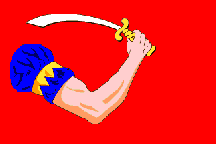
Polish Naval Ensign
|
Polish Naval Ensign/Jack 1627
This colorful flag was a unique Naval Ensign (or Jack) of the Polish Navy. Poland has had naval traditions since 1558 when the Polish King Sigismund August (Zygmund August) created the first Polish fleet under the command of Admiral Thomas Sierpinek.
In 1624, the first Polish dockyard was founded at Puck and on November 28, 1627, the Polish Navy, under Admiral Dickman, fought off the Swedish fleet at Oliwa, near Gdansk (Danzig) using this battle ensign. |
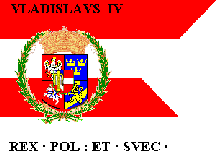
Banner of Wladyslaw IV Waza
|
Banner of Wladyslaw IV Waza 1632-1648
Wladyslaw IV Waza (1632-1648) claimed to be the King of both Poland and Sweden. It should be noted, that Wladislaw IV never was king of Sweden. This was only a title of pretence. His father, Zygmunt III Waza, had been king of Sweden, but was disposed when he wanted to turn Sweden catholic.
Strangely enough, Wladyslaw as Prince had a chance to become the Tsar of all of Russia, because while the Poles occupied Moscow in 1610, the Russian boyars (nobles) agreed to proclaim the young prince Tsar, on the condition he convert to the Eastern Orthodoxy. Both, his father (Sigismund III of Poland and Sweden) and the Pope in Rome, rejected that offer and the deal felt through. The Poles were expelled from the Kremlin in 1612 in a popular uprising. That date, November 4th, is now a national holiday in Russia (with the strong, anti-Polish undertones) that replaces the November 7th "October Revolution" celebrations.
Wladyslaw as King of Poland did managed to prevent the Commonwealth from becoming embroiled in the bloody Thirty Years' War that ravaged western Europe during his reign, and he was fairly successful in defending the Commonwealth from invasion. He supported religious tolerance and carried out military reforms. He failed, however, to realize his dreams of fame and conquest, or to reform and strengthen the Commonwealth. His death marked the end of the Golden Age of the Commonwealth, as the conflicts and tensions that Wladyslaw had failed to resolve led in 1648 to the greatest of the Cossack uprisings, the Khmelnytsky Uprising, and to Swedish invasion.
|
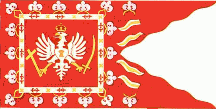
Banner of Jan Kazimierz
|
Battle Banner of Jan Kazimierz 1648-1668
This is the battle standard of the last Vasa king, John Casimir (Jan Kazimierz) 1648-68. It has the sheaf of wheat, mark of the Vasas, embroidered on the eagle's chest. This banner is now on display in the Military Museum in Stockholm. That standard was used during the Polish-Russian War of 1654-67 and the Swedish invasion known as "The Deluge", when the Swedish troops overrun almost the entire country and brought a tremendous destruction to it.
During that war a legendary miracle happened at the monastery on the Bright Mountain in Czestochowa. The Swedish troops encircled the hill with the monastery, which was housing the ancient painting of "The Black Madonna", believed to be the work of Saint Luke the Apostle. The defenders of the monastery, a handful of knights and monks, were hopelessly awaiting the final assault of the Swedes, but in the morning they found them all gone.
The local peasants told them that at down the Virgin Mary appeared over the monastery and covered it with her cloak.
The Swedes, as Protestants, didn't share the veneration of the Virgin Mary accorded to her by the Catholics, and seeing her protecting the monastery on the hill retreated in panic.
After that, the painting of the Black Madonna became holy to the Poles and the Monastery of the Bright Mount is the holiest place in all of Poland, site of the mass pilgrimages. |
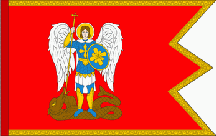
Banner of Hetman Bohdan Khmelnytskyi
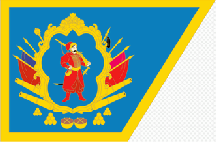
Cossack Hetmanate Banner
|
Cossack Uprising Banners 1648-1757
The Khmelnytskyi Uprising was a Cossack rebellion in Ukraine in 1648-1657 which turned into an Ukrainian war of liberation from Poland. Under the command of Hetman Bohdan Khmelnytskyi, the Zaporozhian Cossacks allied with the Crimean Tatars, and fought several battles against the armies of the Polish-Lithuanian Commonwealth. The result destroyed the control of the Polish Commonwealth over the country.
Although the Uprising started as the rebellion of the Cossacks, it was soon joined by the Orthodox Christian peasants, burghers, and petty nobility of the Ukraine, with the ultimate aim of a creation of an autonomous Ukrainian state. The Uprising succeeded in ending the Polish influence over those Cossack lands, but the Ukraine was eventually taken over by Imperial Russia. These events, along with internal conflicts and hostilities with Sweden and Russia, resulted in severely diminished Polish power during this period and is often referred to in Polish history as "The Deluge."
The names: "Ukraine" and "Ukrainians" were not in use at those times. Khmielnitskyi wanted to call his country "Rus," after the Kievan Rus of the IXth Century. But after consigning it to Russia in the Treaty of Pereyslav in 1654, it was totally lost and absorbed into the Russian Empire. |
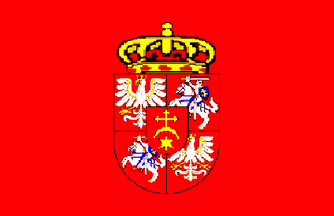
Banner of Michal Korybut Wisniowiecki
|
Michal Korybut Wisniowiecki 1669- 1673
Michal (Michael) Korybut Wisniowiecki was elected king by the Sejm (Parliament)
of the gentry after the abdication of John II Casimir (Jan II Kazimierz). He was the son of the famous, albeit controversial, military commander, Prince Jeremi (Jeremiah) Wisniowiecki accused of excessive brutality in trying
to subdue the Khmielnitskyi Uprising of the Cossacks. Michael reign was less than successful. His father's military fame notwithstanding, he had lost the war with the Turks and the province of Podolia (Podole). He couldn't reconcile the warring factions of the nobility and was rather poor administrator of the country. After his 4-year, unimaginative reign, a great king was elected - John III Sobieski.
This is the Royal banner of Michael, slightly simplified (without the ornate embroidery
along the edges).
|
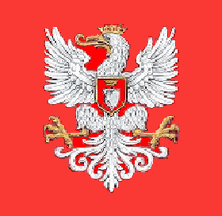
Banner of Jan III Sobieski
|
Banner of Jan III Sobieski 1674-1696
Jan III Sobieski (1674-96) the last great King of Poland. This is his personal battle banner (standard). As the Grand Hetman of the Crown (the highest military rank of the Commonwealth) he did achieve several great victories over the Cossacks, Tatar and Turks (Chocim 1673).
As The King, his biggest triumph was the victory at Vienna in 1683. Commanding the Polish, German and Austrian armies he struck the Turks besieging Vienna with the awesome force of his hussars and forced them to run in panic for their life. He was hailed as the "Savior of Vienna and Western European civilization" by the Pope and the Turks called him respectfully "The Lion of Lechistan." His troops gathered a huge loot abandoned by the Turks in their camp and hauled it happily home. The Turkish banners of Kara Mustafa's army were sent to Rome as a war trophy.
|
The Wettin Kings
(Saxon Kings)
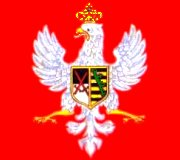
Banner of Królestwo Polskie
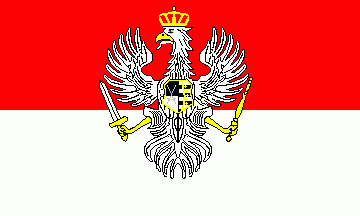
Kingdon of Saxony and Poland
|
Banner of Królestwo Polskie (Kingdom of Poland) 1697-1764
This was the Banner of the Królestwo Polskie (Kingdom of Poland) during the Saxon reign of Poland (1697-1764). It began when the Elector Frederick Augustus I of Saxony was elected King of Saxony and Poland in 1697 as "Augustus II the Strong." However, since the Saxons were allied with Russia, a power struggle developed between Augustus II and the Swedish and French who supported Stanislaw Leszczyński as king. To further confuse things, between 1704 and 1709 Augustus II was forced to renounce his throne when King Charles XII of Sweden marched into the Kingdom of Saxony and Poland during the Great Northern War. Charles forced the Polish nobility to accept Stanislaw Leszczyński as Stanislaw I. In 1709 Charles inturn suffered a defeat from the Russians and lost his throne. Augustus II became King of Poland again. This dynastic tension continued until Augustus' death in 1733, and eventually saw Stanislaw Leszczyński once again ascended to the Polish crown as Stanislaw I with his French and Swedish support.
In the end, however, the Russians prevailed by imposing the election of Augustus III Sas (the Saxon), son of Augustus II, who would rule for 30-years. During his 30-year rule Augustus spent only three years in Poland and neglected the affairs of the state to the point of allowing total anarchy. His son was supposed to be the next king of Poland, but lost the Russian's support who then forced the election of Catherine the Great's lover, Stanislaus Poniatowski instead.
Nevertheless, the Constitution of 1791, is still regarded as Europe's first modern codified national constitution and it established the hereditary throne of Poland. Unfortunately, it came too late to save the country and Poland was soon erased from the political map by the Third Partition between Russia, Prussia and Austria, who were afraid of the impact that constitution could have had on their own empires and the rest of Europe. |
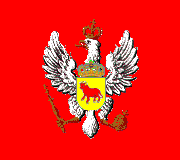
Banner of Stanislaw August Poniatowski
|
Banner of Stanislaw August Poniatowski 1764-1795
Stanislaw August Poniatowski (Stanislav II), was the last King and Grand Duke of the Polish-Lithuanian Commonwealth (1764–95). As a young man, through the influence of Russian Empress Elizabeth and Chancellor Bestuzhev-Ryumin, he joined the Russian court as ambassador of Saxony. At Saint Petersburg he met and befriended the married twenty-six-year-old future Empress Catherine Alexeievna (Catherine the Great). By 1768, the Polish-Lithuanian Commonwealth had effectively became a protectorate of the Russian Empire. In 1770, the Council of the Bar Confederation proclaimed him dethroned.
As the last king, Poniatowski witnessed the Russian army's crushing of the Bar Confederation (1768-72), and although he protested the first partition of the Commonwealth in 1772, he was powerless to do anything about it. Russia saw to it that Poland did not exist anymore at the end of his reign. |
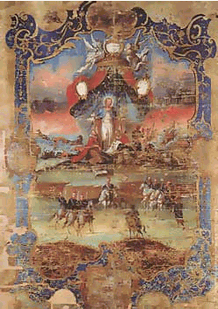
Bar Confederacy Standard
|
Bar Confederacy Standard 1766-1772
An union of the Polish nobility in the defense of the faith and the independence of the country. It was organized against the king, Slanislus Augustus Poniatowski, and the Russians, who were supporting him. It was the first National Uprising against the foreign meddling in the affairs of the country.
One of the leading military commanders of the Confederacy was Count Kazimierz (Casimir) Pulaski, who eventually became the National Hero of Poland and the United States. In America, he is hailed as the "Father of the American Cavalry." He died, mortally wounded in the Battle of Savannah, while leading the cavalry charge against the British.
During the Confederacy, Pulaski was joined by his good friend, a Hungarian-Slovak aristocrat, Count Maurycy Beniowski (he considered himself Polish after that). He was an ultimate adventurer: captured by the Russians, exiled to the Far East, he managed to escape hijacking a Russian ship and the daughter of the Russian commander. His journeys took him almost around the world, Hawaii, Macau, the United States, France and Madagascar. He established a close friendship with Benjamin Franklin, whom he was trying to persuade to take Madagascar as an American colony, and was in America again to be at his friend's bedside (Pulaski's) just before he died. Finally, he returned one more time to Madagascar where he became an Emperor by popular acclaim. |
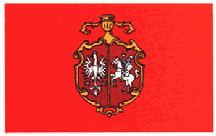
Poland-Lithuania Banner
|
Banner of Poland-Lithuania 1772
The last state flag of the Commonwealth of the Kingdom of Poland and
Grand Duchy of Lithuania. The flag features the combined Arms of the Crown (Poland) and Lithuania (Grand Duchy). The Polish White Eagle is joined by the charging knight on the horse Vytis (Chaser).
There was also another banner in use during the rule of the last King Stanislaus Augustus
Poniatowski, a battle banner of the military formations of the Commonwealth of Both Nations featuring the common coat-of-arms of the State.
|
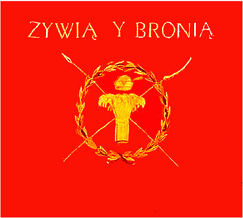
Kosciuszko Insurrection Banner
|
The Kosciuszko Insurrection of 1794
Just before the third and final partition of Poland, General Thaddeus (Tadeusz) Kosciuszko, the National Hero of Poland and the American War for Independence, organized this uprising against Russia, Prussia, the Polish King and the Targowica Confederation (plotting the demise of the rest of independence left after the second partition). Kosciuszko's proclamation, after he assumed the powers of the Commander-in-Chief of all Polish forces, vowed "not to abuse these powers to oppress any person, but to defend the integrity of the borders of Poland, regain the independence of the nation, and to strengthen universal liberties."
After the initial successes against both Russian and Prussian armies, the Kosciuszko's forces, poorly armed (many peasant carried only straightened scythes) were overwhelmed and Kosciuszko himself, wounded, was taken prisoner and sent to Saint Peterburg. There he was freed on the intervention of the U.S. Ambassador to the Imperial Court, John Paul Jones. Many historians blame Kosciuszko for precipitating the final partition and the demise of Poland for the next 123 years, but others maintain it was planned and inevitable anyway. With better military equipment the insurrection could have a chance to be victorious. Kosciuszko partially abolished the serfdom of the peasants and granted them the civil liberties, thus many of them enlisted in his units.
Although the insurgents used the flags and banners of the Commonwealth, there were other, specific, vexillums carried into battles. One of them, a peasant banner with the slogan "Zywia y Bronia" (We
Feed and Defend) is shown here. |
- My thanks to Chrystian Kretowicz for all his expert help, research, advise, and images used on this page -
| Learn about "The Evolution of the Polish Coat-of-Arms" Here |
| Top of Page | Medieval Poland 900 to 1599 | 17th and 18th Century Poland 1600 to 1795 |
| Alliance of the Three Black Eagles (Poland Partitioned) 1795 to 1807 | Napoleonic Era and Poland 1807-1824 |
| The Congress of Vienna and its Aftermath 1820-1914 | World War I and the Parliamentary Democracy 1914 to 1926 |
| Second Republic of Poland (Sanacja) 1926 to 1939 | World War II (German and Soviet occupation) 1939 to 1945 |
| People's Polish Republic (Communist regime) 1945 to 1999 | Third Republic of Poland 1999 to present |
|