Image by Rick Wyatt
Image by Dave Martucci

Home  |  British Flags  |  Canadian Flags  |  Czech Flags  |  Mexican Flags  |  German Flags  |  Polish Flags  |
|  Flags of the Early Colonies  |  American Revolution Flags  |  Mexican-American War Flags  |  Flags of the Civil War |
Spanish-American War Flags  |  World War I Flags  |  World War II FlagsCold War Flags  |
Modern Conflict Flags  |  Flags of Extremism  |  Flag History & Terminology  |  Artistic Credit & Contact Information  |

The Historical Flags of Germany
(including the Flags of Prussia)

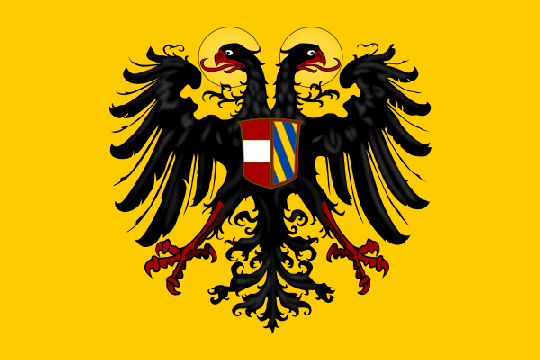
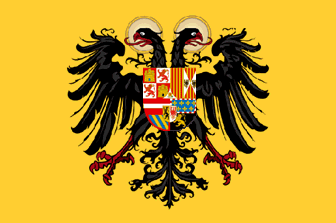
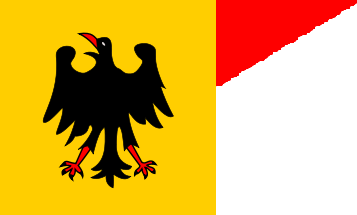
        To understand German thinking of this period one must first understand that they looked back to the Frankish King, Karl the Great (Charlemagne), and his "Holy Roman Empire," which lasted from 800 to 925, as the first great Deutsches Reich (German Empire). In 962, Karl's grandson, Otto I of Germany was re-crowned "Emperor of the Romans" by Pope John XII, thus giving the German kings once again claim to the title "Holy Roman Emperor." From this time forward, the German kings would continually claim the right to rule this central European empire.


| Top of the page | Prussian Flags Before 1800 | Prussian Flags 1800-1892 | Prussian Flags After 1900 |
| Imperial Germany Era Flags | Weimar Republic Era Flags |
| Third Reich Era Civil and Political Flags | Third Reich Era Military Flags | Modern Era Flags |

Flags of the Prussia - Before 1800

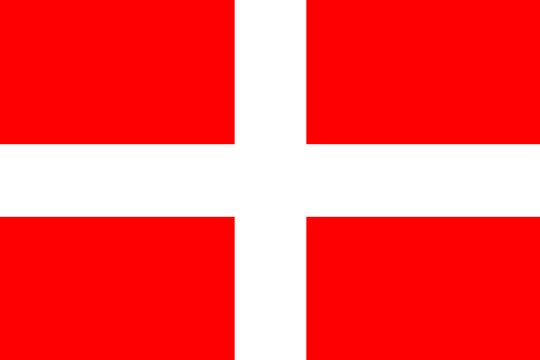
        Among the groups of knights organized during the Crusades (e.g Templars, Hospitallers) was a group, largely German, called the Deutscher Orden (German Order), or Teutonic Knights. In 1225, after the failure to reconquer the Holy Land, Pope Gregory IX ordered the Teutonic Knights to convert the Prussians, a people related to the Lithuanians and Latvians, and who were the last remaining pagans in Europe. This historic event would start Prussia on the road to empire and the process of forming a new Germanic empire. By 1701, Prussia became a kingdom and from then until 1871, it was in a continuous stage of expansion until it came to be by far the largest German state, almost as large as all the others together, and the neclus of the Second Reich.


Teutonic Knights

Teutonic Order Banner

Turning loose the Teutonic Knights on the Prussians apparently pleased the Poles, especially their ruler the Duke of Mazovia, to whom the Prussians were not only non-believers, but also warlike pains-in-the-neck. In a long war the Order finally conquered the Prussians by 1285, killing some, converting and subjecting others, and set up a unique feudal state.

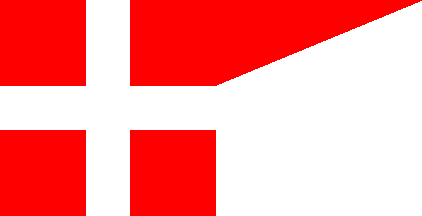
Their symbol was a Black Scandinavian Cross on a white field. Occasionally, the flag is shown with a narrow blue stripe along the hoist, and more often with the fly split into three tails.


Image by António Martins and Adam Kromer
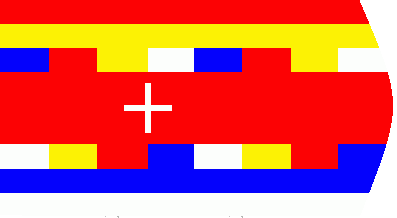
Royal Prussia

Royal Prussia 1466-1772

After the battle of Tannenberg in 1410, the treaty of 1466 gave the King of Poland most of the Teutonic Order's territory west of the Vistula. This became Royal Prussia, and the rest of Prussia in 1525 became the Grand Duchy of Prussia after the Grand Master, Albrecht von Brandenburg, secularized the Teutonic Order, making the Duchy a fief of Poland.

Shortly after the Grand Duchy of Prussia was inherited by the Elector of Brandenburg, one of the princes entitled to elect the Holy Roman Emperor. (see below)


Duchy of Prussia

Grand Duchy of Prussia 1525-1657

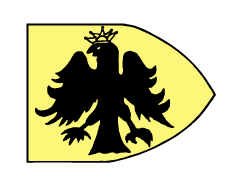
In 1466, the state of the Teutonic Order (that part of Prussia not under Polish sovereignty as Royal Prussia) became a Polish vassal. In 1525, with the secularisation of the Teutonic Order, the Grand Duchy of Prussia (Ducal Prussia) was established as a Polish vassal. In 1525, the Polish King Zygmunt Stary (Sigismund the Older) gave Ducal Prussia a flag and a coat of arms: a black eagle with a crown on its neck and the letter S (Sigismund) on its breast. Ducal Prussia was a Polish vassal until 1657.

When in 1660, the Duchy of Prussia became independent of Poland the way was opened to unite with Brandenburg and and eventually the Prussian state.


| Top of the page | Prussian Flags Before 1800 | Prussian Flags 1800-1892 | Prussian Flags After 1900 |
| Imperial Germany Era Flags | Weimar Republic Era Flags |
| Third Reich Era Civil and Political Flags | Third Reich Era Military Flags | Modern Era Flags |

Flags of the Prussia 1800-1892

        At the end of the Napoleonic wars, a paranoid Imperial Russia and an aging Hapsburg-dominated Austria and Hungary made sure they were protected from any future French menace by placing 38 small Germanic buffer states between France and themselves at the Congress of Vienna in 1816. While this reassuring Russia and Austria, it made the small German buffer states a bit nervous, and this combined with the dreams of a second Reich, led to a slow, but sure process of unification within what eventually became known as the "Confederation of the Rhine" under the leadership of Brandenburg/Prussia.


Image by Santiago Dotor
Province of Posen 1849

Grand Duchy of Posen 1815-1849
Posen Province 1849-1886 (Prussia, Germany)

The Grand Duchy of Poznan (Posen) was part of the Kingdom of Prussia, created from territories annexed by Prussia after the Partitions of the Polish-Lithuanian Commonwealth, and formally established following the Napoleonic Wars in 1815. Per agreements derived at the Congress of Vienna it was to have some autonomy. However in reality it was subordinated to Prussia and the proclaimed rights for Polish subjects were not fully implemented. The name was unofficially used afterward for denoting the territory, especially by Poles, and today is used by modern historians to describe different political entities until 1918. Its capital was Posen (Poznan). The Grand Duchy was formally replaced by the Province of Posen in the Prussian constitution of 1848.


Image by Santiago Dotor
Province of Posen 1886

Posen Province 1886-1920

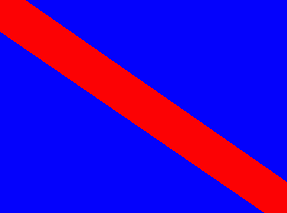
In 1886, the flag was changed by the Prussian authorities into horizontal white-black-white triband, because the former was far too similar to Polish. The White-black-white triband was the official provincial flag until 1918.


Image by Santiago Dotor
Flag of Brandenburg

The Brandenburg Province Flag (East Prussia) 1882-1935

This red and white horizontal striped bicolor flag was officially adopted in 1882. Brandenburg's capital was originally Potsdam, before moving to Berlin in 1827. Following German reunification in 1990, Brandenburg was re-established as a state of the Federal Republic of Germany.


Image by Jaume Ollé
Brandenburg State Flag

The Brandenburg Province State Flag (East Prussia)

The ruling family of Brandenburg (East Prussia) were the Hohenzollerns. They united both East and West Prussia, and eventually became the ruling family of Imperial Germany. They also used the plain red and white striped flag without the shield shown above.


Image by Jaume Ollé
East Prussia Flag

The East Prussia Flag 1882-1935

This black and white horizontal striped Bicolor flag was officially adopted October 22, 1882, and abolished in 1935 by Adolf Hitler and the Third Reich.


Image by Peter Loeser
East Prussia State Flag

The East Prussia State Flag

In 1701, the Elector Frederick III of Brandenburg began using the title "King in Prussia." East Prussia was later joined with West Prussia to become the Kingdom of Prussia. East Prussia is now located in the modern country of Poland. Besides this flag they also used the plain black and white striped flag without the shield shown above.


Image by Santiago Dotor
West Prussia Flag

The West Prussia Province Flag 1886-1920

This black/white/black horizontal striped Tricolor flag was officially adopted November 9, 1886, and abolished in 1920 when it became part of the Posen-West Prussia Frontier Province (1920-1935).


Image by António Martins and Adam Kromer
West Prussia State Flag

The West Prussia State Flag

West Prussia was separated from Brandenburg by a part of Poland and bordered the Baltic Sea. She joined with East Prussia to become the Kingdom of Prussia. West Prussia is now located in the modern country of Germany and is known as the State of Brandenburg. They also used the plain black/white/black striped flag without the shield shown above.


Image by Jaume Ollé
Kingdom of Prussia Flag

The Kingdom of Prussia Flag 1701-1918

The Kingdom of Prussian eventually became the North German Federation between 1867 and 1871. Under the leadership of Kaiser Wilhelm II and Otto von Bismarck they formed Imperial Germany or the Second Reich (Second Empire).


Image by Jaume Ollé
Prussian War Ensign 1862


Image by Jaume Ollé
Prussian Civil Ensign 1817

Prussian War and Civil Ensigns 1818-1863

The first Prussian warship was built in 1816 (the Stralsund) and it needed an ensign. Kaiser Wilhelm chose a design of a black eagle in heraldic form, on a white background charged in the canton with the iron cross. This ensign was first used in the spring of 1817 and appeared both as a traditional rectangular-shaped flag and as a swallow-tailed flag. During this early period, several slightly different interpretations of the eagle were used, but after 1863, the ensigns were mainly used in their rectangular form without swallow-tails. The final design was confirmed in 1850, and the swallow-tailed war ensign disappeared from the open seas by 1867. After 1871, when Prussia became Imperial Germany, this ensign's use was restricted to internal waters only.

Image by Jaume Ollé
    
Image by Jaume Ollé
Prussian War Ensign 1818
    
Prussian War Ensign 1823

These flags without the Iron Cross acted as the "Prussian Civil or Merchant Ensign" and the Prussian government allowed ship owners and sailors to add the name of their own town or province on the white stripe when used as a merchant ensign. Between 1892-1918 these flags were also known as the "Imperial Inland Waters Ensign," and used an eagle design based on the shield of the Imperial German War Ensign.


War Flag of Prussia until 1867
Top Mast Flag of SMS "Prussia"
Weimar Republic 1919-1935


Inland Waters General Services

The eagle used on these interesting flags were based on the shield design used on the old national flag of the Kingdom of Prussia and also were used on the Imperial German War Ensign.

Prussian Inland Waterways Ensigns 1867-1918

The Inland Waters General Services Ensign was the general Imperial Service Flag for all Prussian Inland Waterways. This service was responsible for the monitoring, regulation, and control of all inland shipping, such as the transport of bulk goods (ore, coal, etc.), on the important Prussian waterway system.

The Inland Waters Customs Service Ensign was the Prussian Service Flag for Inland Waterways used by the Customs Service. The Customs Service was the agency in Prussian Germany responsible for collecting and safeguarding of customs duties and for controlling the flow of goods including animals, personal effects and hazardous items in the inland waterways.

The Inland Waters Fishery Service Ensign was the Prussian Service Flag for Inland Waterways used by the Fishery Supervision Service. This service was responsible for the stewardship of the German fishing industry and other inland marine resources, including the monitoring, regulation, and control of commericial and sports fishing on the Prussian German waterway system, much like any modern Wildlife Service.

   
Inland Waters Customs Service
   
Inland Waters Fishery Service

| Top of the page | Prussian Flags Before 1800 | Prussian Flags 1800-1892 | Prussian Flags After 1900 |
| Imperial Germany Era Flags | Weimar Republic Era Flags |
| Third Reich Era Civil and Political Flags | Third Reich Era Military Flags | Modern Era Flags |

Flags of the Prussia Since 1900

        During the beginning of the 20th Century Prussia was the heart of the Second Reich, and then with the defeat of Imperial Germany, a part of the Weimar Republic, until the rise of the Third Reich. Since the end of World War II the lands of Prussia have been divided between Poland and Germany. Germany itself was divided into East and West until 1992.


Free State of Prussia Flag

Free State of Prussia Flag 1918-1933

The Free State of Prussia (Freistaat Preussen) was a German state formed in the aftermath of World War I. It was the major state of Germany during the time of the Weimar Republic, comprising almost five-eighths of its territory and population. "Free State" is a German term for Republic. The democratic Free State of Prussia was taken over by coup in 1933 and its President Otto von Braun taken out of office. His government went to court over this ouster and after the end of war, Otto von Braun approached U.S. officials to reinstate the legal Prussian government. They and the other Allied Occupation forces, who had taken up occupation of all of Germany, were not interested and declared Prussia abolished in 1947.

As was the case after World War I, almost all of this territory had been Prussian territory and most of it went to Poland (the northern third of East Prussia, including Königsberg, now Kaliningrad was annexed by the Soviet Union). The losses represented nearly two fifths of the Prussian territory and nearly a quarter of territory within Germany's pre-1938 borders. An estimated ten million Germans fled or were expelled from these territories as part of the German exodus from Eastern Europe. See the "Territorial Association of East Prussia Banner" below.


Image by Santiago Dotor
Posen/West Prussa Flag

The Posen/West Prussia Frontier Province Flag 1920-1935

This flag is divided into three horizontal stripes and in half vertically. (Left black-white-black, right white-black-white). It was adopted in 1920 and abolished in 1935 by the Third Reich.


Image by Peter Loeser
Posen/East Prussia State Flag

The Posen/West Prussia Official State Flag

This design is of a possible administrative flag for the Posen-East Prussia Province between 1920-1935, with a coat of arms, consisting of a silver field with a black Prussian eagle; emerging from the neck is a silver arm with armor grasping a silver sword.


Republic of Ostrów Flag

Republic of Ostrów Flag 1918

The Ostrowska Republic (Republic of Ostrów), which only lasted between October 10, 1918, and November 26, 1918, was another short-lived republic that existed in the former Grand Duchy of Posen. About a month before the start of the Greater Poland Uprising (Powstanie Wielkopolskie), which would bring the whole area out of German hands and back into Poland in 1919, the citizens of the town of Ostrów Wielkopolski decided to liberate themselves from the Germans and declared themselves the independent Ostrowska Republic. This flag, very obviously an ancester of the modern flag of Poland, did fly over an independent Republic of Ostrów for that very short period of time.

On October 10, 1918, the newly formed People's Committee of Ostrów issued their declaration of independence to the Germans, but after a few sporadic skirmishes, the Committee decided it was in over its head, negotiated a few favorable concessions with the Germans, and then, dissolved itself on November 26, 1918. The Greater Poland Uprising started a month later in the town of Ostrów.


Image by António Martins
Modern Poland Flag

The Flag of Poland 1919

Prussia no longer exists as an independent state, but is split into two parts and incorporated into the modern countries of Germany and Poland. The Polish flag dates back to the pennants of the Middle Ages. At first they were all red with a white eagle, but by the 17th Century the background colors of red and white stripes were firmly established. The banners usually bore the official crest of the State. These Polish national colors were used during the November Uprising of 1831, and the colors were used in all national uprisings since that time. They were officially recognized as state colors in 1919 after Poland had regained her independence.


Image by Adam Kromer
Poland State Flag

The Poland Official State Flag

Poland's "landesfarben," or land colors, derived from its coat-of-arms, are white-red; the opposite of the red-white of modern Brandenburg (West Prussia), which is now located in Germany. The State Flag of Poland, with the Polish coat-of-arms, has been in use since 1919. The flags only change came during Communist rule when the crown was removed from the head of the eagle. After Poland became independant the crown was returned. Interestingly, Poland doesn't have a king, but the crown remains. Some also claim the length of the eagle's claws having been changed.


State of Prussia Flag 1933

Free State of Prussia Flag (under Nazi Germany) 1933-1935

Although this is an early Third Reich flag, it seemed better suited at this location since individual State flags virtually disappeared in Germany after 1935. This was the Flag of the Free State of Prussia during its brief existence in the Nazi era.

In 1933, the "Preussenschlag" (Prussian coup), Reich Chancellor Franz von Papen unseated the democratic Free State of Prussia government under Otto von Braun under the pretext that it had lost control of public order. This was triggered by a shootout between SA demonstrators and Communists in Altona, Hamburg. After this emergency decree, Papen appointed himself Reich Commissioner for Prussia and took control of the government. This made it easy for Adolf Hitler to assume control over Prussia in the following year.


Landsmannschaft Ostpreussen

Territorial Association of East Prussia Banner - Since 1948

One of the results of the disappearence of the Free State of Prussia was the forming of the "Landsmannschaft Ostpreussen" (Territorial Association of East Prussia) as a non-profit organization for Germans who were evacuated or expelled from East Prussia during World War II and its aftermath. It was formed in 1948 by a group of East Prussian "vertriebene" (refugees) in West Germany. The Landsmannschaft of East Prussia flies a hanging flag (Banner) in the historical East Prussian colors of black and white. Instead of the historical coat-of-arms of East Prussia, they use the arms of the Landsmannschaft, an elk's antler.

The organization's current president is Wilhelm von Gottberg. Its seat is located in the City of Hamburg, and it is a member of the "Bund der Vertriebenen" (Union of the Displaced). Its official newspaper is the "Preussische Allgemeine Zeitung" (Prussian General Newspaper).

The "Bund Junges Ostpreussen" (Union of Young East Prussians) is a subsidiary youth organization of the Landsmannschaft; its predecessor, "Junge Landsmannschaft Ostdeutschland" (Cultural or Welfare Society of Young East Germans), was disassociated from the parent organization in 2000.


| Top of the page | Prussian Flags Before 1800 | Prussian Flags 1800-1892 | Prussian Flags After 1900 |
| Imperial Germany Era Flags | Weimar Republic Era Flags |
| Third Reich Era Civil and Political Flags | Third Reich Era Military Flags | Modern Era Flags |

Flags of Imperial Germany (Second Reich) 1871-1918

         In 1862, a financial crisis arose in the Kingdom of Prussia, when the Diet refused to authorize funding for a proposed re-organization of the army by King William I (Wilhelm I). To end the crisis, the King chose a Prussian nobleman (Junker) named Otto von Bismarck to handle the crisis. The rest is history, not only did Bismarck make Prussia the most powerful and dominant state in Germany, but he also ensured that Prussia would become leader of the Second Reich, the dreamed of united German empire under Prussian leadership.
         Bismarck became known as "The Iron Chancellor" and along with Wilhelm established their famous policy of "Blood and Iron," which eventually made Wilhelm the Kaiser (Emperor or Caesar) of Imperial Germany. Wilhelm was proclaimed "German Emperor" on January 18, 1871, in the Hall of Mirrors in the Château de Versailles, after the forces of the German Confederation (under Prussian leadership) defeated the forces of Napoleon III of France in the Franco-Prussian War of 1870.


Image by António Martins
Imperial Tricolor Flag

Imperial German Tricolor 1892-1918

The black-white-red striped German imperial flag was adopted by the North German Confederation in 1867, as a combination of the black-white of Prussia and the red-white of Brandenburg. In 1871 it was adopted as merchant flag for the German Empire, and in 1892 declared to be the national flag of the Second Reich and continued in use until 1918. It was briefly reintroduced later just prior to World War II between 1933 and 1935, and used jointly with the Nazi swastika flag, then banned as symbol that could be used by "reactionary" groups.


Image by Fornax
Imperial War Ensign 1813

Imperial War Ensign 1867-1892

This naval war ensign was used from 1867 to 1892 by both the German Confederation and the Second Reich at sea. It had a white field, a black and white cross, and a small black-white-red flag with a black Iron Cross in the canton.

The Iron Cross was a Prussian order first established by King Frederick William III in 1813 for military valor or patriotic service in the 1813-15 war against Napoleon. It was revived in 1871 for the Franco-Prussian war and in 1914 for the First World War. It was also revived as a German order in 1939 by Hitler.

( Click here to learn more about the history of the Imperial War Flag 1867-1921 )


Image by Fornax
Imperial War Ensign 1892

Imperial War Ensign 1892-1903

This was the German War Flag used from 1892 to 1903. It was changed when the Germany army began to use this flag as a war flag on land.

After Wilhelm II succeeded to the Second Reich throne in 1888, this flag, with its redesigned Prussian eagle and Imperial arms overlaid in the middle on a white disc, came into used until the flags last change in 1903.

( Click here to learn more about the history of the Imperial War Flag 1867-1921 )


Image by Fornax
Imperial War Ensign 1903

Imperial War Ensign 1903-1919

This was the German War Flag used from 1903 to the end of World War I in 1918. The Kaiser Wilhelm II ordered the design changed in 1902 because he felt it looked too similar to the British White Ensign under certain lighting conditions.

Germany declared war on France in July of 1914 and Russia in August of 1917, coming to the aid of Austria-Hungary.

( Click here to learn more about the history of the Imperial War Flag 1867-1921 )


Image by Fornax
Former Naval Officer's Vessel

Merchant Ensign with Iron Cross 1898

German Emperor William II (Kaisar Wilhelm II) authorized the use of a modified version of the Imperial Civil Ensign for former German Naval Officers called the "Merchant Ensign with the Iron Cross" in 1898.


Image by Peter Loeser
General Pilot's Flag 1876

General Pilot's Flag 1876

In 1876, the German General Pilot's flag was designated as the Civil Ensign of smaller size, surrounded by a white stripe of the same width as the other stripes.


Image by Fornax
Department of Commerce
Vessel Ensign

Image by Fornax
Barges, Auxiliary Hired Vessel

Image by Fornax
German Pilot Vessel Ensign

German Naval Ensigns, Jacks, and Service Flags 1867-1892

All Imperial German Service Flags of the North-German Union and the German Empire are based on the German Naval Ensign flown on the Royal Prussian Navy since 1867.

Special emblems for each service branch were added below the canton and Iron Cross.

Image by Fornax
   
Image by Fornax
Postal Service Vessel Ensign
Customs Service Vessel Ensign

All these flags had corresponding jacks. There were five jacks in all. Here is an example of the Customs Authorities Jack. They were all the same design, and just exchanged the special emblems for the service branch in the center of the white stripe.

Image by Fornax
Imperial Customs Service Jack

All German Naval Ensigns, jacks, and Service Flags containing these special signs were used only until 1892, when the flag system was completely changed in Imperial Germany.


Image by Fornax
Imperial Service Flag at Sea

Image by Fornax
Imperial Service flag on Land

German Imperial Service Flags 1893-1918

In 1893, new Service flags were introduced, replacing the five former naval ensigns. Those official authorities, which used flags on sea had to fly the "Dienstflagge der Kaiserlichen Marine" (Service flag of the imperial navy). The remaining authorities had to fly the "Dienstflagge für die übrigen Verwaltungszweige des Reiches" (Service flag for the remaining branches of Reich authorities).

Image by Fornax
Imperial Postal Service Flag

The postal authorities had to fly their new "Imperial Postal Service flag."


Image by Fornax
Flag for the Foreign office and "Reichskolonialamt."

Image by Fornax
Flag for Pilots Authorities in the German colonies.

Image by Fornax
Flag for the Customs Authorities in the German colonies.

The Imperial Flags for the Auswärtiges Amt (Foreign Office) 1893-1918

In April 1893, the Imperial Foreign Office received a special flag, consisting of the National colors Black-White-Red and the Reich eagle topped with the imperial crown. The eagle was centered on the flag within a white disk. This flag was to be used by authorities of the foreign office, including the authorities in the German colonies, for example, by most of their governors. With the new "Reichskolonialamt" (Reich Office for the Colonies) established in 1907, all tasks in the colonies were transferred from the "Auswärtiges Amt" to the Reichskolonialamt, which adopted the same flag as the Auswärtiges Amt.

In August of 1893, special flags, based on the flag for the Foreign office, were created for the Pilots and the Customs authorities in the German colonies. While the pilots flag was equipped with the red letters "L" and "V" (standing for "Lotsenverwaltung"), enclosing a yellow anchor, the customs flag got the letter "Z" instead of an "L" (standing for "Zollverwaltung"). These flags were to be hoisted on official buildings, as well as on ships and boats, and were in use until the outbreak of World War I in the year 1914.

Image by Fornax
Flag for the Official Authorities in Alsac-Lorraine

In 1892, a flag was adopted for the authorities in the "Reichslande Elsaß-Lothringen" (Alsace-Lorraine). The area of Alsac and Lorraine was annexed by Germany after the war between Gemany and France in 1870-1871. Although the civil flag used in the Reichslande was the simple Black-White-Red striped flag, because the territory was then a part of Germany, it is interesting that the official authorities in 1893 received a flag that was based on the flag for the Foreign Office. The flag displayed the coat-of-arms of Alsace-Lorraine, which was placed in the upper left corner. This coat-of-arms was already adopted in 1891.


Image by Fornax
Boxer Rebellion Command
(Retangular Flag)

Image by Fornax
Boxer Rebellion Command
(Square Cavalry Standard)

The Commander-in Chief of the Armed Forces in China 1900-1901

The Boxer Rebellion, more properly called the Boxer Uprising, was a violent anti-imperialistic and anti-Christian movement in China between 1898 and 1900. In June of 1900, Boxer fighters, lightly armed or unarmed, gathered in Beijing to besiege foreign embassies. Finally, the Boxers declared war on the foreign powers that had diplomatic representation in Beijing. The result was that foreign navies started building-up their presence along the northern China coast in April of 1900. Among these troops were about 900 German soldiers, who in particular were later criticized for their enthusiasm in carrying out Kaiser Wilhelm II's spoken advise given during the departure ceremonies. He said "Just as the Huns a thousand years ago, under the leadership of Attila, gained a reputation by virtue of which they still live in historical tradition, so may the name Germany become known in such a manner in China, that no Chinese will ever again dare to look askance at a German."

The siege of Peking was finally ended when Indian troops of the international expeditionary force arrived under the command of German Field Marshal Alfred Graf von Waldersee. The main German force arrived too late to take part in the fighting, but undertook several punitive expeditions against the Boxers.

In August of 1900, Wilhelm II bestowed on Field Marshal von Waldersee, a unique command flag that was his as the Commander-in-Chief of the Imperial Armed Forces in China. This flag consisted of the national flag with an Iron cross on it. The cross was underlain by two diagonally crossed marshal's batons. This flag was used both as a rectangular flag and square standard, respectively. After the return of the German contingent in 1901 the flag was exhibited in a Berlin museum.


Image by Fornax
Imperial Naval Ensign

German Naval Jack 1903-1919

This was the jack used by all Imperial German warships between 1903 and 1919 and later briefly reintroduced between 1933 and 1935. It was replaced by the swastika type in 1935.

A jack is a flag that looks like the union or canton of a national war ensign (see Imperial War Ensigns above). On warships, the jack is flown from a flag pole (jack-staff) located on the vessel's front end (bow) when at anchor or in port.


| Top of the page | Prussian Flags Before 1800 | Prussian Flags 1800-1892 | Prussian Flags After 1900 |
| Imperial Germany Era Flags | Weimar Republic Era Flags |
| Third Reich Era Civil and Political Flags | Third Reich Era Military Flags | Modern Era Flags |

Flags of the Weimar Republic 1919-1933

         With the defeat of Imperial Germany by the Allied forces at the end of World War I, and the abdication of Wilhelm II in 1918, a new parliamentary republic was established in 1919 in Germany to replace the imperial form of government. It was named after Weimar, the place where the constitutional assembly took place, and became popularly known as the Weimar Republic, although interestingly enough, its official name remainded the "Deutsches Reich" or "German Empire."
        In its 14 years the Weimar Republic was faced with numerous problems, including depression, hyperinflation, political extremists (and their paramilitaries), and the discriminatory regulations of the Treaty of Versailles. However, it overcame many of the discriminatory regulations, reformed the currency, unified tax politics, built an impressive railway system, and its brief existence actually represented a period of cultural innovation in Germany. Unfortunately, this liberal democratic government eventually fell victum to the increasing economic depression in the early 1930s, leading to the ascent of the NSDAP and Adolf Hitler in 1933.


Image by António Martins
Weimar Republic

The Weimar Republic Flag 1919-1933

Black, red and gold in three equal horizontal stripes are the colors of the flag of the Federal Republic of Germany. The colors date to the emperors of the Middle Ages. They reappeared in the war against Napoleon when a corps of army volunteers drawn from all the German principalities adopted black uniforms with red braid and gold buttons.

Subsequently, student organizations, dedicated to the unification of Germany, used the colors on their banners. In the first attempt to create a democratic and unified Germany, leaders of the 1848 Revolution adopted the tricolor flag in the National Assembly or Frankfurt Parliament.

The flag was not actually used until 1918 when the German National Assembly of the democratic Weimar Republic adopted it officially. When Hitler came to power in 1933 he abolished the tricolor flag. In 1950, the flag was reintroduced by the German Parliament as the official symbol for the Federal Republic of Germany and is still used today.


Weimar Postal Service Flag
1919-1921


Weimar Postal Service Flag
1921-1933

The Weimar Republic Postal Service Flags 1919-1933

When in 1919, the German Empire was overthrown and new republican symbols were adopted, it was clear that also the Postal flag had to be changed. The former imperial postal flag not only consisted of black-white-red stripes, but also contained a post horn with a cord and tassels of black-white-red strands, and it used the Imperial crown, which topped the post horn.

In September of 1919, it was decided to introduce a new postal flag of black-red-gold colors, placing the post horn in the center of the red stripe. In view of the shortage of raw materials the only possibility was to use the material of the former imperial postal flags and manufacture the new flag out of this pieces of cloth. Thus the first postal flags looked very makeshift. Since it was not possible simply cutting out the imperial post horn and sewing it on the new flag a different post horn had to be designed.

As one stripe of the imperial postal flag was white, it was decided to form a completely white post horn. Soon there arose oppositions against this design and in 1921 a new postal flag was adopted. It showed a gold colored horn that appeared on a now widened red stripe. This flag continued to be used until 1933 when the Nazis again changed the National colors.


Image by Marcus Schmöger
Weimar War Flag

The Weimar Republic War Flag 1919-1921

This was the Reichskriegsflagge adopted in 1919. It was never used, although samples were produced, because the old Imperial War Ensign of 1888 remained in use throughout this time period.

The new unused design was based on the previous imperial war ensign, replacing the eagle and the black-white-red canton with a black-red-gold canton.

( Click here to learn more about the history of the Imperial War Flag 1867-1921 )


Image by Marcus Schmöger
Weimar Service Flag 1921
(for use on land)

Weimar Service Flag on land 1921-1933

This design was used as the German flag by non-military official authorities and organizations. The black-red-gold is historically associated with "liberal" nationalism in Germany.

This flag was also called as the Dienstflagge der übrigen Reichsbehörden zu Lande (Service flag on land). This flag was abolished on April 22, 1933, by Adolf Hitler's government.


Image by Fornax
Weimar Service Flag 1921
(for use at sea)

The Weimar Republic Service Flag at Sea 1921-1926

This was the flag normally used by all German Government Ships smaller than a warship at sea between 1921-1926. This flag was known as the Dienstflagge der übrigen Reichsbehörden zur See (Service flag on sea). It was replace with a new design in 1916 that featured the Weimar tricolor in the Canton.


Image by Fornax
German War Flag

The Weimar War Flag 1922-1935

Since the leadership of the German Navy did not accept the new republican Reichskriegsflagge adopted in 1919 and refused to hoist the new version and insisted upon using the old Imperial War Flag of the German Empire, on January 1, 1922, this entirely new design replaced the War Flag of the German Empire.

It was in use between the years 1922-1935. It was replaced by the swastika type in 1935.

( Click here to learn more about the history of the Imperial War Flag 1867-1921 )


Image by Fornax
Reichspräsident Standard 1921

Image by Fornax
Reichspräsident Standard 1926

Flag and standard for the German Reich President 1919-1933

The Reichspräsident (Reich President) was the German head of state during the period of the 1919-1933 Weimar Republic. The first Reichspräsident was Friedrich Ebert who held the position from 1919 to 1925, followed by Paul von Hindenburg, who died in 1934. Contrary to the present Bundespräsident of the Federal Republic of Germany, the Weimar Reichspräsident posessed a lot of political power. For example, he appointed the Government: The Reichskanzler (Reich Chancellor) and his cabinet were appointed and dismissed by the Reichspräsident. Moreover, he could dissolve the parliament and was Commander-in-chief of the armed forces.

Image by Fornax
Reichspräsident Flag 1919-1923

The first insignia for the Reichspräsident was adopted in September of 1919 and was a rectangular shaped flag in the National colors Black-Red-Gold. In the center of the flag there appeared the Reichsadler (Reich eagle), laid down on a gold (yellow) colored, rectangular field, which had a small white border. Soon it became clear that this model was not at all satisfactory, because it looked rather like a national (state) flag. Thus in 1921 it was decided that the Reichspräsident was to be equipped with a square standard. On a yellow, red bordered square there was displayed a new designed Reichsadler. It is interesting to note that this standard virtually was identical to the present standard of the Bundespräsident of Germany. Regulations of 1926 introduced an alternative version of the standard. Apart from a slightly different shape of the eagle the main difference was an added sixth feather at each wing of the eagle. Contemporary pictures indicate that both, the five, as well as the six-feather version was used from 1926 to 1933, when the border of the standard was changed to black-white-red colors.


Image by Fornax
Weimar Navy Jack

The Weimar Republic Naval Jack 1921-1933

The Weimar Naval jack was adopted in September of 1919, however, owing to the flag conflict as to the "true" German colors, the jack wasn't actually used until January of 1922. Up to that point the former imperial naval jack, which displayed no black-red-gold canton, was in use. This jack (Gösch) was in use on German Naval ships until 1933.

On warships, the jack is flown from a flag pole (jack-staff) located on the vessel's front end (bow) when at anchor or in port.


Image by Fornax
Weimar Defense Minister

The Weimar Republic Defense Minister's Flag 1921-1933

The Reichswehrminister (Defense Minister) was in times of peace the Commander-in-chief of the German Reichswehr. The Weimar Republic deliberately avoided the title "War minister."

The was actually the second variant of the War Minister's flag and adopted in 1921. It was similar to the first version adopted in 1919, but the proportions were changed from 3:5 to 2:3 and the Iron Cross was made thicker.


Image by Marcus Schmöger
Weimar Service Flag 1926
(for use at sea)

The Weimar Republic Service Flag at Sea 1926-1933

This was the flag used by all German Government Ships smaller than a warship at sea between 1926-1933. This flag was also known as the Dienstflagge der übrigen Reichsbehörden zur See (Service flag on sea). It's use was abolished on March 31, 1933, by Adolf Hitler's government.


"Chef der Heeresleitung"
Command Flag


Commander Army Group 1
Command Flag

Weimar Republic Reichsheer (Reich army) Command 1927-1934

Limited by the Treaty of Versailles to a total of 100,000 men, the Reichswehr was a unified originization composed of the Reichsheer (Reich army) and Reichsmarine (Reich navy). The Reichsheer consisted of two group commands with seven infantry and three cavalry divisions, all in all. According to the Weimar constitution the Commander-in-chief of the Reichswehr was the Reich President, while in times of peace the Reichswehrminister (Reich Defense minister) took over the command.

The army was commanded by the "Chef der Heeresleitung" (Chief of the army), who were subordinated two group commands. In 1925, the Weimar Republic adopted special command flags for the Reichsheer-commands.

In 1927, the eagles displayed on the flags were modified. They then had almost the same shape as the present coat-of-arms of the Federal Republic of Germany.

The last "Chef der Heeresleitung" of the Weimar Reichsheer was Kurt Freiherr von Hammerstein-Equord who held the post between 1930-1934.


Weimar Reichsbanner

Weimar Republic Reichsbanner (German Reich Banner *) 1927-1933

An interesting flag in the Weimar Republic was the so-called "Reichsbanner" (Reich banner). It showed the national colors in a vertical position. On the top of the colors there was the "Reichsadler" (Reich eagle) on a yellow background, displayed in a special design.

Only adopted in 1927, this banner was manufactured in order to increase the popularity of the black-red-gold colors with the German people. It was to be used during all kinds of official festivities.

Obviously, the addition of a somewhat "imperial" looking eagle had the task of impressing those Germans, who were conservative and were grieving for the lost Empire. In fact, the Reich banner was a last, desperate attempt to increase the acceptance of the Black-Red-Gold colors within the German people. In 1927, hotels and even official buildings refused to hoist the black-red-gold colors, although it was the day of the German constitution. They insisted upon the former black-white-red flag of the Empire. Indeed, the famous hotel "Adlon" in Berlin hoisted the flag of the United States of America on the U.S. Constitution Day, but refused to do the same with the German flag on the German day of the constitution. This flag conflict was never solved during the time of the Weimar Republic. As soon as the Nazis gained control over Germany in 1933, they almost instantaneously readopted the colors of the German Empire, Black-White-Red.

* Translation Note: you cannot translate the German word "Reichsbanner" as "German Empire banner." The word "Empire" was only used during the imperial time. Since there was no Emperor during the Weimar Republic, you have to use the words "German Reich banner," simply not translating the word "Reich." In German the word "Reich" does not always implicate an Empire and doesn't translate.


Reichsbanner
Schwarz-Rot-Gold
Stockheim Chapter

The Black, Red, Gold Banner of the Realm 1924-1933
(Reichsbanner Schwarz-Rot-Gold)

Another flag of the period that used the Reich Eagle was that of the "Reichsbanner Schwarz-Rot-Gold," a Social Democratic paramilitary force set up in the Weimar Republic in 1924. In February of that year, members of the SPD, the German Centre Party, the German Democratic Party and trade unionists in Magdeburg established what was basically their own private security army. Because Right wing and nationalist armed groups, like the Stahlhelm (Steel Helmet) or the SA, as well as the Communist Red Front Fighters had continued to radicalize and intensify the political struggle in the Weimar Republic, the "Reichsbanner" saw its main task as the defense of the Weimar Republic against enemies from the National Socialist, monarchist and Communist camps. Attempted coups in 1923, like the Hitler's far-right Munich "Beer Hall Putsch" and far-left "Hamburg rebellion" indicated the need for the paramilitary force.

The last federal general assembly of the "Reichsbanner" met in February of 1933 in Berlin. In March "Reichsbanner" was banned throughout the Reich by the Nazis. Members of the organization were systematically hunted down for deportation to concentration camps and partially exterminated.


Image by António Martins
German Tricolor

The German National Tricolor Flag 1932-1935

The German Imperial Tricolor flag was briefly reintroduced between 1933-1935 and used jointly with the Nazi Swastika Flag, then abolished in 1935 to try and prevent it being used by reactionary groups.


Image by Fornax
German Naval Jack

The German War Ensign and Naval Jack 1933-1935

This was the flag used by all German warships between 1933-1935. It was replaced by the swastika type Naval Flag in 1935

On warships, the jack is flown from a flag pole (jack-staff) located on the vessel's front end (bow) when at anchor or in port. In the case of this flag it was also used as a regular ensign, or flag to be flown while at sea.


Image by Santiago Dotor and Dieter Linder
Civilian State Flag
(Used on land and sea)

Image by Fornax
Military Service Flag
(For use at sea)

The German Service Flag 1933-1935

In March and April of 1933, a couple "new/old" Reichsdienstflagge (Service flags) designs (which used imperial colors) were approved for use: one used at sea by military ships, and one on land and sea as substitute for the civilian Service Flag which used the Weimar colors.

The first design shown here became the German State flag and ensign used between the years 1933-1935. The reason for this was because, although in March of 1933, the swastika flag was introduced as national flag, Paul von Hindenburg was still President of the Reich. Nothing could be done about the existing Weimar Republic Service flags without the agreement of the President.

In the end, President Hindenburg agreed to reinstate some of the former Imperial Service flag designs.

The German Service Flag for the Wehrmacht 1933

This particular State Service flag design was only used by the Wehrmacht between March 14, 1933, and April 21, 1933. After April 21, 1933, the Wehrmacht also used the Reich Service flag (1933-1935). This service flag was then used by all official authorities on land and sea, including the Wehrmacht, until the introduction of the Reichskriegsflagge (War flag) in 1935.


The Flags of the Third Reich 1932-1945
Click here for the Political and Civil Flags
Click here for the Third Reich Military Flags

| Top of the page | Prussian Flags Before 1800 | Prussian Flags 1800-1892 | Prussian Flags After 1900 |
| Imperial Germany Era Flags | Weimar Republic Era Flags | Modern Era Flags |

Modern German Era Flags 1946-present

         With the defeat of Nazi Germany by Allied forces at the end of World War II, once again Germany would find itself conquered and occupied. From the east had come the forces of Soviet Russia and from the west the forces of the democratic west, and this time, deep political and social divisions existed resulting in a divided Germany for the next 50 years. The "Cold War" between the east and west had begun, and nowhere else in the world was it so apparent as in Berlin, a island city divided into East and West Berlin, located behind the "Iron Curtin" which divided East and West Germany and the world, and marking the beginning of a 50-year worldwide struggle between the "Superpowers" of the communist USSR and the capitalistic and democratic USA.


Image by António Martins
German National Flag

NOTE: The flags of the Federal Republic of Germany continued to be used after the reunification of East and West Germany in 1990. From this point onwards the FRG flags represented the unified Germany down to the present day.

The Federal Republic of Germany Flag since 1949 and
The German Democratic Republic Flag between 1949-1959

The Federal Republic of Germany, or West Germany, was formed from the Western Allies part of conquered Germany, with Bonn as its capitol. The city of Berlin, located 30 miles inside of East Germany, was divided into West and East Berlin. West Berlin, located on the Soviet side of Germany, was still part of West Germany. Stalin tried to starve the West Berliners into submission during the "Berlin Blockade" in 1948, but the United States successful flew supplies into the beleaguered city in the "Berlin Airlift" until Stalin backed down and lifted the blockade. The Communists built the "Berlin Wall" across the city and it became a symbol of the Cold War.

It is interesting that the flag of the German Democratic Republic (East Germany) was the same as the flag for the Federal Republic of Germany (West Germany) from 1949 to 1959, i.e. both countries used the simple striped black-red-gold flag without a coat of arms. Only in 1959, the GDR decided to insert the arms of the state in order to distinguish it from the FRG flag. Today, this flag is once again the flag of both Germanies.


Image by Marcus Schmöger
West Germany Service Flag

The Federal Republic of Germany Service Flag since 1949

This flag with the "Bundesschild" (a special coat of arms) on it, is called "Bundesdienstflagge," which can be translated as "Service Flag for Federal Institutions."

This flag is presently used by all the military forces of Germany stationed on land. The military forces at sea are using a special "Bundesdienstflagge" that is swallow-tailed.

There is one exception for the use of this flag at sea: The "Bundespolizei" (Federal Police), who are responsible, amongst other things, for the protection of the external borders of Germany, is using the rectangular version of the "Bundesdienstflagge" on sea.


West Germany Service Flag
(at Sea)

The Federal Republic of Germany Naval Service Flag since 1949

The German military forces at sea are using this special swallow-tailed "Bundesdienstflagge." This swallow-tailed flag is used as ensign and also as jack, the latter in scaled down size.

Swallow-tailed flags are commonly used in the region of the North Sea and Baltic Sea for warships; for example in Danmark, Sweden, Norway, Finland, Poland and Estland. By means of this special shape, as well as referencing to the "Bundesdienstflagge," the Federal Republic of Germany is distancing itself from the "Reichskriegsflaggen" (War flags) that were used from 1871 on.


Image by Jaume Ollé
Communist East Germany

The German Democratic Republic Flag 1959-1990

At the end of World War II, the USSR set up friendly buffer nations in Eastern Europe. The German Democratic Republic, or East Germany, was one of those "satellite" nations, with East Berlin as its capital.

The Soviet Union then basically dismantled East German factories and shipped them back to Russia along with any other resources they could take, then set up a puppet communist government in charge of what remained.


Image by Fornax
East German Merchant Flag

The German Democratic Republic Merchant Flag 1959-1973

In 1959, the Communist East Germans (GDR) introduced a special Merchant Flag, which was used until 1973. This flag was only used until 1973 because the leaders of the GDR thought that the coat-of-arms was too small, as displayed on the Merchant Flag, and that it might have been mistaken for the flag of the Federal Republic of Germany.

From 1973 until 1990, the GDR National flag also became their Merchant flag.


Image by Stefan Schwoon
Bonn City Flag

Flag of the City of Bonn 1971

This is the flag of the City of Bonn which would act as capital of West Germany for 50 years until Germany was reunited and the infamous Berlin Wall torn down. Since the traditional capital city of Germany was Berlin, which found itself divided into West Berlin and East Berlin and actually located 60 miles behind the Iron Curtin in East Germany, the City of Bonn became the new capital of the Federal Republic of Germany.

Bonn is located in the Cologne/Bonn Region, about 20 kilometres south of Cologne on the river Rhine in the Federal State of North Rhine-Westphalia. It was the capital of West Germany from 1949 to 1990 and the official seat of government of united Germany from 1990 to 1999. Bonn is about the 19th largest city in Germany.


Image by Marcus Schmöger
West Berlin City Flag
1954-1990


East Berlin City Flag
1954-1990

Flags of the City of Berlin 1954-present

Founded in the thirteenth century, Berlin was successively the capital of the Kingdom of Prussia (1701–1918), the German Empire (1871–1918), the Weimar Republic (1919–1933) and the Third Reich (1933–1945). After World War II, the city was divided; East Berlin became the capital of East Germany while West Berlin became a Western exclave, surrounded by the Berlin Wall (1961–1989). Today, Berlin is once again the capital city of Germany and one of sixteen states of Germany. With a population of 3.4 million, Berlin is Germany's largest city.

The bear on the flag and coat of arms of Berlin represents the first half of the city's name, German Bär, meaning "bear."

Between 1913 and 1954, the civil flag was similar to the current one, except the design of the bear was different. It wasn't until 1935 that the emblem's design was fixed and many variants existed. When Berlin was split into West and East Berlin, the East Berlin flag was modified with the addition of two white stripes outside the upper and lower red stripes, a slightly different designed bear was placed inside an escutcheon, which was then topped with a crown. During this period the West Berlin Flag remained same as it had been prior to the split.

After 1990, the West Berlin flag was again adopted for the whole of Berlin, and remains Berlin's only flag.


Image by Fornax
Generalinspekteur

Image by Fornax
Deputy Generalinspekteur

Vehicle Command Flag for the Generalinspekteur der Bundeswehr
(Chief of Staff of the Bundeswehr) 1959-present

The Generalinspekteur der Bundeswehr (GenInspBw)) is the highest-ranking military post in the Bundeswehr, the modern German armed forces. Normally, his rank of that of a (four star) General or Admiral.

The Generalinspekteurheads the "Führungsstab der Streitkräfte" (German General Staff), and is the direct military advisor to the Federal Minister of Defence. The Generalinspekteur has two deputies, one of them is the chief of the "Zentralen militärischen Dienststellen" (Central military offices), the second is the "Inspekteur der Streitkräftebasis" (Inspector for the base of the Armed forces).

In 1959, the Generalinspekteur received a special command flag consisting of a square of black and yellow-quartered field, surrounded by a small red border. In the center of the field there is the Federal eagle, displayed in a strong "Prussian" fashion, contrary to the somewhat rounded version that can be seen on the flags for most Federal German authorities (for example, the Service Flag).

In 1995, the Deputy of the Generalinspekteur was given his own special command flag. It is the same as the Generalinspekteur's one, but with the addition of two small stripes in the lower part of the flag, one in black, the second in yellow, in order to contrast the squares. A further difference is the size of the standard. While the Generalinspekteur has a square of 30x30 cm the Deputy Generalinspekteur uses a standard of 22x22 cm.

- My thanks to "Fornax" for all his expert help, research, advise, and images used on this page -

| Top of the page | Prussian Flags Before 1800 | Prussian Flags 1800-1892 | Prussian Flags After 1900 |
| Imperial Germany Era Flags | Weimar Republic Era Flags |
| Third Reich Era Civil and Political Flags | Third Reich Era Military Flags | Modern Era Flags |