Note: If an image ever fails to appear - refresh your page, it really is there
Modern American Protest and Message Flags - Part I
Accepting the notion that many of the flags used by the British Colonists prior to the American Revolution and many of the secession flags of the American Civil War can be considered "Protest Flags," I ignore them on this section as they are featured in their own individual sections of this website, and concentrate on the lesser known and more modern flags of either protest or message flags used by Americans today. It also should be noted that some of the flags on this page can't be considered either "protest" or "message" flags, they are rather "aspiration" flags. By this it is meant that it is the manner in which they are used that determines what they are. For example, a peace flag reflects an aspiration and it only becomes a protest flag when used that way, otherwise, it remains just a peace flag.
The UNIA Flag
UNIA Flag Variant #1
UNIA Flag Variant #2
|
Black Liberation Flag 1920
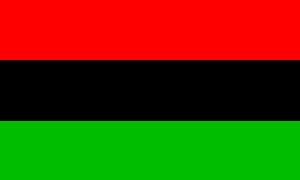
The Black Liberation Flag, also known as the Afro-American Flag, Pan-African Flag, and the UNIA Flag, is a symbol of African and African-American unity and pride. In the 1960s this flag became a symbol of Black liberation in the United States. This design was first adopted in 1920 as the official banner of the African Race at a meeting of the Universal Negro Improvement Association and African Communities League (UNIA) held in New York City. Popularly known today as the Garvey flag, named after Marcus Garvey, it was originally known simply as the "Red-Black-Green" flag.
This flag uses what is known as the pan-African colors (red, black and green). The red represents the blood shed in the struggle for liberation. The black color represents the Black race, the green color represents the natural resources of Africa from where the Black race comes from. The flag has also been called at various times the Marcus Garvey flag, the Black Nationalist Flag, the African National Flag, the New Afrikan Liberation Flag, the African-American Flag, the Universal African flag, and the International African Flag.
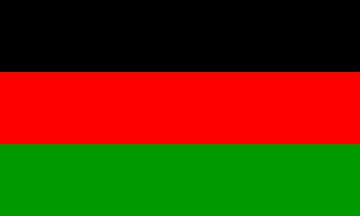
The second flag shown (Variant #2) is an African-American flag which uses the colors introduce by Marcus Garvey, but uses them in a different order, putting the black stripe on top to emphasize the black races' importance. This black-red-green flag first appeared on a stamp issued by the United States Postal Service in 1997 to commemorate Kwanzaa, the African-American yearly celebration. Since then, it has appeared in the African-American Parade in Cleveland, Ohio, where it was seen mixed in with flags in the more normal red-black-green pattern.
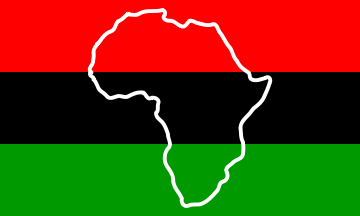
The third flag shown (Variant #3) with the large white outline of Africa is currently offered for sale at several websites; its exact first use date and origin is unknown. During the 1960s many variants of this flag were available, some with a gold Africa, some with a green Africa, some with madagascar included, some without, and the continent in various sizes.
Another version reported, but not shown here, apparently had a red star added to the center black strip and was used by Black Panthers' sympathizers in Oakland, California, in 1989, at the funeral of Huey Newton, co-founder of the Black Panther Party. See the "Black Panther Party" on the "Political Flags of Extremism" page for more information. |
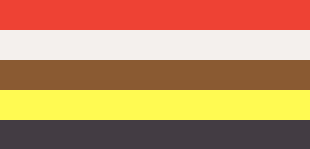
Brotherhood Flag
|
World Peace Association (WPA) Flag 1958
The World Peace Association (WPA) was based in Jenkins, Minnesota. The flag was dedicated at Odessa, New York, in May of 1958. It was used at the exhibit for the association at the Brussels World's Fair.
The Brotherhood Flag consists of five horizontal stripes of equal width. The top strip is red, the second stripe is white, the third stripe is brown, the fourth strip is yellow, and the fifth or bottom stripe is black. Each stripe represents one of the five different groups of the human race. |
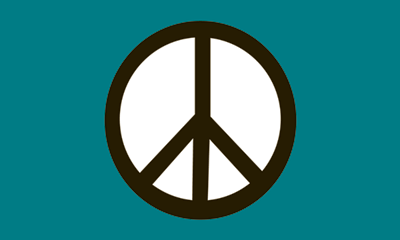
Peace Flag
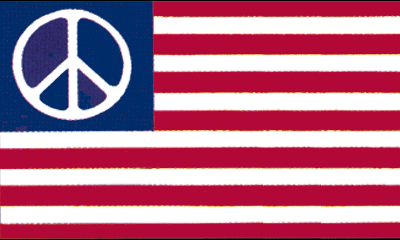
U.S. Peace Flag
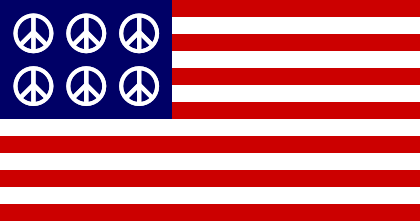
U.S. Peace Flag
(reported variant)
|
Peace Protest Flags 1960-1970s
In the 1960's a strong protest movement was born among the draft age college students to protest the Vietnam War. At first the student protesters used crude peace symbols, usually black painted on white backgrounds, at their rallies. The peace symbol was also spray painted on walls and clothing.
The Peace Symbol itself is an internationally recognized symbol for peace that was originally designed for the British nuclear disarmament movement by Gerald Holtom in 1958. Holtom, an artist and designer, made it for a march from Trafalgar Square, London, to the Atomic Weapons Research Establishment at Aldermaston in England.
The symbol is a combination of the semaphore signals for the letters "N" and "D," standing for "nuclear disarmament". The original drawing by Gerald Holtom of the symbol is housed in the Peace Museum in Bradford, England.
The use of the peace symbol on a flag was rare in the early protest rallies, where signs of protest leaned heavily on the burning of flags rather than carrying them. However, as the protest movement matured into the Peace Movement several popular flag designs emerged, the most popular being a turquoise green flag with a white peace symbol on it.
Also reported were two United States flags with modified blue cantons. The first had a single large white peace symbol centered in the canton. The second, which had the traditional stars replaced by six white peace symbols arranged in two rows of three, was rarely seen when compared to the popularity of other designs. Both these "stars and stripes" hybrids were reported being used in the United States in the early 1970s in the growing widespread opposition to the Viet-Nam War. These Peace flags were most commonly flown at anti-war demonstrations and rock festivals, but also used as wall decorations. |

UFW Flag
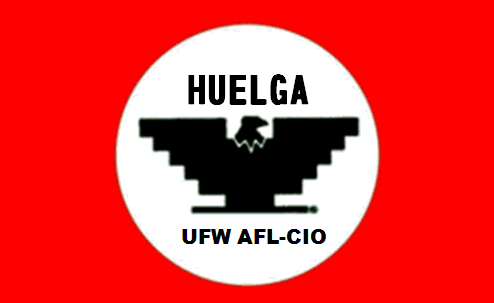
UFW Strike Flag
|
United Farm Workers 1962
In 1962, Cesar Cesar and Dolores Huerta founded the United Farm Workers. Their goal was to organize the Mexican agricultural workers and improve their working conditions, mostly in California. For two decades they attempted to raise public awareness to the struggles of the farm workers for better pay and safer working conditions. They eventually succeeded, using nonviolent tactics, boycotts, pickets, strikes, and hunger strikes.
Richard Chavez designed the UFW black eagle and his brother Cesar chose the black-white-red colors (white for their hope, black for their struggle, and red for their sacrifice) for their flags design. The story told is that Richard first sketched a "Aztec, or Mexican" black eagle on a piece of brown wrapping paper, then squared off the wing edges so that the eagle would be easier for union members to draw on their handmade red flags and banners.
The black eagle (some have called it a thunderbird) became a powerful symbol and the farm workers and their supporters proudly carried the black eagle flags and banners, sometimes with the words "huelga" (strike), or "viva la causa" (Long live our cause) or simply "UFW AFL-CIO" (for the United Farm Workers, American Federation of Labor and Congress of Industrial Organizations) added to the basic design within their white "circle of hope." The similarity of the design to far-left and right extremist flags was not lost to their detractors. |
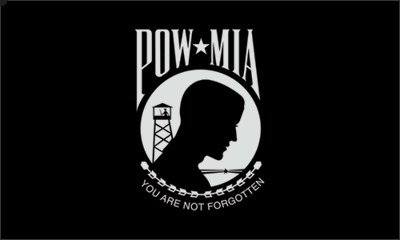
MIA-POW Flag (Type #1)
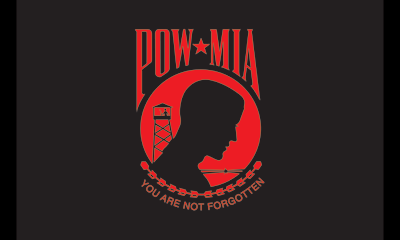
MIA/POW Flag (Type #2)
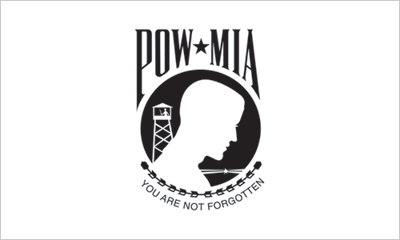
MIA/POW Flag (Type #3)
|
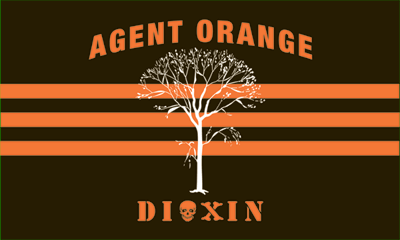
MIA/POW Flags and Agent Orange Flags
Two more Vietnam War Era protest flags that are still in use are the "Missing In Action, Prisoner of War" Flags (MIA/POW) being flown by those wishing to remind people that there are still American soldiers missing in action and possibly being held as prisoner by the Vietnamese government. These flags can be found with white and black backgrounds, and with silver, white or red lettering. The flags state: "You are not forgotten." Interesting enough, in 1990, Congress adopted the MIA/POW flag (Type #1) as a symbol of our nation's concern and commitment to resolving as fully as possible the fates of Americans still held prisoner, or missing and unaccounted for in Southeast Asia," thus making it a national flag which entitles it to be flown above all State flags.
|
|
|
Agent Orange Flag (Type #1) |
|
Agent Orange Flag (Type #2) |
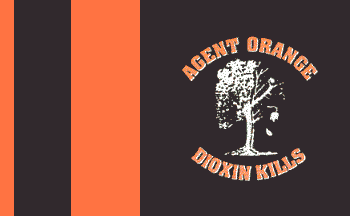
The second type of protest flag to come out of the Vietnam War era is from those angered with the secret use of Agent Orange to defoliate the Vietnam jungles, and especially about the harmful health effects the use of this chemical had on people and troops who came in contact with it. |
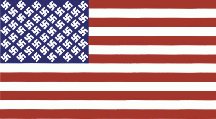
"50 United Fascist States" Flag
|
Black Panther Protest Flag 1966
In 1966, in Oakland, California, Huey Newton and Bobby Seale founded the Black Panther Party for Self-Defense. The Panthers practiced what they called "self-defense" for the minority communities against the U.S. government, and fought to establish revolutionary socialism through mass organizing and community based programs. The party was one of the first organizations in U.S. history to militantly struggle for ethnic minority and working class emancipation, and their agenda was the revolutionary establishment of real economic, social, and political equality across gender and color lines.
Black Panther Activist Bobby Seals and Angela Davis protested the use of what they called the "Fascist Pigs" of the local and State police forces that conspired against the Black Panther movement. This flag was reportedly used at one of their protest rallies, but currently has not been documented. |
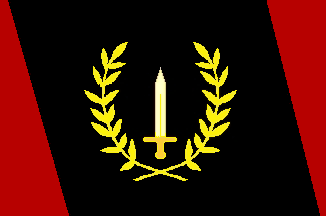
The Black Heritage Flag
|
Black American Heritage Flag 1967
The Black American Heritage flag was designed in 1967 by Melvin Charles and Gleason T. Jackson. According to the designers, "...the elements of the flag include the color black to represent pride and pigmentation and race; red, to remind us of the rich blood black men have shed for freedom, equality, justice and human dignity throughout the world; and gold, to represent intellect, prosperity, and peace. These colors are woven into a composition that juxtaposes the red and black in a set of three stripes: one black stripe centered between two red."
"Superimposed on the black stripe is a golden wreath of fig leaves. The cultivated fig is a native of Africa, and ranks as one of the most ancient of life-sustaining fruits. Centered within the golden wreath is a blunted Moorish boarding sword, symbol of leadership carried by the great Moorish leaders of the 8th century. The sword represents the strength and authority exhibited by a black culture that made many contributions to the world in mathematics, art, medicine, and physical science, heralding the contributions that black Americans would make in these and other fields." |
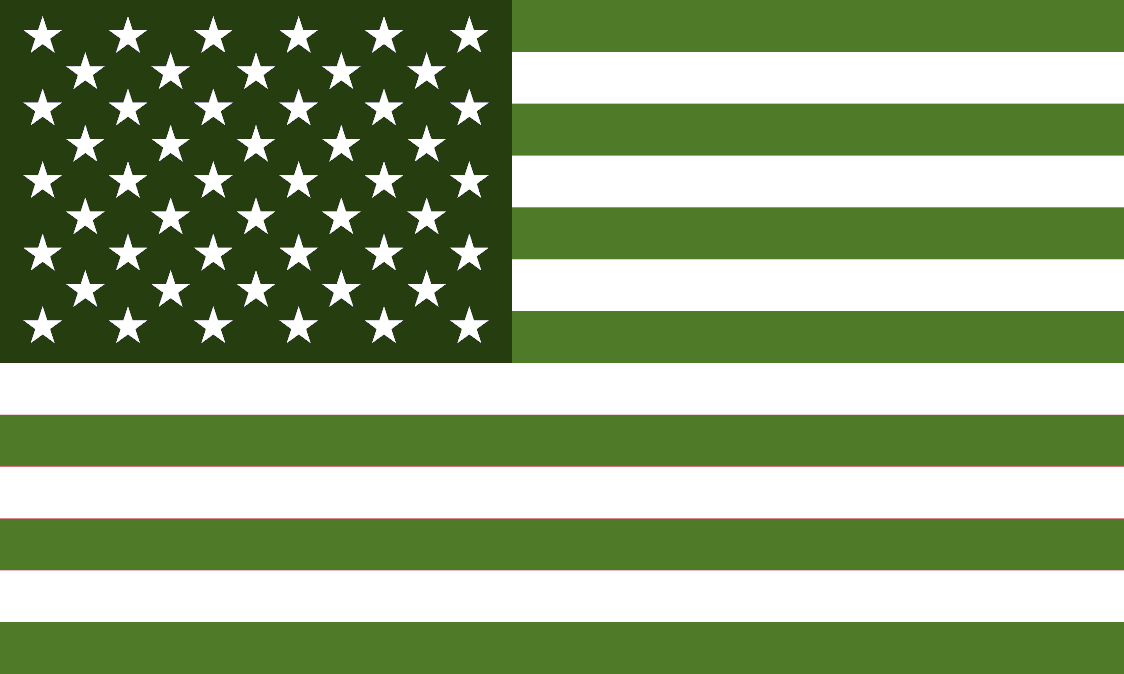
First US Ecology Flag 1967
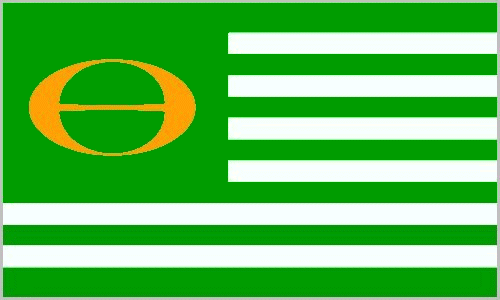
Theta Ecology Flag 1969
|
American Ecology Movement Flags 1967/1969
The first Ecology Flag was made by the San Francisco based Paramount Flag Company in 1967. This flag was based on the Stars and Stripes, but used a Hunter Green background in the canton and lighter Irish Green stripes instead of red stripes. The green and white colors were said to represent "pure air and green land" and environmental action. This first Ecology Flag has seen limited use at American Ecology Conferences, meetings and protests since the 1970s.
In 1969 Ron Cobb created an ecology symbol which was published on October 25, 1969 in the Los Angeles Free Press and then placed in the public domain. His symbol was formed by taking the letters "e" for "environment" and the letter "o" for "organism," thus forming what looks similar to the Greek letter Θ (Theta). This symbol was embraced by the ecology minded public.
Jack Shepherd of Look Magazine would use Cobb's symbol to replace the 50-star pattern in the canton with a gold Theta on the green field in Look's April 21, 1970 issue. His version of an Ecology flag caught the public's interest, possibly because he associated it with the Greek word thanatos (death), warning of human threats to the environment and atmosphere of the earth. Today, one rarely sees the original version. |
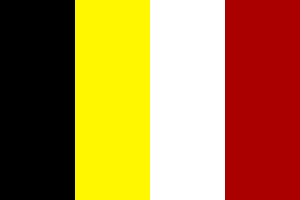
AIM Flag
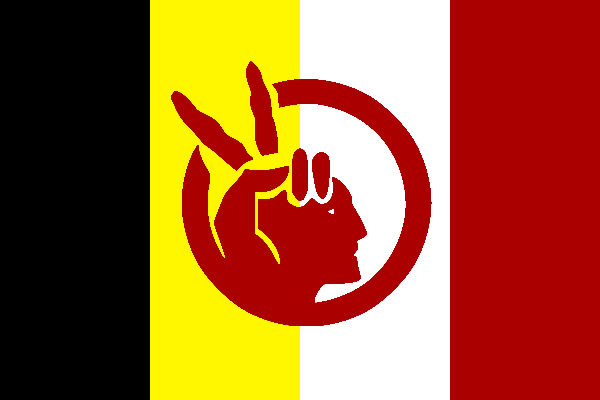
AIM Flag (variant)
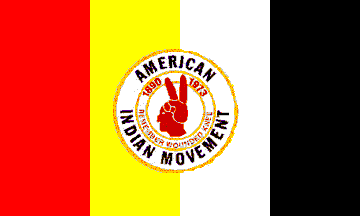
Remember Wounded Knee
40th Anniversary Flag 2013
|
American Indian Movement Flags 1968
The American Indian Movement (AIM) is a Native American activist organization in the United States. Founded in 1968, AIM calling itself the "Trail of Broken Treaties," began championing the cause of Indian unity. AIM was founded by Dennis Banks, George Mitchell, Herb Powless, Clyde Bellecourt, Harold Goodsky, and Eddie Benton-Banai in Minneapolis to address issues of Native American poverty, housing, treaty issues, and police harassment.
In 1972, AIM gained international press when it seized the Bureau of Indian Affairs headquarters in Washington, D.C., and again in 1973 at a standoff at Wounded Knee, South Dakota, on the Pine Ridge Indian Reservation. Their goal was to take a stand against centuries of what they claimed was mismanaged by the U.S. government policy and trust.
In the decades since AIM's founding, the group has led protests "advocating indigenous American interests, inspired cultural renewal, monitored police activities, and coordinated employment programs in cities and in rural reservation communities across the United States." They continue to sponsor protest marches, long walks, and numerous conferences supporting both Canadian and American Native American interest.
In 2013 AIM released a special flag commemorating the 40th anniversary of the 71 day occupation of Wounded Knee in 1973. The site was obviously chosen for its symbolic value as the location of the 1890 Wounded Knee Massacre. The 1973 incident began when approximately 200 Oglala Lakota and followers of the American Indian Movement seized and occupied the town of Wounded Knee, South Dakota, on the Pine Ridge Indian Reservation. The protest followed the failure to impeach tribal president Richard Wilson, whom they accused of corruption. The gun toting Oglala and AIM activists controlled the town for 71 days while the United States Marshals Service, FBI agents, and other law enforcement agencies exchanged gun fire. In the end, the siege was successful, but the violence continued between the opponents of the tribal government and Wilson's supporters for the next three years resulting in over 60 known deaths. |
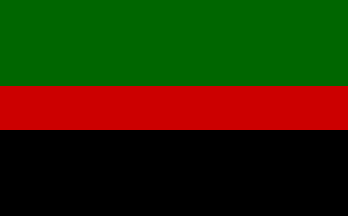
PG-RNA Flag
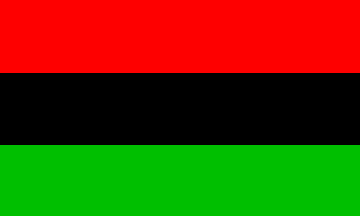
RNA Flag Variant
(Based on UNIA flag)
|
Republic of New Afrika Movement (USA)
The Republic of New Afrika Movement was created at the Black Government Conference in Detroit, Michigan, held in 1968, This group of Afro-American separatist wrote and signed a "Declaration of
Independence" and a "New Afrika Constitution." They then elected a Provisional Government of the Republic of New Afrika (PG-RNA) for their fanciful republic, comprised of the states of Louisiana, Mississippi, Alabama, Georgia, and South Carolina. The imaginative protest movement then elected Robert F. Williams, a controversial human rights advocate, then living in exile in China, as the President, attorney Milton Henry (a follower of Malcolm X) as First Vice President; and Betty Shabazz, the widow of Malcolm X, as Second Vice President.
Their somewhat unusual social protest resulted eventually in the FBI of the 1960s naming them a seditious group. The FBI began conducting raids on the RNA meetings, which then escalated into violent confrontations, and the eventual arrest and imprisonment of the RNA leaders. This group is an example of an protest movement which crosses the line into the violent extremist actions, under presure from governmental agancies. The remaining group would became a target of diverse Red Squad activities of the Michigan State Police and the Detroit Police Department, effectively ending the protest movement.
The PG-RNA still exists and maintains a Web presence, consistently displaying a flag derived from the Black Liberation Flag of 1920, but with different shades and order of colors and stripes of varying width. The original flag is still used by several other groups which support the same ideals. |
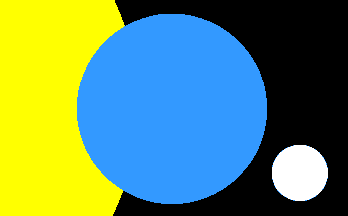
Flag of Earth
|
Flag of Earth 1969
The "Flag of Earth" was designed by an Illinois farmer named James Cadle shortly after the first manned landing on the moon in 1969. It consists of a blue circle, representing the earth, on a black background. To the left is a segment of a large yellow circle, representing the sun. On the lower right is a small white circle, representing the moon.
It was meant to be a flag for all nations and yet a flag of no nation. There are no rules to observe in displaying the flag, it could be flown at any time, in any weather, for any reason. The Flag of Earth Movement had no political, cultural or geographical affiliations. The flag itself was made by the Paramount Flag Company of San Francisco in the 1970's and 1980's. They were purchased mostly by astronomers where the flag apparently became quite popular. It was flown all over the globe, including in the former Soviet Union at observatories. They became very popular with SETI, and a similar design is still in use by the environmental group Knights of Gaia (the Earth). |
.gif)
IAT Mock Trial Flag
.gif)
IAT Dock Tower Flag
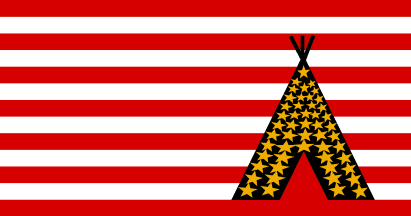
Old Glory's Helper Flag
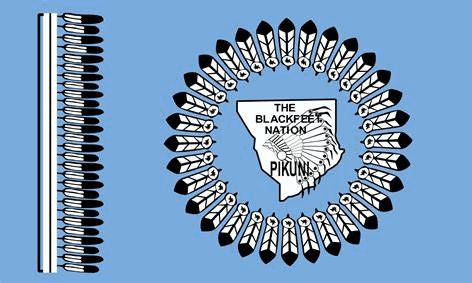
Blackfoot Nation Flag
|
Indians of All Tribes Protest on Alcatraz Island 1969-1971
The 1868 Treaty of Fort Laramie suggested that if any governmental property became surplus, the Sioux could claim it. When a Sioux social worker living in the San Francisco Bay Area learned that the Alcatraz Federal Penitentiary was to be closed and given to the City of San Francisco, it seemed the treaty provision might apply. In March of 1964 a small group of Sioux wearing traditional clothing demonstrated at the docks on the island for four hours, claiming the island. They displayed a standard 49-star American Flag, but bigger plans were in the works.
Between November of 1969 and June of 1971, a group of American Indian activists and supporters occupied Alcatraz Island in San Francisco Bay. As the first occupiers arrived the lone guard on the island sent out the humorous announcement of "Mayday! Mayday! The Indians have landed!" The 19-month-long protest was meant to raise public awareness to the violations of civil rights experienced by Native Americans. The protesters came at the invitation of the leaders of Indians of All Tribes (IAT) movement-Richard Oakes, Adam Fortunate Eagle Nordwall, and John Trudell.
Three flags, possibly four, were used during the occupation of the island. The first two were one-of-a-kind hand-made flags made with materials available on the island. The third was a more commercialized flag made especially for the protest. The fourth, also commercially made, was that of the Blackfoot Nation. All were flown there at one time or another during protest.
The first colorized flag is from the mock trial of the U.S. government held by the protesters. According to Time Magazine in an article headlined New Flag Over Alcatraz, the protestors "...raised their own flag over Alcatraz: a broken peace pipe and crimson tepee emblazoned on a field of azure." A picture of the Dock Guard Tower Flag, taken by a Swedish photographer in July of 1970, showed a second IAT flag with a red tepee and red broken peace pipe on a white field, bordered in red.
The third was "Old Glory's Helper," a commercial flag flown from one of the guard towers. It was designed by Lulie Nall, a Penobscot Indian who spent years after the protest (until her death in 1983) promoting it as an American Indian symbol for the protest. This third flag is an "associated flag" and flown for an undetermined time on the island; it had no direct connection to the Indians of All Tribes movement. On January 5, 1970, the San Francisco Chronicle published a picture of the Old Glory's Helper flag with Nall and credited her as its designer.
Joe Lonewalker Morris, a Blackfoot longshoreman who joined the occupation in 1969, didn't recall Nall's flag, but said he did bring a blue Blackfoot Nation flag of his own to the protest. However, this was unverified by any contemporary photographic evidence. However, between 10,000 and 15,000 supporters spent time on Alcatraz during the occupation and some may have come with flags their own. |
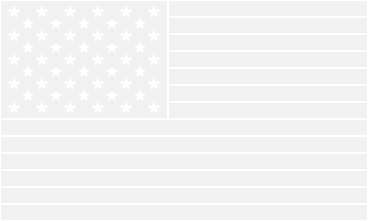
Example of the US White Flag
|
Brooklin Bridge White "Stars and Stripes" 2014
The idea of an all-white Stars and Stripes has been around since the 1960s and earlier. The first appearance might have been in the 1955 painting named the "White Flag" by Jasper Johns. Several
other all-white flags have appeared in later years as parts of larger art projects, the most recent one being the all-white flag which was hoisted over the Brooklyn Bridge in 2014.
In the 1970s and 1980s a white flag, which was sold by the Paramount Flag Company, was created as an homage to the book "The Stars and the Stripes" by Boleslaw and Marie-Louise D'Otrange Mastai, which was published in 1973. The edges of stripes and canton were created by heavy stitches, making them look "whiter than white" - actually, less transparent than the rest of the field; the stars were embroidered on the canton, which produced the same effect. The bottom line is the concept of an all-white American Flag has been a reoccurring art theme without having developed an universal meaning. |
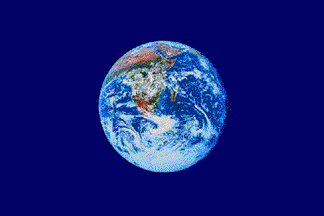
McConnell Earth Flag
|
Earth Day Flag 1970
The Earth Flag, often called the Earth Day Flag, was designed by John McConnell in 1970. It is the photographic image of the earth taken during the flight of Apollo 10 in 1969, viewed from above the Indian Ocean just east of the Cape of Good Hope, on a background of dark blue.
The first Earth Flag was created for the first Earth Day in San Francisco in March of 1970. It was primarily a Peace Day. Later, McConnell became active in the United Nations Earth Society Foundation where he met Margaret Mead, who really made the Earth Flag the icon it has become today. She literally carried it with her wherever she went. It is still sold by flag companies today. |
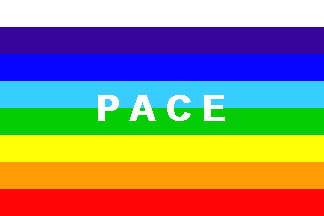
Italian PACE Flag c1970
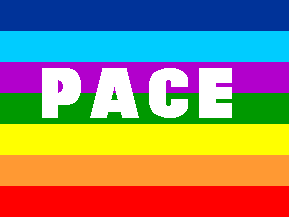
Italian PACE Flag c1980
Italian Variant #2
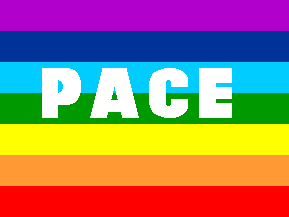
Italian PACE Flag c1990
Italian Variant #3
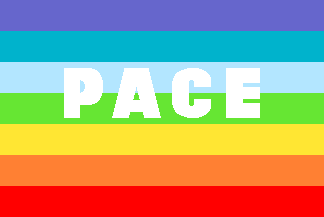
American PACE Flag c2000
American Variant #1
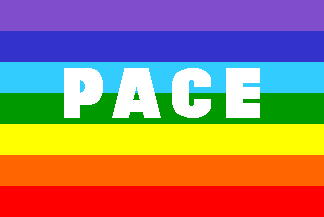
American PACE Flag c2000
American Variant #2
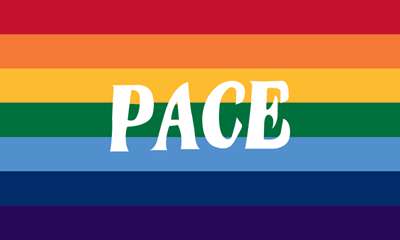
American PACE Flag c2000
American Variant #3
American PEACE Flag
Migrated from LGBT Demostrations
|
Italian "PACE" Flag
American Variant "PEACE" Flags
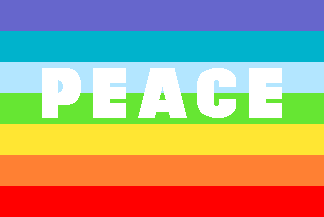
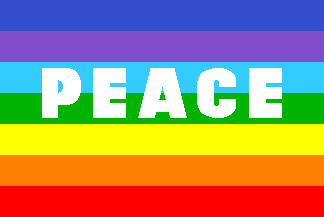
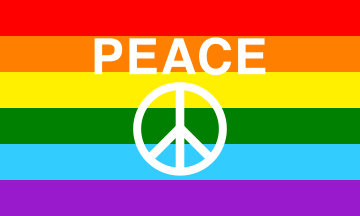
This rainbow colored flag is the Italian Peace Flag, which dates from the 1970s. In Italian, the word "pace" means "peace." This foreign flag has in recent years enjoyed some success in the United States as a substitute for the more commonly used and traditional Peace Flag, and is still popular in Italy and other parts of Europe today. The original striped rainbow peace flag, which included a white stripe since removed, first appeared in Italy in 1961, minis the white word "PACE" which was added in the early 1970s.
Because of the Italian PACE flag´s similar appearance it has been confused by the uninformed with the American Gay Rights (LGBT) Rainbow flag. However, upon close examination you will discover that it has more stripes and colors (7 instead of 6) than the Gay Right´s flag. It is basically a case of two similar flags both attempting to mimic the colors of the rainbow, but with the important difference of an extra dark blue stripe added to the Italian Peace flags.
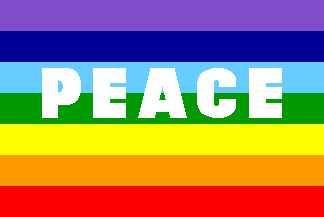
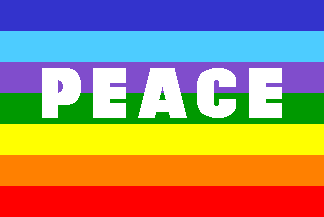
These Italian-style peace flags are now being "localized" in countries other than Italy and the word PACE is being translated to local languages like English, German (FRIEDE) or Turkish (BARIS). In the United States the most common variants (American PEACE variants #1-4) substitute the Italian "PACE" with the inscription "PEACE." A peculiarity of their use in the USA is that they are used not only at the pacifist rallies and protests, but also at LGBT events, having been adopted by their participants, probably because of their similarity with the rainbow LGBT flags. The color shades seem to vary a lot, so note that these images show only the most typical sets of colors.
|
|
|
American PEACE Variant #1 |
|
American PEACE Variant #2 |
|
|
|
American PEACE Variant #3 |
|
American PEACE Variant #4 |
The most widely used American variant (American PEACE variant #1) has the following color pattern: dark blue, cyan, light blue, green, yellow, orange, and red; with the word "PEACE" in white written over the violet blue and green stripes. Unlike the USA, this variant is rarely seen in Europe.
A variant widely used in Europe, but apparently less so in the USA, has the color pattern: purple, dark blue, light blue, green, yellow, orange, red; word PEACE is inscribed in white over light blue and green (American PEACE Variant #2).
Another American PEACE flag variant (American PEACE Variant #3) that is very popular in Europe, but used less in the USA, has the color pattern: dark blue, light blue, purple, green, yellow, orange, and red; word PEACE is inscribed in white over purple and green.
The variant most rarely seen in the USA (American PEACE Variant #4), a bit more popular in Europe, has the color pattern: dark blue, purple, light blue, green, yellow, orange, and red; word PEACE is inscribed in white over light blue and green.
The American PACE Flag (Variant #1) uses the same color pattern as American PEACE Variant #1 (dark blue, cyan, very light blue, green, yellow, orange, red), but has the white word "PACE" inscribed over very light blue and green instead.
A recent version of this popular flag (American PACE Variant #3) uses a very distinctive typeface, which is centered on the flag and covering three stripes (orange, green, light blue), and is currently being marketed, but has not yet been actually documented in use.
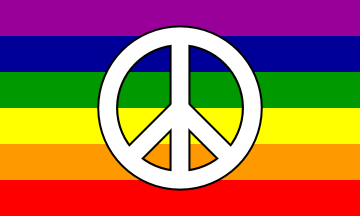
Other symbols have been added to the rainbow flag. A frequently used one is the peace sign, sometimes combined with the word PEACE, as shown in the example to the left. This flag's origin was at LGBT-related events in the USA in the mid-2000s, but its use spread to Peace Demonstrations and also to Canada in the mid-2010s. Although used at these pacifist events, it still remains primarily a LGBT flag. |
Rainbow Children Flag
|
The New Glory Flag c1970
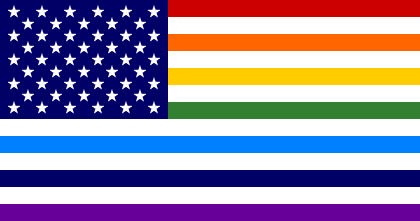
This interesting variation of the U.S. flag has its red stripes repainted into the seven colors of rainbow. The remaining red stripe retains its original shade, and the dark blue stripe near the bottom is in the same shade as the canton. It was originally popular in the 1970s with the "Rainbow Children" and other similar counter culture groups, but has gained new life as a Gay Rights/Gay Pride flag today. It was originally used by the "Hippy" generation at their Rainbow Gatherings, but the flag, now re-purposed, was used at the Gay Rally in Dallas in 2008, and again in San Francisco during the 2009 Gay Pride Parade.
The original flag was made by the Paramount Flag Company in San Francisco and later by Colors of the Wind, Inc. in Santa Monica. A variant version starts with the purple stripe instead of the red one. |
ERA Flag
|
Equal Rights/Equal Pay Movement mid-1970s
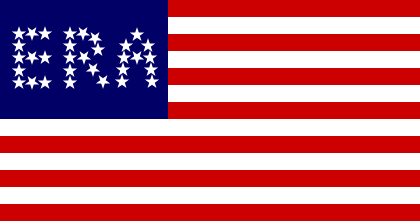
The Equal Rights Amendment (ERA) was a proposed amendment to the United States Constitution designed to end sex discrimination and guarantee all women equal protection and rights under the law, especially in the workplace. The concept was originally written and introduced for the first time by Alice Paul and Crystal Eastman in 1923. In 1972, the ERA Amendment passed both houses of Congress and was submitted to the state legislatures for ratification. Congress set a ratification deadline of March 22, 1979. Through 1977, the amendment received 35 of the necessary 38 state ratifications. Five states later rescinded their ratifications before the 1979 deadline. In 1978, a joint resolution of Congress extended the ratification deadline to June 30, 1982, but no further states ratified the amendment and it died.
This modified United States flag with 32 stars spelling out the letters "ERA" was seen during some of the Equal Rights Amendment rallies and demonstrations held in the mid-1970s. Sadly, only about 30 States eventually ratified the law and it died. |
One People/One Planet
|
Fuller Projection World Flag c1980s
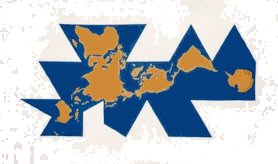
Buckminster Fuller envisioned one people/one planet, the "Spaceship Earth" as he called it. He predicted the worldwide economic collapse of the early 21st Century and hoped it would be the beginning of humanity acting as one race, one people, one planet. In the 1980s Seth Lefferts, who described himself as "one of the people on Spaceship Earth," created this design based on Fuller's vision.
The flag is named after the the Fuller Projection Dymaxion Air-Ocean World Map. This image was first conceived and created by Fuller in 1938 by collapsing the sphere of the Earth onto a flat surface of the ocean and land masses, without splitting or exaggerating their relative sizes. The idea was to show an equal representation of all of humanity. |
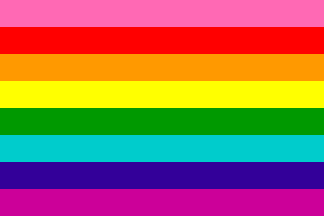
Gay Pride/Rainbow Flag
8 stripes (1978)
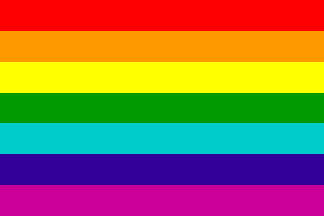
Gay Pride/Rainbow Flag
7 stripes (1978)
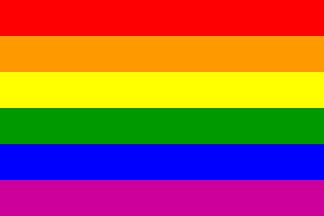
Gay Pride/Rainbow Flag
6 stripes (1979)
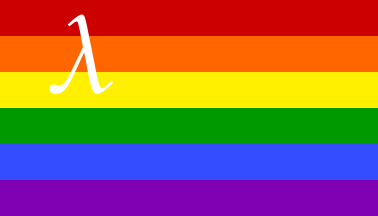
Lambda Rainbow Flag
Rainbow PEACE Flag
Used at LGBT and Peace Rallies
|
Gay Pride/Rainbow Flags
Policy on lesbian, gay, bisexual, and transgender (LGBT) behavior in the United States is a hot political and social issue. Five states and one district (Massachusetts, Connecticut, Iowa, Vermont, New Hampshire, and District of Columbia) have legalized same-sex marriage. Sexual acts between persons of the same sex have been legal nationwide in the United States since 2003, pursuant to the US Supreme Court ruling in Lawrence v. Texas. Openly lesbian and gay members of the US military is subject to a "Don't ask, don't tell" policy, but President Barack Obama indicated during the 2008 presidential campaign, and also during his 2010 State of the Union Address, his desire to end this policy.
The Rainbow Flag was designed in 1978 by Gilbert Baker, a San Francisco artist, for the San Francisco Gay Freedom Day Parade (now San Francisco Pride). Its original eight colors stood for sexuality, life, healing, sunlight, nature, magic (or art), serenity (or harmony) and spirit. Demand for the flag greatly increased after the assassination of openly gay San Francisco City Supervisor Harvey Milk in November same year. Due to unavailability of hot pink fabric used for top stripe, the pattern was reduced to seven stripes. In 1979, in the flags hung vertically from the lamp posts of San Francisco's Market Street, turquoise and indigo stripes were replaced by a single blue stripe, so that no stripe could be obscured by the post itself.
Since then, the six-striped flag has become a worldwide symbol of Gay Pride. it is usually flown with red at the top, but also with the reversed color order, or stripes arranged vertically or even with an order not matching that of the natural rainbow. The rainbow pattern may also be combined with other flag designs, such as those of the US or state flags, to produce "localized" LGBT emblems.
This use of the lambda as a gay symbol began when it was adopted in 1970 by the New York Gay Activists Alliance as the symbol of their growing movement of gay liberation. The lambda was subsequently adopted by the International Gay Rights Congress in 1974 in Edinburgh, Scotland. Today, the symbol generally denotes lesbian and gay men´s concerns together because the lambda was not linked to any specific gender or sexual orientation. Rainbow Gay Pride Flags with white letter lambda either centered or placed in the cantons have been used in West Hollywood, Long Beach, San Diego and other areas of Southern California. Other symbols may be added to the rainbow flag in the same manner.
Since 2000, Baker has been promoting the re-introduction of his original design, which has sparked more interest in seven-striped flag as well, both designs still being in limited use. Neither of them is really meant to completely replace the six-striped flag: "The idea of the rainbow is what counts", Baker himself said. The use of sets of six or eight solid color flags instead of a single rainbow flag has also been introduced.
An interesting migration occurred with the Rainbow PEACE Flag. It is common for additional symbols or text to be added to customized rainbow flags. A frequently used addition is the peace sign, sometimes combined with the word PEACE, as shown in the example to the left. This flag's origin was at LGBT-related events in the USA in the mid-2000s, but its use has spread to PEACE Rallies thus re-purposing the flag with additional meaning. This practice has spread to Canada and the Rainbow PEACE Flag is now used there. However it remains primarily a LGBT flag.
To see a more complete collection of images without any detailed text of American Rainbow flags in one place (Click Here). |
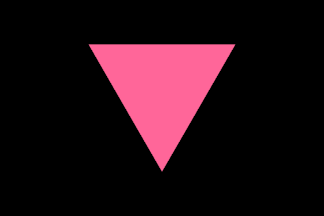
Pink Triangle Flag
Variant with black field
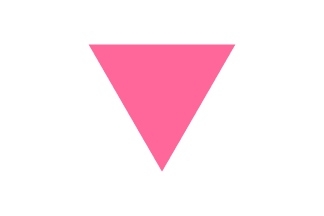
Pink Triangle Flag
Variant with white field
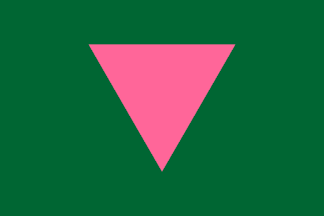
Pink Triangle Flag
Variant with olive-green field
|
Pink Triangle/Rainbow Flags
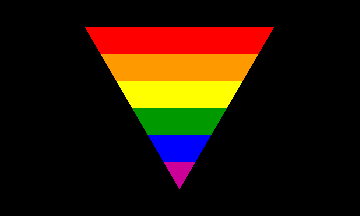
Originally used as one of the Nazi concentration camp badges, the pink triangle was used to identify male prisoners who were sent there because of their homosexuality. Today the pink triangle appears on modern gay pride protest flags centered on a variety of colors used as a field. Shown here is the most common with a black field, with a large pink triangle, point down, centered on the flag, but also one with a white field.
The olive green (or olive drab) field variant has used in Provincetown, Rhode Island, known as the United States East Coast’s gay Mecca.
Today, it should be noted, flying a Gay Pride flag openly, like many similar flags, only indicates political support for gays who shouldn't be persecuted for their beliefs in a free society, and doesn't mean that those flying are necessarily gay themselves.
|
|
|
Rainbow Triangle Flag
Variant with black field |
|
Pink Triangle Flag
Variant with rainbow field |
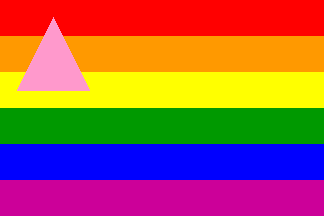
Rainbow Triangle "hybrid" variants of the Pink Triangle flag have also appeared in the United States with either a centered triangle striped red-orange-yellow-green-blue-purple (the colors of the basic Gay Pride flag) on a black field or a pink triangle (pointed up) in the canton area with the field behind done in rainbow colors. Other versions have the canton background done in blue or black.
To see a more complete collection of images without any detailed text of American Pink traingle/Rainbow flags in one place (Click Here). |
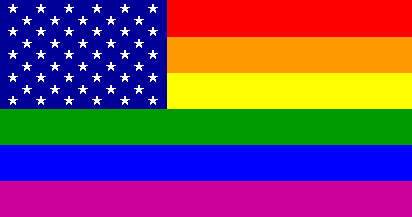
Gay Pride Flag c1990
Gay Pride Flag 2008
|
The New Glory Flag c1990
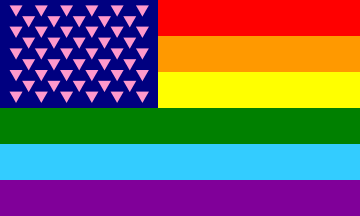
A fusion of the "Gay Rights, Gay Pride" Flag and the "Rainbow Children" Flag of the 1970s has resulted in this interesting flag. The New "Old Glory" Rainbow Flag is a more recent development. It basically adds a familiar blue canton of 50 stars to the Gay Pride flag to stress that equal rights for gays and lesbians are crucial in all 50 states. This strange merging of the long haired "Rainbow Children" of the 60s and 70s with the Gays of the 90s is an interesting vexillological development.
It should be noted, however, that although similar in general appearance with each other, the "old" New Glory flag had thirteen multi-colored stripes in a slightly different order, whereas on the "new" flag these thirteen stripes have been replaced with only the six colored stripes of the Gay Movement.
A similar and interesting variant of this flag which replaced the stars with pink triangles first made its appearance in 2008 at the Las Vegas LGBT Equality Rally.
Variants of this basic design continue to appear and can be seen both on the Internet and at LGBT demonstrations. |
African American Flag
|
Hammons´ African American Flag 1990
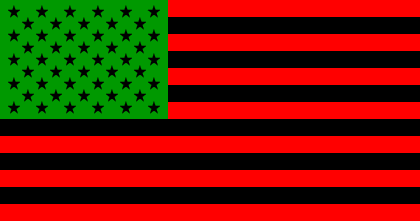
This flag was designed by David Hammons, an African-American artist from New York City. His works were inspired by the civil rights and Black Power movements. He designed the "African-American Flag" in 1990 by recoloring the US national flag in the Garvey colors. The flag is now a part of the permanent collection of the New York Museum of Modern Art and a copy is flown daily at the entrance of the Harlem Studio Museum, a New York museum devoted to the art of African-Americans, so his design is no longer just a work of art, but has become a very real and used flag.
The dimensions of the original flag was 56" x 88" (142.2 x 223.5 cm), but a variety of sizes can now be seen on the Web and the flag flown at the Studio Museum seems closer to the default proportions of the US national flag than to the Hammons' original model. |
African American Unity Flag
|
African American Unity Flag 1991
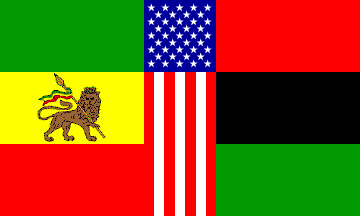
The African American Unity Flag was designed by Vincent Paramore as part of the African American Unity Flag Association (AAUF) grant. The Flag "tells the history of a people who originated from Africa and found themselves in a new land stripped of their religion, culture, language and history. It also memorializes black heroes and heroines known and unknown. The AAUF [flag] Serves to salute our continued progress for total freedom and equality."
A detailed explanation of the flag´s different elements and their meanings can be found on the African American Unity Flag (U.S.) page of the "Flags of the World" website. |
African-American Flag
|
Harvey African-American Flag 1991
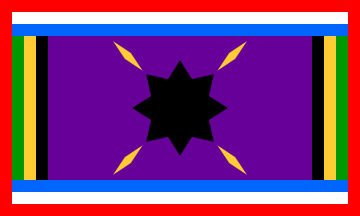
This flag was created in 1991 by David and Tonya Harvey of Baltimore, Maryland. Their flag represented the African-American population as a whole, and was not related to any political movement. The flags were sold by a company founded by the Harveys, and were quickly accepted by a number of institutions, including the Morgan State University, the National Black Catholic Congress, and many others. The flag has a black eight-pointed star, surrounded with four gold "flashes of light", on purple field, all within a complex border composed of red, white, blue, green, gold and black segments.
According to Harveys, the purple symbolizes the regal history of African-Americans; the gold flashes of light around the star symbolizes perseverance, love, knowledge and spirituality; the black stripe symbolizes African-American nearness to regality; the green stripe symbolizes abundant life in Africa; the gold Stripe symbolizes the riches of Africa; and the red, white and blue stripes symbolize the integral part that African-Americans play, have played, and will play in America's greatness. The star symbolizes each
individual African-American and its points stand for their principles: Aspirations, Family, Righteousness, Individuality, Community, Ability, Nobility, Scholarship - the acronym of which is AFRICANS |
New Peace Flag
(Type #1)
New Peace Flag
(Type #2)
New Peace Flag
(Type #3)
New Peace Flag
(Type #4)
|
New Peace Protest Flags 1990-2015
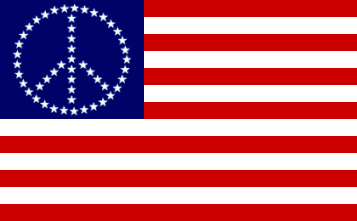
The Gulf Wars and later the Afghanistan War brought a whole new generation of Peace Protests to life, and with them a whole new set of flags to wave.
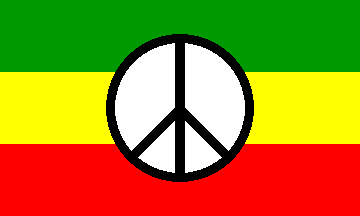
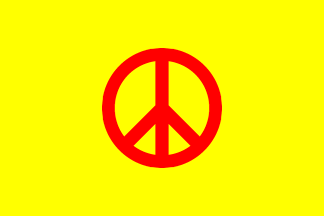
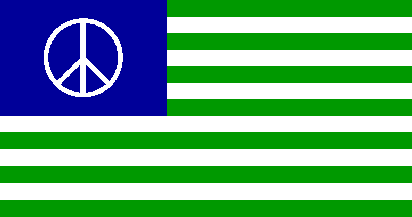
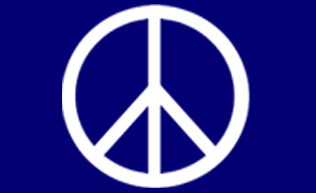
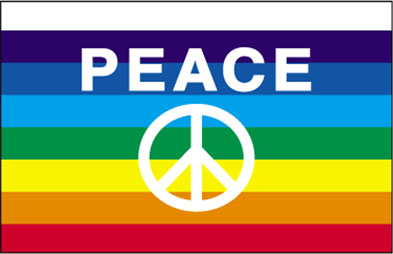
Type #1 features the traditional peace symbol done with 50 five-pointed stars and Type #2 seems to be a marriage of the Ecology Flag and the Peace flag. Type #3, with an enlarged plain white peace symbol comes with either a blue (as shown here), black, green, or red background. Type #4 turns the Italian Pace Flag upside down, adds a white stripe and white peace sign and the English translation of "Pace," (Peace) to the mix.
|
|
|
New Peace Flag (Type #5) |
|
New Peace Flag (Type #6) |
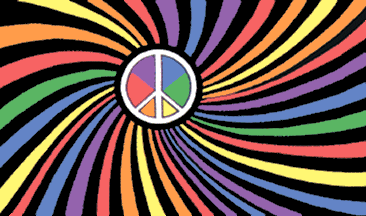
Type #5 has the field in a rainbow swirl pattern, the colored stripes separated with black, issuant from a white peace sign, bordered black and enclosing a disc composed of six segments in rainbow colors, while Type #6 has a white peace sign, bordered black, over the field in rainbow colors.
|
|
|
New Peace Flag (Type #7) |
|
New Peace Flag (Type #8) |
Type #7 has a black peace sign, enclosing a white disc, over the Rastafarian tricolor. Type #8 is similar to type #3, only with smaller peace sign, shown in red over a yellow field.
Because of the popularity of these flags, quite frankly, too many variants exist to be able to show them all here. Each year variants are added to the collection.
|
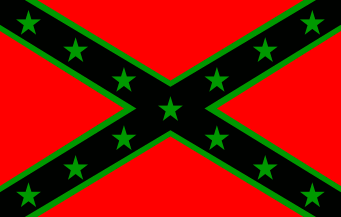
NuSouth Flag (Type #1)
Used as the flag and the logo
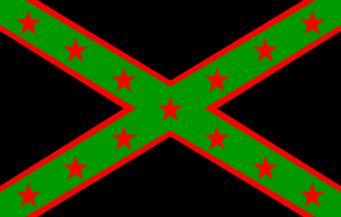
NuSouth Flag (Type #2)
Used only as the logo
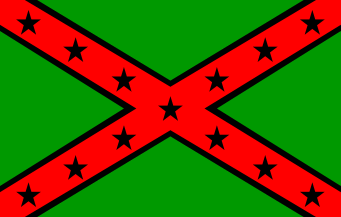
NuSouth Flag (Type #3)
Used only as the logo
|
NuSouth Flag 1993/1994
NuSouth Apparel was a clothing company from Charleston, South Carolina whose logo, used as the conspicuous decoration of their products, was derived from the Confederate flag by replacing white and blue with green and black, respectively, thus displaying Garvey colors - a design to be rightfully called a vexillological oxymoron. The emblem actually predates the company, whose founders, Angel Quintero and Sherman Evans, created it in 1993 while running the recording company named Vertical Records, along with the concert and event promotion agency named Free at Last Entertainment. As a part of the promotion campaign for local hip-hop group named DaPhlayva, a symbol was made to express the group members' identity as the African-Americans from the South.
The emblem, which placed the flag between black-red-black vertical stripes, appeared on the cover of DaPhlayva's album "Phlayva 4 Dem All" and on the promotional T-shirts which were distributed during their concert. Shortly afterwards, wearing of these shirts was banned in a local high school, one student being suspended for not respecting the ban (her response to the lack of same reaction to the shirts with white racist messages). At that time, Quintero and Evans had produced a flag with this design and publicly displayed it before the South Carolina State House, proposing that it replace the Confederate flag, whose flying atop the building (it remained there until 2000) was becoming a heated topic at the time. In 1995, they sold numerous shirts with the emblem during the Million Man March rally in Washington, D.C. A growing demand for the clothing with such decoration followed, eventually resulting in the founding of NuSouth company in 1997. The company name used the hip-hop style spelling of words "New South", but was also interpreted as "N-U-South", a same-style spelling of the words "In You, South", both interpretations expressing the wish to help creating a new, unified Southern identity, the symbol of which could be this flag.
The company website, online since early 2000, was closed down by the end of April 2003. Although the home page, displaying only the company logo, actually remained until early 2009, NuSouth probably did not outlive the year 2003, its logo eventually falling out of use with the changes of fashion. The fate of the produced flag is currently not known, but its existence is recorded on the photo showing Quintero and Evans wrapped in it, which was published at the NuSouth website and can still be viewed at the Internet Archive.
Two rarely used variants of the NuSouth logo were displaying Garvey colors in different patterns. One of them was replacing red, white and blue with black, red and green, respectively. On the other one, red, white and blue were replaced with green, black and red, respectively. None of these patterns seem to have been used as the flags. |
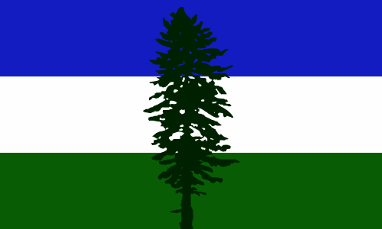
Cascadian Flag (Type #1)
Cascadian Flag (Type #2)
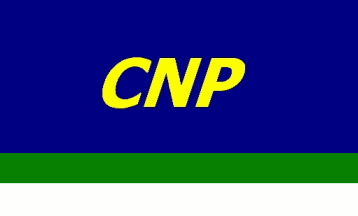
Proposed by the CNP
Cascadian Rainbow Flag
Derived from
Baretich's flag 2012
|
The Imaginary State of Cascadia 1994
On a less serious vain, Cascadia is an imagined independent state that would incorporate parts of British Columbia, Washington, Oregon, Southern Alaska and Northern California. It would somehow be formed if these states and province would ever successfully secede from their respective federal governments.
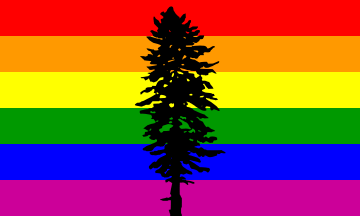
Designed in 1994 by a Portland University Political Science professor named Alexander Baretich, the flag has appeared on a couple of local microbrews labels with strange names like "Secession IPA" or "Cascadian Dark Ale," and has been seen at occasional sporting events and on college campuses. Most recently it has popped up at Occupy protests held in the Pacific Northwest. A Rainbow version of the Cascadian Flag has also made its appearance. At the present time, there seems to be more flags than acres.
|
|
|
Cascadian National Party Flag (Type #1) |
|
Cascadian National Party Flag (Type #2) |
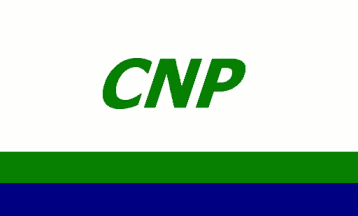
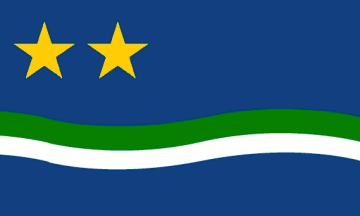
Besides the two "national flags" variants, there are also two varaint Cascadian National Party flags. The party goal is the creation of an independent Cascadia. It was founded in 2001, but quickly went inactive. The party proposal for the national flag (Type #2) has two gold stars in canton, above a bicolor wavy stripe, green above white, all on blue field. According to the CNP website the flag symbolism has "the two gold stars represent the states of Oregon and Washington. The top blue background represents freedom. The white flowing stripe represents hope. The green flowing stripe represents the environment and resources of Cascadia. The bottom blue background represents the water of the Pacific Ocean, the Columbia River, and the Puget Sound." |
WWII 50th Anniversary Flag
|
50th Anniversary of World War II Flag 1945-1995
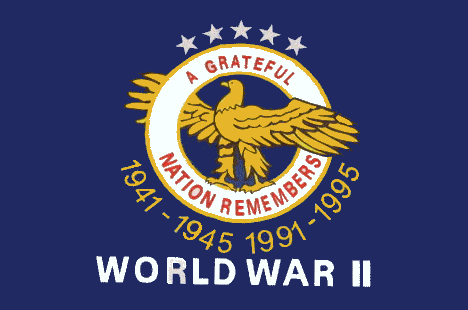
The United States Department of Defense issued a World War II 50th Anniversary Flag as the first of a new officially sanctioned set of commemorative flags designed to honor and commemorate the 50th anniversaries of modern American military campaigns and those who served in them. This World War II 50th Anniversary flag will be followed by a Korean War 50th Anniversary flag in 2000 and a Vietnam War 50th Anniversary flag in 2015 honoring the veteran´s of those conflicts.
The World War II 50th Anniversary flag design features the American Bald Eagle, head turned towards the hoist, with wings outstretched and overlapping a white circle on a blue field, with the red words "A grateful Nation Remembers" circling to honor these who served in World War II between 1941 and 1945 in both the Pacific and Europe. |
African American Flag House
|
African American Flag House 1995
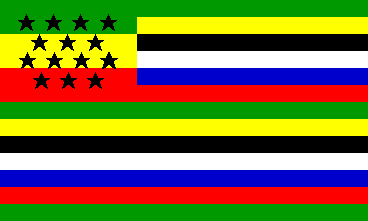
This flag was first flown at the African American Flag House in Charleston, South Carolina, on July 3, 1995, just one day before our nation's 4th of July celebration. The African American Flag House foundation hoped the flag would become "a positive and unifying symbol that represents the enormous historical investment of African Americans in the Nation, their defense of the Constitution of the United States, and the promise of opportunity for all. This original flag proclaims African Americans as an important part of the rich mosaic of the United States of America, its protectorates and territories."
A detailed explanation of the flag´s different elements and their meanings can be found on the Afro-American flags (U.S.) page of the "Flags of the World" website. |
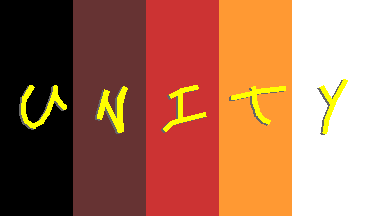
U.S. Unity Movement Flag
|
American "Hip Hop Nation" Unity Movement Flag 1996
In the summer of 1996, a flag symbolizing the values of the Hip Hop Nation was officially revealed in San Francisco. The Hip Hop Unity Flag is the brain child of community activist James P. Queen, who is the President of Racial Unity Inc. The flag features the colors of our human family: Black, Brown, Red, Yellow and White. Unlike most flags whose stripes are laid horizontally the Hip Hop Generation-Unity Flag's stripes stand vertical/side by side. The significance of this is to show equality because no color is above the other. In short, the flag stands for unity.
On the reverse side of this flag the colors are reversed, i.e. - White, Yellow, Red, Brown, and Black with the word Unity spelled from right to left. |
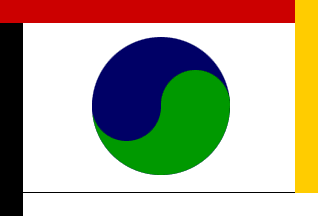
One World Flag
|
One World Flag Movement 1996
The One World Flag was designed by David Bartholomew in 1996. He claims it occurred to him in a dream. It consists of a traditional yin-yang symbol, blue above and green below, representing the planet earth living in harmony, on a background of white, representing peace. The edges are formed of colored bars, red above, yellow on the right, white below, and black on the left, representing the four compass directions.
Bartholomew hoped the One World Flag would become an international symbol of diversity, tolerance, uniqueness, self-esteem, and cooperation. He still heads the One World Flag Movement which partly supports itself by selling the One World flag. |
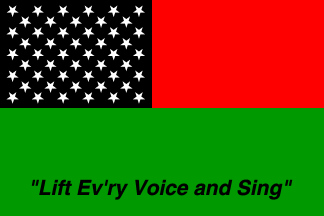
AANH Flag (variant)
|
African American National Heritage Flag 1998
The original African American National Heritage Flag was created in 1998 by James Wesley Chester, founder of the Institute for African American National Heritage. It was divided horizontally red above green, with a black canton, which is charged with 50 white stars, arranged as in the USA national flag, but set upside-down, perhaps indicating distress and sorrow.
In this variant, in the bottom central part of the green field, there is a black inscription "Lift Ev'ry Voice and Sing", which is the title and first verse of the song written by James Weldon Johnson, an African-American writer and activist, which was considered the African-American national anthem.
|
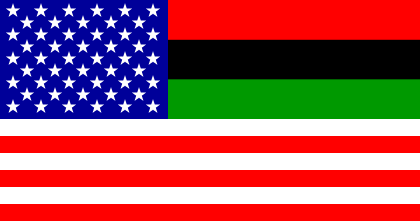
African American Flag of Inclusion
|
African American Flag of Inclusion 1999
This flag was designed by Cecil Lee, a visual artist from New York City known by combining the painting, photography and computer graphics into the Computer Evolved Multi-medium Art (CEMA), as he has named it. He created the flag in 1999 and presented it at a one man art show at Gallery X in Harlem. From 2002 to 2009, T-shirts decorated with the flag image could also be purchased from his website.
By replacing top seven stripes of the United States national flag with the Black Liberation flag pattern, Lee intended to represent "all African Americans regardless of their individual beliefs or political affiliations", and their "unique contributions and accomplishments toward the inventiveness, creativity, building, growth and stability of the United States of America". |
| Top of Page | Part II - After 2000 |
|