Note: If an image ever fails to appear - refresh your page, it really is there
Flags of Modern Conflicts
| Page Top | Cyprus | Palestine Conflict | Iran-Iraqi War | Falkland Islands War | Gulf Wars | Balkan Wars |
| War on Terrorism | War on Piracy | Unrest in the Arab World |
The Struggle for Cyprus
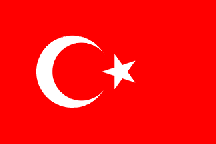
Ottoman Turkish Empire
|
The Ottoman Empire 1570-1878
In 1570, a full scale conquest under Piyale Pasha with 60,000 troops brought the Island of Cyprus under control of the Ottoman Empire, despite stiff resistance by the inhabitants of Nicosia and Famagusta.
Administration control (but not sovereignty) of the island was ceded to the British Empire in 1878, in the aftermath of the Russo-Turkish War (1877–1878). The island would serve Britain as a key military base in its colonial routes.
|
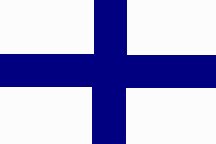
Greek Revolutionary Flag
|
Greek Revolutionary Flag 1821-1829
The Greek War of Independence (1821–1829), also commonly known as the Greek Revolution, was a successful war waged by the Greeks to liberate themselves from the Ottoman Empire. Before the war was over both the western and eastern great powers would become involved. The London Conference of 1832 established the Kingdom of Greece, with an imported Bavarian prince named Otto being made its first king. An independent Greek state had been established, but with Britain, Russia and France claiming a major role in Greek politics, and with a ruler supported by a mercenary army.
|
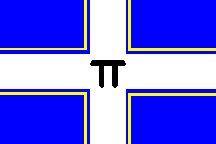
Kokkinochoria Flag
|
Kokkinochoria Flag 1821-1832
This flag was one used in the region of Kokkinochoria during the Independence War of 1821. People in Cyprus then fought for enosis (Union) with Greece.
The Greek letter "TT" placed in the middle of the flag represents the village of Paralimni, where soldiers were recruited and organized.
|
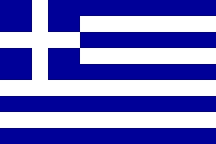
Greece National Flag 1833
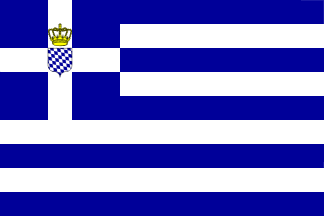
Greece Naval Ensign 1858
|
Greece 1833-present
After a long and bloody struggle against the Ottoman Empire, Greek liberation was finally succeeded by the Treaty of Constantinople in July of 1832. The Greeks were thus the first people of the Ottoman Empire's subjects to secure recognition as an independent sovereign power.
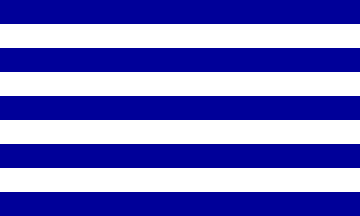 Greece Merchant Flag 1833-1858 The first national flag of Greece was adopted in 1833 and is still basically in use today. Between 1833 and 1858 a merchants ensign for non-military shipping was approved, but little used. In 1858, a special naval ensign for Royal Navy vessels was approved and after 1858, the regular national flag was used at sea by civilian vessels.
|
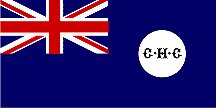
Cyprus Colonial Blue Ensign 1905
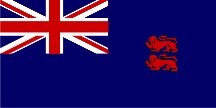
Cyprus Colonial Blue Ensign 1922
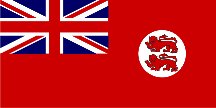
Cyprus Colonial Red Ensign 1922
|
Cyprus under British rule 1878-1960
In 1878, in exchange for assistance against Russian encroachment in eastern Turkey, Cyprus was put under British administration, but remained part of the Ottoman Empire until 1914 when Turkey entered World War I on the German side. At this time Cyprus was annexed by the British Crown, and in 1925 the annexation was recognized by both Greece and Turkey under Treaty of Lausanne and Cyprus officially became a Crown Colony.
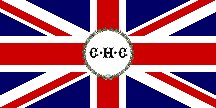
Cyprus High Commissioner 1881
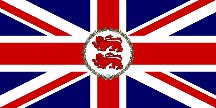
Cyprus High Commissioner 1922
The British would rule the Island of Cyprus until 1960 when Cyprus independence was recognized.
|
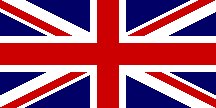
United Kingdom
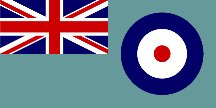
Royal Air Force Ensign
|
Sovereign Base Areas Flag (United Kingdom)
Cyprus gained its independence only in exchange for the creation of three British military bases on its territory: these are the base of Akrotiri, the base of Dhekelia and the Mount Olympus radar centre on the top of the Troodos Mountains. The British Law is the only law there.
The three Sovereign Base Areas in Cyprus are administered by the Commander British Forces on behalf of the Ministry of Defence, and not by the Foreign and Commonwealth Office. At one time the RAF Ensign was used as the de-facto national flag of the Sovereign Base Areas because of local political sensitivity to the use of the Union Flag in Cyprus.
|
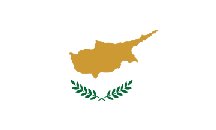
Republic of Cyprus
|
Republic of Cyprus Flag 1960
The Republic of Cyprus was proclaimed on August 16, 1960, as a compromise solution between the Greek and Turkish communities of the island. The Greek aspiration to "enosis" (incorporation of the whole island to Greek) as well as the Turkish aspiration to "taksim" (sharing of the island between Greece and Turkey) were rejected. According to the Constitution, the Greek community elected the President of the Republic, Archbishop Makarios III (1913-1977), whereas the Turkish community, elected the Vice-President of the Republic, Fazil Küçük. |
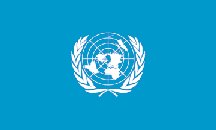
United Nations
|
United Nations Force in Cyprus (UNFICYP)
In 1974, the occupation of part of Cyprus by Turkey resulted in the division of the island by the Attila line (also known as the "Green Line"). The line area was provided by the Republic of Cyprus and is controlled only by UN troops. The UN headquarters are located at the Nicosia International Airport which was abandoned after the war in 1974 and now can only be used by the United Nation Force in Cyprus (UNFICYP).
Click here to learn more about the Organizational Flags of the United Nations and its various Agencies.
|
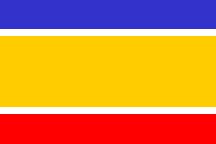
United Cyprus Republic
|
Flag of the United Cyprus Republic 2004 (Proposed)
The above flag was chosen by a committee of Greek and Turkish Cypriots in early March of 2004. They chose from several hundred entries sent in to an international competition organized by the UN in early 2003.
The proposal for a new status of Cyprus drafted by the United Nations was rejected by referendum on April 24, 2004. Accordingly, Cyprus is still de facto divided into two parts, the Republic of Cyprus, internationally recognized, except by Turkey, as sovereign over the whole island but exerting power only on its southern part; and the Turkish Republic of Northern Cyprus, recognized by Turkey only, and exerting power on the north of the island. The capital city of Cyprus, Nicosia, is also divided between the two powers.
|
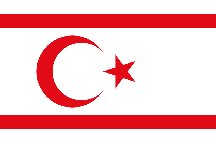
TRNC Flag
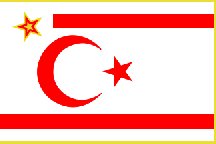
TRNC President´s Flag
|
Turkish Republic of Northern Cyprus 1985-present
In February of 1975, Rauf Denktas, the leader of the Turkish community, was elected President of the self-proclaimed "Turkish Cypriot Federate State" in northern Cyprus.
In 1983, it unilaterally declared independence as the "Turkish Republic of Northern Cyprus." The new state was recognized only by Turkey and condemned by the United Nations Security Council. The flag itself was the winning entry in a public competition. The Constitution of the new state was adopted on May 5, 1985, and presidential and general elections took place in June of 1985.
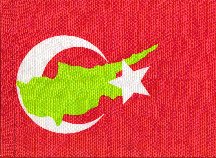
This hand-held flag was sent to Dean Thomas from Turkey. It is apparently a new Turkey/Turkish Cypriot solidarity flag.
|
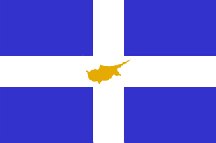
Greek Enosis Banner
|
"Greek Cypriot" flag
This is the unofficial flag of the Greek community of Cyprus. It has no official status, but is being flown in hotels, restaurants, and private homes. Of course, it isn't displayed in any public or government buildings. The flag symbolizes the desire of the Cypriot patriots for an union with Greece.
|
- My thanks to Dean Thomas for all his valuable input on this section -
| Page Top | Cyprus | Palestine Conflict | Iran-Iraqi War | Falkland Islands War | Gulf Wars | Balkan Wars |
| War on Terrorism | War on Piracy | Unrest in the Arab World |
Israel-Palestine Question
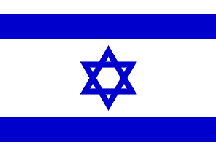
Israel
|
Israeli National Flag 1948
In 1947, the United Nations approved the partition of Palestine into two states, one the Jewish State of Israel and one proposed Arab Country of Palestine. When the neighboring Arab countries refused to accept the plan, the State of Israel proclaimed itself an independent nation in 1948. Since then, Israel has been in conflict with many of the neighboring Arab countries, resulting in several wars and decades of violence that continue to this day. In general, the Israeli have come out on top in each conflict. |
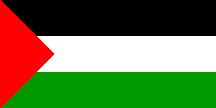
State of Palestine Flag
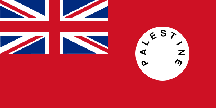
British Palestine Mandate
1920-1948
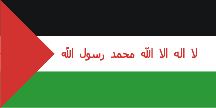
Palestinian Protest flag
with the Shahada
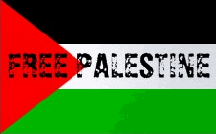
Palestinian Protest Flag
|
Palestine Liberation Organization (PLO) Flag 1964-2005
Palestinian National Authority (PNA) Flag 2005-present
Although this flag design dates back to the Arab revolt against the Ottoman Empire in 1916, it was officially adopted as the flag of the Palestinian people by the Palestine Liberation Organization (PLO) in 1964. In 2005, the Palestinian National Authority (PNA) adopted the flag as the flag of the State of Palestine. Today, the flag is flown widely by Palestinians and their supporters.
Within the context of the Israeli-Palestinian conflict, the boundaries of Palestine are subject to deep dispute. To the Palestinian people, the boundaries of Palestine are those made in the British Mandate of 1920–1948, excluding those of the Kingdom of Jordan, which became an independent Arab country in 1921. However, Israel conquered three-quarters of this territory by the end of the 1948 Arab-Israeli War and the remaining part, comprising the Gaza Strip, the West Bank and East Jerusalem, were first occupied by Egypt and Jordan, but later conquered by Israel during the Six Days War in 1967.
Since that time the question of establishing a "State of Palestine" with precise boundaries has been marred by periodic outbreaks of violence. In 1993, the Oslo Peace Accords, signed by Yassir Arafat and then Israeli Prime Minister Yitzhak Rabin in Washington, managed to get an agreement between the Palestinians and Israelis. Israel would pull out of the Gaza Strip and cities in the West Bank, while leaving the contested East Jerusalem in Israeli control. In 2005, Israel did unilaterally withdraw from the Gaza Strip as agreed in the "Disengagement Plan," and all the Israeli settlers were evacuated from the Gaza Strip. Control over the area was transferred to the Palestinian National Authority (PNA) which was established to govern those areas from which Israel withdrew.
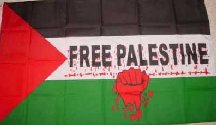 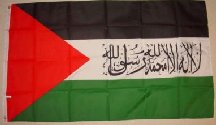
Other variant "Palestinian Protest flags" seen during political demonstrations
(Obviously, those written in English were designed to take advantage of western media coverage) |
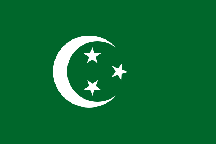
Royal Egypt
|
Kingdom of Egypt Flag 1922-1952
The first official national flag of modern Egypt was adopted by a Royal Decree of the Kingdom of Egypt in 1923, after Britain formally recognized Egyptian independence in 1922. It consisted of a white crescent with three white stars on a green background. |
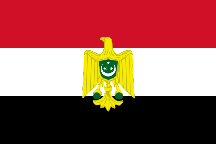
Egyptian Republic
|
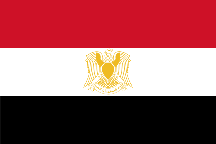
Republic of Egypt Flag 1952-1958
Following the 1952 revolution, the Egyptian Republic initially kept the green flag with the crescent and three stars of the kingdom, but later replaced it with a red-white-black horizontal tricolour with an eagle emblem in the white stripe, bearing a shield of the crescent and stars. |
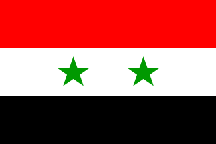
Egypt and Syria
|
Egypt (United Arab Republic) Flag 1958-1972
In 1958, the United Arab Republic, which comprised a merger of Syria and Egypt was founded. A red-white and black tricoloured flag with two green stars became the UAR flag. Egypt continued to use this flag until January 1, 1972, although the short-lived Egypt-Syria union saw its dissolution in 1961. The flag is still used as a national flag by Syria today. |
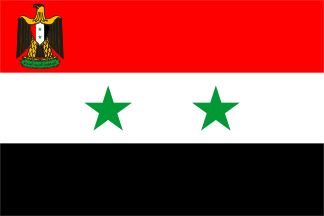
UAR Presidential Flag
(For use on land)
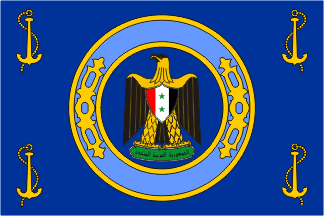
UAR Presidential Flag
(For use at sea)
|
United Arab Republic - Presidential Flags 1958-1972
The very first Presidential flag of Egypt and the United Arab Republic was the national flag of the U.A.R. charged with the new emblem "The eagle of Saladin" in the canton. Saladin is often hailed as a hero in the Arab world because he united so much of it in the late 12th Century and defended Islamic territories against the Crusaders. The "eagle of Saladin" has served at one time or another over the past fifty years as the basis for the arms of Lybia, Egypt, Yemens, Iraq, and Palestine, to name a few.
The first flag illustrated here was for use by the President on land only, a completely different flag was taken into use when at sea. This tradition was quite clearly influenced by the use of two separate flags for the King when Egypt was a kingdom between 1923-1958.
The second Presidential flag illustrate here was for use at sea and consisted of a blue field charged with the seal of Egypt in the center and containing four gold fouled anchors in all four corners. This flag was clearly influenced by the Royal flag of Egypt which also contained 4 crowns in the corners. There was a square version of this flag reported for use as a Naval Jack to be flown from the bowsprit of vessels with the President on board when at anchor.
The use of all three of these flag were abolished when the Federation of Arab Republics was formed in 1972. |
Egyptian Republic
|
Egypt (Federation of Arab Republics) Flag 1972-1984
In 1972, Egypt, Syria, and Libya joined together calling themselves the Federation of Arab Republics. The flag of this new union was once again a red-white-black tricoloured flag with the golden "Hawk of Qureish," holding a scroll with the Arabic name of the Federation placed in the center. |
Egypt
|
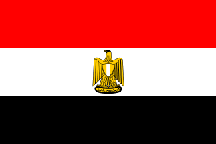
Egyptian National Flag 1984-present
The flag of Egypt in its current form was adopted on October 4, 1984. The flag of 1984 restored the top red stripe to the same red used in the United Arab Republic flag. The flag of 1972 had lightened the red color slightly. It depicts Egypt's national emblem, the Eagle of Saladin (a shield superimposed on a golden eagle facing the hoist side above a scroll bearing the name of the country in Arabic) centered in the white band of the three equal horizontal bands of red, white, and black. |
Lebanon
|
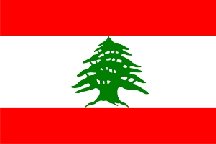
Republic of Lebanon Flag 1943-present
The Lebanese flag is derived from the French tricolor. The cedar was placed in the white of the French flag. When Lebanon pronounced its independence, they got rid of the blue and made the stripes horizontal. The addition of a cedar tree can be easily explained because of the historical importance of the "Cedars of Lebanon" in near eastern history. |
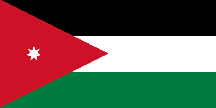
Jordan
|
Kingdom of Jordan 1912-present
The national flag of Jordan is based on the flag of the Arab Revolt against the Ottoman Empire during World War I. The flag consists of three horizontal bands (black, white and green) that are all connected by a red triangle on the left edge. The horizontal colors stand for the Abbasid, Umayyad and Fatimid Caliphates. The red triangle is for the Hashemite dynasty and the Arab Revolt. The seven pointed star, which is the only feature that distinguishes Jordan's flag from that of Palestine, stands for the unity of the Arab peoples. The Kingdom of Jordan became an independent Arab country in 1921. |
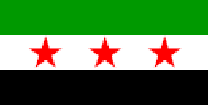
Syria
|
Republic of Syria Flag 1946-1958 and 1961-1963
The first flag to be used by the Syrians, in 1920, was similar in color to the current flag of Jordan, but with the green and white colors reversed. The colors and design were taken from the Pan-Arab flag and inspired by the flag of the Arab Revolt. However, with the fall of the Ottoman Empire the French gained control of Syria until 1946 when Syria once again gained its independence. In 1946 Syria adopted this tricoloured flag with three green stars and used it until 1958 when they joined the United Arab Republic. It was briefly used again in 1961-1963. |
United Arab Republic
|
Syria (United Arab Republic) 1958-1961
Syrian National Flag 1980-present
The United Arab Republic flag was used by Syria between 1958-1961. In 1961, Syria broke the union with Egypt. Strangely enough, the old UAR flag was re-adopted in 1980 by Syria and became its current national flag. |
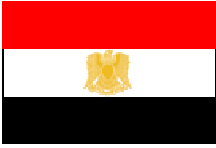
Syria
|
Syria (Federation of Arab Republics) Flag 1971-1980
In 1971, a red-white-black flag with a golden "Hawk of Qureish" holding a scroll with the Arabic name of the Federation of Arab Republics became the Syrian national flag. The Federation of Arab Republics consisted of Syria, Egypt and Libya. |
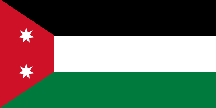
Royal Iraq
|
Kingdom of Iraq Flag 1921–1959
The original flag of Iraq was adopted in 1921, when the country was formed as a monarchy. It was a black-white-green horizontal tricolour, with a red trapezoid (some variants have a triangle) extending from the mast side, inspired by the flag of the Arab Revolt. Two seven-pointed white stars on the triangle denoted the two principal peoples of the kingdom: the Arabs and the Kurds. |
Republic of Iraq
|
Republic of Iraq Flag 1959–1963
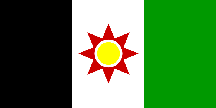
Following Abdul Karim Qassim's 1958 revolution that deposed the monarchy in 1959, Iraq adopted a new flag that consisted of a black-white-green vertical tricolour, and a red eight-pointed star with a yellow circle at its center in the middle white band. The black and green represented pan-Arabism, the yellow sun representing the Kurdish minority, while the red star of Ishtar represented the Assyrian minority. This version of the Iraqi national flag is currently allowed to be flown in the Kurdistan region of Iraq. |
Iraq Flag
|
Flag of Iraq 1963–1991
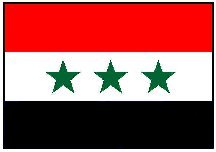
After the Qassim government was overthrown, a new flag was adopted in 1963. The new flag had three stripes, of red, white, and black, with three green stars in the white stripe. The green stars were originally placed there for the proposed, but never-consummated, union of Iraq with Egypt and Syria in the United Arab Republic. By 1961, however, the Union between Syria and Egypt had already fallen apart. |
| Page Top | Cyprus | Palestine Conflict | Iran-Iraqi War | Falkland Islands War | Gulf Wars | Balkan Wars |
| War on Terrorism | War on Piracy | Unrest in the Arab World |
Iran-Iraq War 1980-1988
Ba'ath Iraq
|
Iraqi National Flag 1991–2004
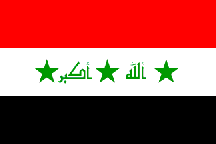
In 1991, the flag was changed again. The meaning of the three stars was changed from their original geographic meaning to representations of the three tenets of the Ba'ath party motto, Unity, Freedom, Socialism. Saddam Hussein decreed to place the Takbir, the words Allaahu Akbar "God is Great," between the stars. It is said (though unconfirmed) that the words on the flag were in Saddam's own handwriting. |
Persia State Flag
|
Imperial State of Persia Flag 1964-1980
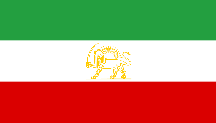
The Imperial State of Iran (Persia) was ruled by the Pahlavi dynasty (1925-1979) until the overthrow of Shah Mohammad Reza Pahlavi in the Iranian Revolution of 1979. With the overthrow of the Shah of Iran the rule of the country passed to the fanatical Ayatollah Khomeini, who was an Iranian politician, scholar and religious figure. |
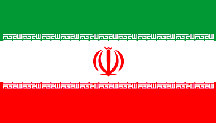
Iran
|
Islamic Republic of Iran Flag 1980-present
Following the 1979 revolution, Khomeini became the country's "Supreme Leader" until his death in 1989. Shortly after assuming power, Khomeini called for Islamic revolutions across the Muslim world, including Iran's Arab neighbor Iraq. Saddam Hussein, Iraq's Ba'athist leader, looking for an excuse to test his military and capture rich Iranian oil fields, eagerly accepted the Ayatollah's challenge, starting the eight-year-long Iran-Iraq War (1980-1988). Both sides would receive help from the East and West Superpowers who saw economic opportunities in the situation. |
| Page Top | Cyprus | Palestine Conflict | Iran-Iraqi War | Falkland Islands War | Gulf Wars | Balkan Wars |
| War on Terrorism | War on Piracy | Unrest in the Arab World |
Falkland Islands War 1982
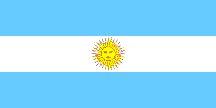
Ceremonial Argentina Flag
1818

Ornamental Argentina Flag 1812
|
Republic of Argentina National Flags 1812-present
The national flag of Argentina dates from 1812. It is a triband, composed of three equally wide horizontal bands coloured light blue, white and light blue. In 1818, a yellow Sun of May was added to the center. Since that time both flags have been used. The full flag featuring the sun is called the Ceremonial Flag and the flag without the sun is called the Ornamental Flag.
The armed forces took power in Argentina in a junta calling themselves the "National Reorganization Process" in 1976. The military government repressed opposition using harsh measures in what became known as the "Dirty War" during which thousands of people "disappeared."
By 1982, Argentina was in the midst of a devastating economic crisis and there was large-scale civil unrest against the repressive military junta. The junta hoped to use what became known as the "Falkland Island War" to solve their problems. |
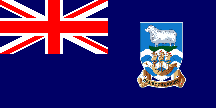
Falkland Islands
|
Falkland Islands Flag 1948-present
The United Kingdom designated this the flag of the Falkland Islands in 1948; following the traditional Blue Ensign design used for British colonies. The United Kingdom has claimed sovereignty over the Falkland Islands since 1833, but this was disputed by Argentina, a dispute which escalated in 1982 with Argentina's invasion of the islands. |
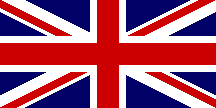
United Kingdom
|
United Kingdom Union Jack 1801-present
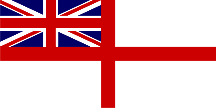
In April of 1982 a combined Argentine amphibious force invaded the Falkland Islands. Immediately, the United Kingdom severed diplomatic ties with Argentina, and began to assemble a task force to retake the Islands. The United Nations Security Council issued a resolution calling on Argentina to withdraw forces from the Islands and asked both parties to seek a diplomatic solution. |
UK Naval Ensign
|
United Kingdom Naval Ensign
On May 1, a British Task Force began offensive action against Argentina. After short but fierce naval and air engagements an amphibious landing was made at San Carlos Bay, and by June 14 the Argentine forces surrendered and control of the islands returned to the UK. |
| Page Top | Cyprus | Palestine Conflict | Iran-Iraqi War | Falkland Islands War | Gulf Wars | Balkan Wars |
| War on Terrorism | War on Piracy | Unrest in the Arab World |
The Persian Gulf Wars 1990-1991 and 2003
Kuwait
|
State of Kuwait Flag 1961-present
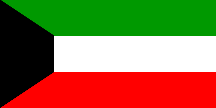
Kuwait is one of the richest oil producing countries in the world. The invasion of Kuwait in 1990 by neighboring Iraq would cause a major United Nations police action.
The flag of Kuwait was adopted on September 7, 1961. Before 1961, the flag of Kuwait, like those of other Gulf states, was red and white. It had a solid red field with the name of Kuwait written across it in large white Arabic script. The present flag is in the Pan-Arab colors.
|
Iraq
|
Iraqi National Flag 1991-2004
Saddam Hussein, Iraq's Ba'athist leader, with help from the United States and Russia, managed to build the fourth largest army in the world during the Iran-Iraq War, thus the stage was set for the Persian Gulf Wars.
In 1990, Iraq accused Kuwait of stealing Iraq's oil through slant drilling, and using this as an excuse, Saddam invaded Kuwait. |
United Nations
|
United Nations Coalition 1990-1991
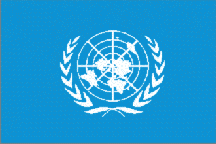
The invasion of Kuwait by Iraqi troops was met with immediate economic sanctions against Iraq by the UN Security Council, and with immediate preparation for war by the United States and the United Kingdom. The resulting First Gulf War (1990-1991), was a conflict between Iraq and a coalition force from 34 nations authorized by the United Nations, but led primarily by the United States and the United Kingdom, in order to return Kuwait to the control of the Emir of Kuwait. It was a decisive victory for the coalition forces, which took over Kuwait and entered Iraqi territory. Aerial and ground combat was confined to Iraq, Kuwait, and bordering areas of Saudi Arabia. Iraq also launched missiles against targets in Saudi Arabia and Israel in retaliation for their support of the invading forces in Kuwait. |
Saudi Arabia 1973
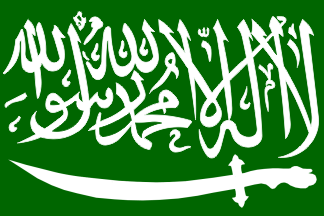
Saudi Arabia variant
|
Kingdom of Saudi Arabia
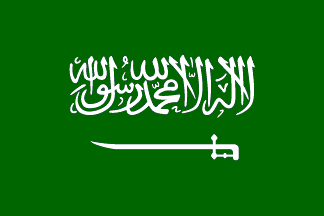
The Kingdom of Saudi Arabian provided a staging area for the United Nations coalition forces as they prepared for what would become known as the First Gulf War. This United Nations sanctioned effort using forces from more that 34 nations had two distingue stages known as Operation Desert Shield and Operation Desert Storm. Desert Storm was also split in two parts: The Air War and the Ground War.
One of the main concerns of the coalition forces was the significant threat Iraq posed to Saudi Arabia. After the conquest of Kuwait, the Iraqi army was in postion to strike the oil fields of Saudi Arabia. Because of this, the first stage was called Operation Desert Shield and composed of a massive military build-up in Saudi Arabia to stop such an invasion. US Army General Norman Schwarzkopf was designated to be the commander of the coalition forces in the Persian Gulf area. The second phase of the war called Operation Desert Storm started with an extensive and successful aerial bombing campaign. The last stage of the war was the ground war, and after just four days of fighting, Iraqi forces were expelled from Kuwait.
The basic design for the flag of the Kingdom of Saudi Arabia has been in use since 1932, but the current version was adopted in 1973. Prior to 1980, there was a variant that briefly saw some use and was reported. |
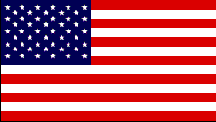
United States
United Kingdom
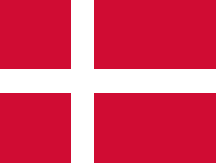
Denmark
|
Second Gulf War Coalition Forces 2003
The "Second Gulf War," or "Operation Iraqi Freedom," began in 2003 with the United States-led invasion of Iraq by a multinational coalition composed of United States and United Kingdom troops supported by smaller contingents from Australia, Denmark, Poland, and other nations. This was not, however, a United Nations sanctioned operation like the First Gulf War.
The invasion led to the quick defeat of the Iraqi military, the flight of President Saddam Hussein, his capture in December of 2003, and his execution in December of 2006. The U.S.-led coalition occupied Iraq and attempted to establish a new democratic government. But shortly after the initial invasion, violence against coalition forces and among various sectarian groups led to sporadic warfare, strife between many Sunni and Shia Iraqi groups, and fresh al-Qaeda operations in Iraq. This situation is still unresolved and continues...
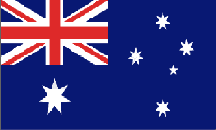
Australia |
|
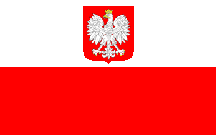
Poland |
|
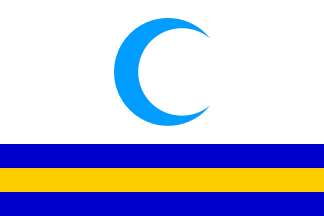
Proposed Iraqi Flag
|
Proposed Iraqi Flag 2004
This flag design was proposed by the Iraqi Governing Council (IGC) as a new Iraqi national flag in 2004, but proved too controversial and was abandoned. The flag was white, with parallel blue-yellow-blue bands across the bottom quarter or third; the blue bands represented the Tigris and the Euphrates rivers, and the yellow represented Iraq's Kurdish minority. In the middle of the white field was a large Islamic crescent which was, unusually, depicted in a shade of blue. Apparently the colors were too close to those of Israel and too much of a break from the traditional Arab colors. |
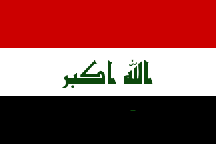
Republic of Iraq
|
Iraqi National Flag 2004–present
On this version of the flag of Iraq the text was changed from Saddam's alleged handwriting to traditional stylized Kufic script, and the red stars eliminated. It was to be a temporary design, because in July of 2008, the Iraqi parliament was to start a contest to design a new Iraqi flag; the contest was to have run until the end of September of 2008, then a committee was to pick the best three designs from which the Iraqi Parliament was to choose the winning design. With the countries current difficulties, it hasn't happened yet, and this flag remains the national flag. |
| Page Top | Cyprus | Palestine Conflict | Iran-Iraqi War | Falkland Islands War | Gulf Wars | Balkan Wars |
| War on Terrorism | War on Piracy | Unrest in the Arab World |
The Balkan Yugoslav Wars 1992-1995
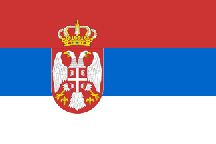
Serbia (Yugoslavia)
|
Republic of Serbia Flag 2006
In 1989, the League of Communists of Serbia selected Slobodan Miloševic to become the President of Serbia. By 1992, Slovene, Croatia, Macedonia, and Bosnia and Herzegovina had all declared independence from Yugoslavia, leaving only Montenegro and Serbia still calling themselves Yugoslavia. This resulted in the outbreak of incredibly brutal warfare as different national and religious groups clashed, especially in Bosnia and Herzegovina.
In 2003, Yugoslavia changed its name to Serbia and Montenegro; a new flag was anticipated, but never created because Montenegro declared itself independent in 2006. However, this new Serbian flag was adopted in August of 2004, featuring the traditional red-blue-white stripes with the Serbian royal arms near the hoist; the civil flag had the three stripes only. |
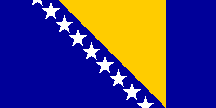
Bosnia and Herzegovina
|
Bosnia and Herzegovina National Flag 1998
The flag of Bosnia and Herzegovina contains the colors traditionally associated with Bosnia. The three points of the triangle are understood to stand for the three nationalities of Bosnia: Bosnian, Coat, and Serbs. It is also seen to represent the map of Bosnia which looks like a triangle. The stars, representing Europe, are meant to be infinite in number and thus they seem to continue beyond the edges of the flag at top and bottom. The flag features white, blue, and yellow colors because they are often associated with neutrality and peace.
Unfortunately, Bosnia/Herzegovina is home to three ethnic peoples and this precipitated a series of wars between the predominantly Muslim government and rebel Serbs (who wished to remain a part of Yugoslavia), rebel Coats (who wished to become a part of Croatia), and Bosnian government forces. In three years of war and bloodshed between 95,000 and 100,000 people were killed and more than 2 million left homeless. |
United Nations Flag
|
United Nations Safe Zones 1993-1995
In 1991, the United Nations (UN) stepped into the Bosnia and Herzegovina situation by imposing an arms embargo on Bosnia and Yugoslavia, who had been supplying arms and support for the fighting. In 1993, the UN also sent in peace keeping troops and set-up "safe areas" for refugees in several parts of Bosnia and Herzegovina. These United Nations safe areas were to be protected using "all necessary means, including the use of force." By 1995, the situation in the UN safe areas was deteriorating and after the Sarajevo Massacre, one of the worst atrocities in Europe since World War II, something different needed to happen. Ultimately, the continued attacks on the UN safe areas, as well as the continued Siege of Sarajevo, resulted in a North Atlantic Treaty Organization (NATO) intervention in Bosnia and Herzegovina named "Operation Deliberate Force."
Click here to learn more about the Organizational Flags of the United Nations and its various Agencies.
|
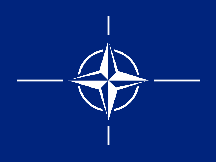
NATO Flag
To see all the NATO flags:
(click here) |
North Atlantic Treaty Organization Flag
The 1995, "Operation Deliberate Force," a sustained air campaign conducted by the North Atlantic Treaty Organization (NATO) in Bosnia and Herzegovina, was begun to undermine the military capability of the Bosnian Serb Army who threatened and attacked UN-designated "safe areas" in Bosnia. The bombing operation was carried out between August and September of 1995 involving 400 aircraft and 5000 personnel from 15 nations. This, along with international outrage at Serb war crimes and atrocities, helped turn the tide of war.
The signing of the Dayton Agreement in Paris in 1995 by the presidents of Bosnia and Herzegovina (Alias Izetbegovic), Croatia (Franjo Tudman), and Yugoslavia (Slobodan Miloševic) finally brought a halt to the fighting. The Hague War Crimes Tribunal would eventually charged Miloševic with crimes against humanity, violating the laws or customs of war, grave breaches of the Geneva Conventions and genocide for his role during the wars in Croatia, Bosnia, and Kosovo. |
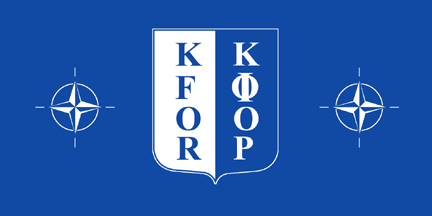
KFOR Flag 1999

KFOR Flag 2008-2009
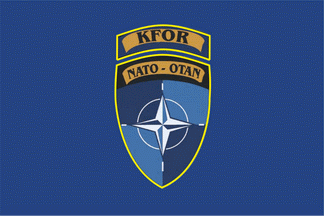
KFOR Flag 2009
|
KFOR mission in Kosovo 1999-current
The Kosovo Force (KFOR) is a NATO-led international force responsible for establishing a safe and secure environment in Kosovo, the self-proclaimed, independent and partially recognized landlocked country in the Balkans, which has been under United Nations administration since 1999. As of 2007, KFOR consisted of approximately 16,000 troops.
The KFOR troops entered Kosovo in 1999 under a United Nations mandate, because Kosovo was being invaded by military and paramilitary forces from the Federal Republic of Yugoslavia (FRY) and the Kosovo Liberation Army (KLA). Nearly one million people had fled Kosovo as refugees. According to some international organizations Kosovo has become a major destination country for women and young girls trafficked into forced prostitution. According to Amnesty International, most women trafficked into Kosovo from abroad are from Moldova, Romania, Bulgaria and Ukraine.
Regarding the flags, KFOR has always used the standard NATO flag (see above) outdoors at any NATO installation. Until the mid-2008, the KFOR flag with the two compasses could only be seen indoors in some offices. A slightly different KFOR flag was used the same way between 2008 and mid-2009. The two compasses were removed, and only the white-blue shield placed on it. The most recent version was put into use in 2009.
Although this newest flag is now the official KFOR flag, it is only used on ceremonial occasions, and is not hoisted on any permanent outdoor flagstaffs except in front of the KFOR Headquarters in Prishtina.
To see more NATO flags used on military missions click here |
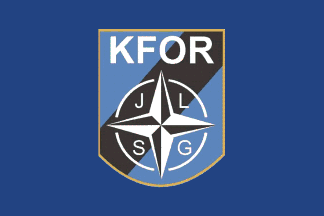
KFOR-JLSG Flag
|
KFOR Joint Logistics Support Group (KFOR-JLSG) 2010
The Joint Logistics Support Group (JLSG) is the newest KFOR unit and is going to establish a new position in the logistic support for KFOR. While in all areas adjustments to the KFOR structure are being prepared, the JLSG starts building up its logistics capabilities in and outside Kosovo. In KFOR the JLSG will bring new transportation units, an engineer unit, a Reception Staging and Onward Movement (RSOM) with the capabilities to support all the deployments and redeployments. KFOR-JLSG was established in January of 2010.
Its flag is blue with its emblem in the center of the flag. The emblem consists a yellow bordered blue shield with diagonal black stripe, white a compass rose, and JLSG letters around it. KFOR letters are placed on the upper part of the shield. The shield is similar to those of NRF, because it is part of this concept. |
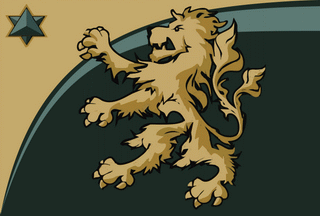
KSF Flag 2009
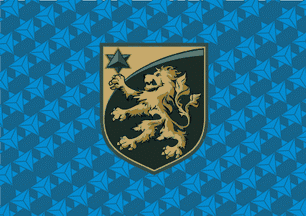
KSF Flag 2010
|
Kosovo Security Force Flags 2009
The Kosovo Security Force (KSF) is a new, professional, multi-ethnic, lightly armed and uniformed Security Force that is subject to democratic, civilian control. Although not officially a NATO organization, after the unilateral declaration of independence of Kosovo, the UCK was dissolved, and this new paramilitary force has been established.
The mission of the KSF is to conduct crisis response operations in Kosovo and abroad; civil protection operations within Kosovo; and to assist the civil authorities in responding to natural disasters and other emergencies. Such duties will include search and rescue operations; explosive ordnance disposal; the control and clearance of hazardous materials; fire-fighting; and other humanitarian assistance tasks.
The emblem of Kosovo Security Force is a dark blue and yellow shield with a rampant lion and a six-pointed star. The first flag of Kosovo Security Force (2009) was based on this emblem. The new flag of the Kosovo Security Force (2010) is also based on the same emblem, but places it inside a more tradition coat-of-arms, or shield. The new flag also features a blue field with an interesting dual slanted six-pointed star pattern placed upon it. |
| Page Top | Cyprus | Palestine Conflict | Iran-Iraqi War | Falkland Islands War | Gulf Wars | Balkan Wars |
| War on Terrorism | War on Piracy | Unrest in the Arab World |
War on Terrorism 2001
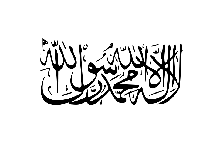
Taliban Afghanistan Flag
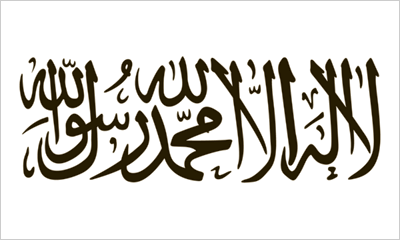
Flag of the Caliphate
|
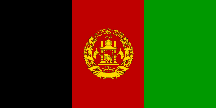
Islamic Emirate of Afghanistan 1997-2001
Between 1996-1997, a plain white flag was flown by the Taliban freedom fighters, but in 1997, the Taliban superimposed the "Shahadah" on to the plain white field. Their new flag was similar to the traditional State flag of the Khilafah (Caliphate), used by the early rulers of Islam, who followed the rule of the first four caliphs (Commanders of the Believers). The most common translation for the word "Khilafah," which appears in the Quran, is vicegerency (or caretaker).
In 1996, the Taliban freedom fighters overthrew the Afghanistan government. The violent fundamentalist Moslem group then provided a sanctuary for the al-Qaeda leaders and their terrorist training camps.
Following the September 11, 2001, attack on the World Trade Center in New York, American President George Bush declared a "War on Terrorism" and all those who support it. The United States launched "Operation Enduring Freedom," a military campaign to destroy the al-Qaeda terrorist training camps inside Afghanistan. In the process the US military helped to overthrow the Taliban government, who had refused to hand over Osama bin Laden and several al-Qaida members.
The US has since made a common cause with the former Afghan Mujahideen to achieve its ends. This includes the Northern Alliance, a militia still recognized by the UN as the official Afghan government. The US presence continues in Afghanistan, seeking a solution to the continuing Taliban efforts to forcibly regain control of the Afghan people. |
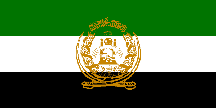
Afghan Northern Alliance Flag
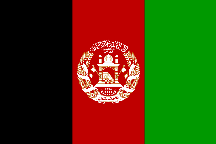
Afghanistan Flag 2004
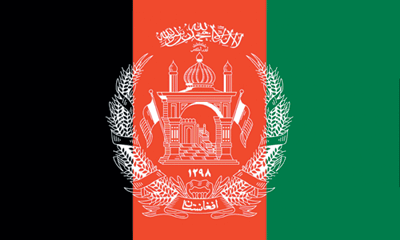
Afghanistan Flag 2006
|
Islamic State of Afghanistan 2004
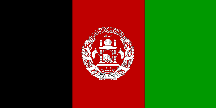
The flag of Afghanistan has gone through some minor design changes since the Taliban were removed. However, the basic flag of Afghanistan consists of three stripes of the colors black, red, and green. This has been present on most flags of Afghanistan in the last twenty years. The center emblem is the classical emblem of Afghanistan with a mosque with its mihrab facing Mecca.
|
|
|
Afghanistan Flag 2001-2002 |
|
Afghanistan Flag 2002-2004 |
The pre-Taliban era and Afghan Northern Alliance flag featured the same emblem, but with green, white and black horizontal stripes instead of vertical stripes.
The flag adopted in 2002-2004 is similar to the one flown in Afghanistan during the monarchy between 1930 and 1973. The difference is the addition of the shahadah at the top of the coat-of-arms in the center.
The newest flags were adopted in 2004 and 2006 and were similar to the previous flags, but with a different ratios. The words "The Islamic State of Afghanistan" was replaced with simply "Afghanistan," and the center crest enlarged to reach the black and green stripes on the latest variant.
|
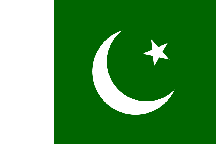
Pakistan War and State Flag
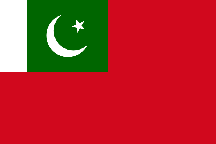
Pakistan Civil Flag
|
Islamic Republic of Pakistan 1947-present
The successful United States military campaign to destroy the al-Qaeda terrorist training camps inside Afghanistan resulted in the overthrow the Taliban government, but Osama bin Laden wasn't captured during the campaign. Intelligence specialist feel he is hiding in northern Pakistan and being protected by a 120-mile ring of tribesmen whose job it is to warn of the approach of any troops.
The national flag of Pakistan was designed by Syed Amir uddin Kedwaii and was based on the original flag of the Muslim League. It was adopted by the Constituent Assembly in 1947, just days before independence. The flag comprises a dark green field, representing the Muslim majority of Pakistan, with a vertical white stripe in the hoist, representing religious minorities. In the center is a white crescent moon, representing progress, and a white five-pointed star, representing light and knowledge. |
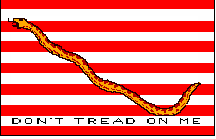
First Continental Navy Jack
|
"War on Terrorism" United States Navy Jack
This powerful American symbol hasn't been seen on the seven seas for almost 200 years, but is now being used again by U.S. Navy warships in the War on Terrorism. The so-called First Navy Jack was first shown in a painting of Commodore Hopkins, the First American Navy Commander-in-Chief, flying from the Ensign gaff (pole) of his ship. |
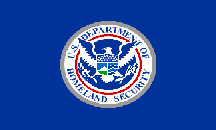
Homeland Security Flag
|
Department of Homeland Security Flag 2001
After the infamous Twin-Towers Terrorist attack of 9/11 the new U.S. Department of Homeland Security was started with vast powers to help track down terrorist living in the United States. Although its powers are controversial, it is a reality. This flag of the new department was unveiled without fanfare at a press conference in October of 2001. It is dark blue with a standard U.S. coat-of-arms design in the center disc. This is a normal design used for organizations within the Executive Office of the President. Upon the disc is the inscription: "Office of Homeland Security United States of America." Centered on the American eagle's breast is a shield divided into three sections containing elements that represent the sky, land, and sea. There are 22 stars in the sky portion of the shield representing the 22 law enforcement and security forces that have come together to form Homeland Security. |
| Page Top | Cyprus | Palestine Conflict | Iran-Iraqi War | Falkland Islands War | Gulf Wars | Balkan Wars |
| War on Terrorism | War on Piracy | Unrest in the Arab World |
International Naval War Against Somali Piracy 2005-2009
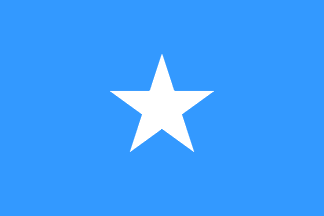
Somalia Flag
|
Republic of Somalia
Piracy off the Somali coast has been a threat to international shipping since the beginning of the Somali Civil War. Since 2005, many international organizations, including the International Maritime Organization and the World Food Program, have expressed concern over the rise in acts of piracy.
Piracy has contributed to an increase in shipping costs and impeded the delivery of food aid shipments. Ninety percent of the World Food Program's shipments arrive by sea, and ships have required a military escort. According to the Kenyan foreign minister, the Somali Falla have received over $150 million in ransom during the 12 months prior to November 2008
|
United Nations
|
United Nations
Clashes have been reported between Somalia's Islamite fighters (who are opposed to the Transitional Federal Government (TFG)) and the pirates. In August 2008, Combined Task Force 150, a multinational coalition task force, took on the role of fighting Somali piracy by establishing a Maritime Security Patrol Area (MSPA) within the Gulf of Aden.
The increasing threat posed by piracy also caused significant concerns in India since most of its shipping trade routes pass through the Gulf of Aden.
Click here to learn more about the Organizational Flags of the United Nations and its various Agencies.
|
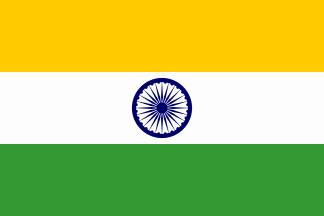
Republic of India
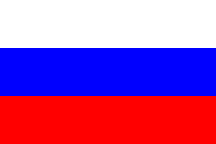
Republic of Russia
|
International Task Force 2008
On October 5, 2008, the United Nations Security Council adopted resolution 1838 calling on nations with vessels in the area to apply military force to repress the acts of piracy. At the 101st council of the International Maritime Organization, India called for a United Nations peace keeping force under unified command to tackle piracy off Somalia. There has been a general and complete arms embargo against Somalia since 1992. The Indian Navy responded to these concerns by deploying a warship in the region on October 23, 2008. In September 2008, Russia announced that it too will soon join international efforts to combat piracy.
In November 2008, Somali pirates began hijacking ships well outside the Gulf of Aden, perhaps targeting ships headed for the port of Mombasa, Kenya. The frequency and sophistication of the attacks also increased around this time, as did the size of vessels being targeted. Large cargo ships, oil and chemical tankers on international voyages became the new targets of choice for the Somali hijackers. Eventually 15 other nations joined in the efforts including: Canada, Denmark, France, Germany, Pakistan, United Kingdom, United States, Australia, Italy, Netherlands, New Zealand, Portugal, Singapore, Spain, and Turkey.
|
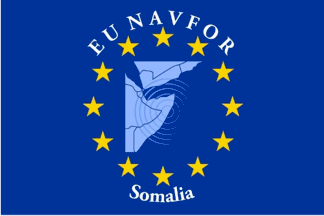
EU NAVFOR Flag
|
European Union Naval Force
Flag 2008
The European Union is now conducting a military operation to help deter, prevent and repress acts of piracy and armed robbery off the coast of Somalia. The European Union Forces are part of an international military organization consisting of forces of European Union countries with their own command structure.
This military operation, named European Union Naval Force Somalia – Operation ATALANTA, was launched in support of Resolutions 1814, 1816, 1838 and 1846 which were adopted in 2008 by the United Nations Security Council. Its mandate is to contribute to the protection of vessels of the World Food Programme (WFP) delivering food aid to displaced persons in Somalia; and the protection of vessels sailing in the Gulf of Aden and off the Somali coast. |
| Page Top | Cyprus | Palestine Conflict | Iran-Iraqi War | Falkland Islands War | Gulf Wars | Balkan Wars |
| War on Terrorism | War on Piracy | Unrest in the Arab World |
Unrest and Revolution in the Arab World 2011
(The Arab Spring, The Arabic Rebellions, and The Arab Revolutions)
Although this isn't one specific event, but rather a series of large political demonstrations and political protest that have resulted in governments being toppled in some places, harsh repressions in others, and revolutions that are changing the political face and character of the Arab World. They remind one of the year 1848 in Europe when a series of similar popular revolutions ended and modified the existing power structures of most of the nations of Europe.
Since December of 2010 there have been revolutions in Tunisia and Egypt; a civil war in Libya resulting in the fall of its regime; civil uprisings in Bahrain, Syria, and Yemen; major protests in Israel, Algeria, Iraq, Jordan, Morocco, and Oman, and smaller protests and demonstrations in Kuwait, Lebanon, Mauritania, Saudi Arabia, Sudan, and Western Sahara.
An interesting side effect of these protests have been the use of social electric media to organize, communicate, and raise an awareness that made it possible to sustain the resulting campaigns of strikes, demonstrations, marches and rallies.
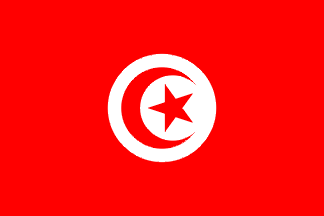
Tunisian Flag
|
Flag of Tunisia 1999-present
The whole the Arab Spring began with a series of increasingly violent street demonstrations starting in late 2010 against the 23 year regime of President Zine El Abidine Ben Ali. The demonstrations were caused by high unemployment, food inflation, governmental corruption, poor living conditions, and a lack of political freedom in Tunisia. There were scores of deaths and injuries, most of which were the result of action by police and security forces against demonstrators, eventually Ben Ali fled into exile in Saudi Arabia.
Following Ben Ali's departure, a state of emergency was declared and a coalition government under Prime Minister Mohamed Ghannouchi was created, which at first included members of Ben Ali's party, the Constitutional Democratic Rally (RCD), as well as opposition figures from other parties. Continued daily protests soon resulted in Ghannouchi, removing all former RCD members and finally Ghannouchi himself was forced to resign. In February of 2011, Beji Caid el Sebsi became Prime Minister, for how long is anybody's guess. |
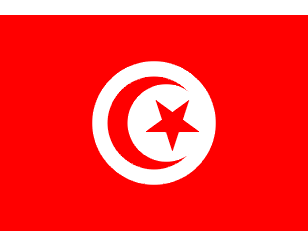
RCD Party Flag
(Unverified - Based on Party Logo)
|
Flag of The Constitutional Democratic Rally 1988-2011
The Constitutional Democratic Rally (RCD - Rassemblement Constitutionel Démocratique) was the governing party in Tunisia during the years that Zine El Abidine Ben Ali was President. The party held strong majorities in both the Chamber of Deputies and the Chamber of Councilors, though elections in Tunisia were widely regarded as rigged. This contributed to the series of violent street demonstrations which pressured President Zine El Abidine Ben Ali into relinquishing authority and fleeing Tunisia. After Ben Ali departure the incumbent president and prime minister both resigned from their memberships in the RCD, as did the remaining RCD-aligned ministers.
In February of 2011, Beji Caid el Sebsi took Mohamed Ghannouchi place as Prime Minister. Under his direction the Ministry of Interior banned all meetings and activities of the RCD party, and requested the courts to dissolve it. In March of 2011, the court in Tunis did outlaw the former ruling party and ordered the liquidation of all its assets and funds. The Central Committee of the party was also dissolved at this time.
|
Egyptian Flag
(sometimes defaced with slogans
and dates - especially "25 JAN")
|
Egyptian National Flag 1984-present
The Arab Spring protests in Egypt began in January of 2011 as tens of thousands protested on the streets of Egypt's major cities, despite government attempts to eliminate the nation's internet access, in order to inhibit the protesters' ability to organize through social media. As a result of the protest, eventually President Mubarak resigned, dismissed his government, and transferred power to the Armed Forces of Egypt. The military immediately dissolved the Egyptian Parliament, suspended the Constitution of Egypt, and promised to lift the nation's thirty-year "emergency laws." It further promised to hold free, open elections within the next six months, or by the end of the year at the latest.
A civilian, Essam Sharaf, was appointed as Prime Minister of Egypt in March of 2011 to widespread approval among Egyptians. Some protests have still continued in response to Sharaf and the Armed Forces' perceived sluggishness in instituting reforms, the result of which is still to be determined. |
Current Syrian Flag
(favored by the pro-Assad groups)
Syrian Flag of 1936
(favored by protesters & resistance)
|
Syrian National Flag 1980-present
In Syria, we see and example of violent and harsh repression by an entrenched government. Arab Spring protests in Syria also started in January of 2011 calling for political reforms and the reinstatement of civil rights, as well as an end to the "state of emergency" which has been in place since 1963. In March, the Syrian security forces arrested about 15 children for writing slogans against the regime, reportedly the children were tortured and started widespread protest against the Paathy regime, which has ruling Syria since 1963. Thousands of protestors gathered in Damascus, Aleppo, al-Hasakah, Daraa, Deir ez-Zor, and Hama with recently released politician Suhair Atassi becoming an unofficial spokesperson for the "Syrian revolution."
Since then there have been reports of thousands of arrests and some deaths, but no official figures have been determined. Protest continue as the government is responding with harsh security clamp downs and military operations in several districts, especially in the north. In July, Syrian army tanks stormed several cities, including Hama, Deir ez-Zour, Abu Kamal, Daraa, Medmah where at least 136 people were killed.
An old Syrian National flag (1936-1958, 1961-1963) has also reappeared. It has been seen on TV coverage of the demonstrations and in programs covering the Syrian situation in depth. This old flag has also been flown by Syrian families in exile, and although it has not "taken off" in the way that the pre-Ghaddafi flag did in Libya, it may be an indication of future developments. |
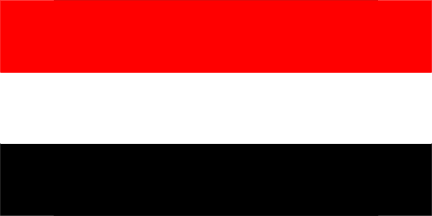
Libyan Flag 1969
|
Libyan Arab Republic Flag 1969-1972
To understand the future Arab Spring protests in Lybia, we must begin in the late 1960s. In 1969, a swift and bloodless coup toppled the Libyan monarchy and proclaimed the new Libyan Arab Republic. At that time thousands of Libyans took to the streets to demonstrate their support for the revolution. When the new cabinet was announced the 27 year old commander-in-chief of the armed
forces, Colonel Muammar Gaddafi, took the title of Prime Minister.
This new flag for Libya was adopted and consisted of three equal horizontal stripes of red (top), white, and black. At that time it was assumed that a green star would be added for each on the white stripe, similar to the flag of the United Arab Republic and other Arab states. However, this idea never materialized.
|
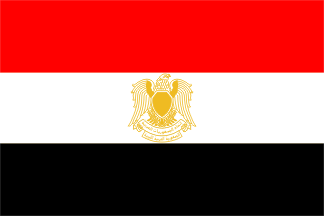
Libyan Flag 1972
|
Libyan National Flag 1972-1977
In 1971, the presidents of Egypt, Libya and Syria signed an agreement calling for uniting of their three nations into a single political unit. The new "Federation of Arab Republics" came into existence on the first day of 1972 and the new constitution called for a single flag for its three member states.
The flag consisted of the colors of the Arab Liberation Flag (red, white, black). In the center of the white stripe appeared the hawk of Quraish. The bird held in its talons a scroll with the words "Federation of Arab Republics" written in Arabic. Beneath the inscription was the name of the member country. In the case of Libya, this read "Libyan Arab Republic."
|

Libyan National Flag 1977
|
Libyan National Flag 1977-2011
Following a visit by the President of Egypt Anwar Sadat in
1977 to Israel, who had intentions of improving relations with that state and the Arab world, Libya withdrew from the federation in protest and subsequently, the "Federation of Arab Republics" ceased to exist. By this time Colonel Muammar Gaddafi was firmly entrenched as the dictator of the "Libyan Arab Republic" and his wishes were law.
Gaddafi named his Libya the "Socialist Libyan Arab Peoples Republic." and this simple green flag was adopted in 1977. According to Gaddafi, green became the national color of Libya, as well as its symbol of devotion to Islam. |
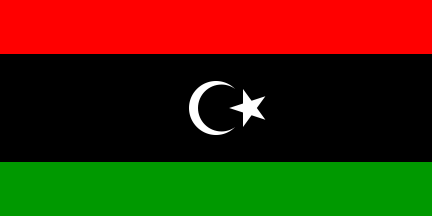
Libyan Flag 2011
|
Flag of the Libyan Revolution 1951-1969, 2011
In 2011, large violent Arab Spring demonstrations changed into outright armed revolution in Libya against the dictatorship of Muammar Gaddafi, and this traditional flag of revolution was seen more and more. Soon the Libyan rebels began receiving international support from the United States, United Kingdom, and various NATO nations as part of the western world's continuing "War Against Terrorism." It was widely recognized that Gaddafi's government had been supporting Terrorist training camps in Libya and these western powers would eventually provided key air support for the rebels.
The flag being most used by the rebels is the historic flag adopted by Libya on independence in 1951. The flag continued in use until the overthrow of the monarchy in the military coup of 1969. The stripes represent the three constituent provinces of Cyrenaique (black), Fezzan (red) and Tripolitania (green). |
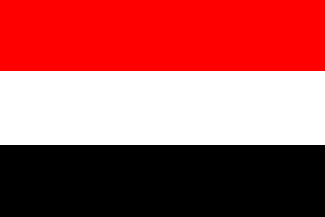
Yemeni Flag
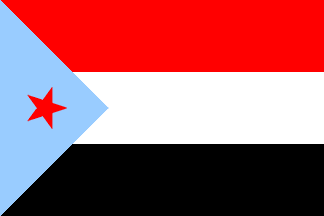
South Yemeni Flag
|
Republic of Yemen Flag 1990-present
Major Arab Spring protests started across Yemen in January of 2011 and have continued. Demonstrators initially protested against governmental attempts to modify the constitution to further entrench their power base, current unemployment and economic conditions, and plain governmental corruption, but these protest soon included a call for the resignation of President Ali Abdullah Saleh. In response to these protest, Ali Abdullah Saleh first stated that he would not seek another presidential term in 2013. However, protest continued, and many injuries and deaths were reported as attempts by riot police to stop the protesters intensified. Late in May, actual urban warfare between allied Hashid tribesmen and army defectors against the security forces and militias loyal to Saleh broke out.
To stop the violence, Saleh agreed to give up power in exchange for immunity, but a RPG attack in June left him and several other high-ranking Yemeni officials injured. Saleh was evacuated to Saudi Arabia for treatment, and handed over power to the Vice President Abd al-Rab Mansur al-Hadi. In late September, Yemeni state-television announced that Saleh had returned to the country after three months amid increasing turmoil in a week that saw increased gun battles on the streets of Sana'a and more than a 100 deaths. It is unclear whether Saleh will remain in power, but protests have continued and are still ongoing.
In the current Yemen demonstrations many of the protesters seem to prefer using the old South Yemen flag (1967-1990) also shown here.
|
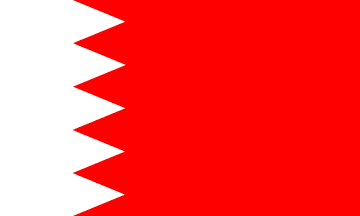
Bahraini Flag
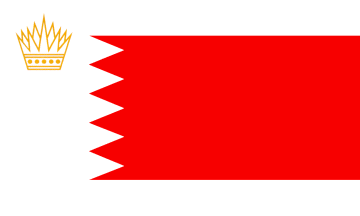
Bahraini Royal Standard
|
Flags of the Kingdom of Bahrain 2002-present
During the February 2011 Arab Spring protest government forces opened fire on both protesters and news journalists, and although the original protest were about achieving greater political freedom and respect for human rights, it soon was also aimed at the ruling royal family. The following months were filled with reported arrests, tortures, and deaths. Most of the protestors were from the Shia Islamic sect who make up the majority of Bahrainis, but are disproportionately represented by the Sunni royal-led government.
King Hamad bin Isa Al Khalifa declared a three-month state of emergency in March of 2011 and asked the military to reassert its control as clashes spread across the country. At his request, troops from Saudi Arabia and the United Arab Emirates, with the stated purpose of protecting essential facilities including oil and gas installations and financial institutions, entered Bahrain. Later thousands of Shia protesters arose in Iraq and Qatif in opposition to the Saudi-led intervention in Bahrain. Although in June the declared "state of emergency" ended, several large rallies were staged by the Shi'ite community demanding the release of detained protesters, greater political representation, and an end to sectarian discrimination. In June, Hasan Mushaima, Abdulhadi Khawaja, and several other opposition activists were sentenced to life in prison by a military court, and medical personnel were being prosecuted for treating injured protesters. Since then, several human rights groups and news organizations have alleged they have been deliberately targeted by the Bahraini government.
|
| Page Top | Cyprus | Palestine Conflict | Iran-Iraqi War | Falkland Islands War | Gulf Wars | Balkan Wars |
| War on Terrorism | War on Piracy |
|