Note: If an image ever fails to appear - refresh your page, it really is there
The Flags of NATO
(The North Atlantic Treaty Organization)
With the visible common threat of Soviet expansionism following World War II, the Western powers began the difficult job of overcoming the old attitudes between nations with different cultures, traditions, and political systems. Creating an effective defensive alliance in which these nations maintained their full individual sovereignty, but developed a coordinated international military force was not an easy one. However, the alliances of necessity formed during World War II did provide some common ground.
After a year of intense diplomatic consultations, the North Atlantic Treaty was signed on April 4, 1949, by the United States, Canada, Denmark, Iceland, Italy, Norway and Portugal. In 1952, Greece and Turkey joined NATO to bring the membership up to the number it would basically remain at for the next 50 years of the Cold War. It also divided the military responsibilities into five regional military groups: Northern Europe, Western Europe, Southern Europe-Western Mediterranean, Canada-United States, and the North Atlantic Ocean.
Fifty years later, with the end of the Cold War and the dissolution of the Warsaw Pact, NATO faced a strategic reevaluation of purpose, nature and tasks. This has resulted in a gradual (and still ongoing) expansion of NATO into Eastern Europe, as well as the extension of its activities into areas which had not been formerly of concern. Today, NATO is still active and has 28 member nations: Albania, Belgium, Bulgaria, Canada, Croatia, Czech Republic, Denmark, Estonia, France, Germany, Greece, Hungary, Iceland, Italy, Latvia, Lithuania, Luxembourg, The Netherlands, Norway, Poland, Portugal, Romania, Slovakia, Slovenia, Spain, Turkey, the United Kingdom, and the United States.
| Top of Page | Strategic Commands | Operational Commands | Component Commands | Other Commands |
| Military Missions | Rapid Deployable Corps | Military Centers | Centers of Excellence |
| NATO Signal Flags | Related Non-Military Flags |
NATO Strategic Commands
During the 2002 Prague Summit, NATO's military command structure was reorganized into a leaner, but meaner structure. The Strategic Command was focused on NATO's operations - Allied Command Operations (ACO/SHAPE).
Finally in 2003, the Alliance Defence Ministers approved another historic reform of NATO's command structure, the establishment of a new command, the Allied Command Transformation (ACT) headquartered in Norfolk, Virginia, and ACT commands the Joint Warfare Center (JWC) in Stavanger.
North Atlantic Treaty Organization
|
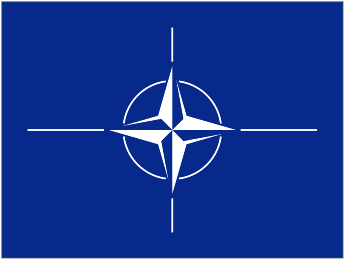
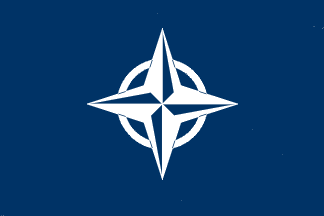
The North Atlantic Treaty Organization Flag (NATO) 1949 to present
The exact origin of the NATO emblem is unclear, although it is known that the basic design was conceived by a member of the International Staff. In 1953, the design of a white and blue compass on a dark blue background was officially approved for use at all NATO faculties and on all NATO documents, etc.
At the same time the flag of the North Atlantic Treaty Organization was determined to be a plain navy blue (Pantone 280) field charged with a white compass "rose" emblem from which radiates four white lines. It was officially endorsed and approved for use by all NATO Headquarters and operations on October 14, 1953. |
IMS Flag
|
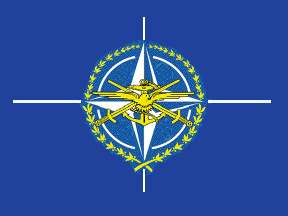
International Military Staff Flag
The International Military Staff (IMS) is the executive agency of the Military Committee. It provides staff support to the Military Committee and is responsible for the preparation of assessments, studies and other papers on NATO military matters. The IMS also ensures that decisions and policies on military matters are implemented by the appropriate NATO military bodies. The IMS provides the essential link between the political decision-making bodies of the Alliance and the NATO Strategic Military Commanders and their staffs.
It is headed by a General/Flag officer, selected by the Military Committee from candidates nominated by member nations for the position of Director of the International Military Staff (DIMS). The IMS, under his direction, is responsible for planning, assessing and recommending policy on military matters for consideration by the Military Committee, as well as ensuring that the policies and decisions of the Committee are implemented as directed. |
ACO HQ Flag
(formerly SHAPE)
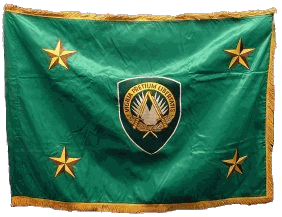
Supreme Allied Commander Europe
|
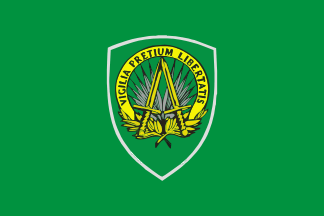
Allied Command Operations (ACO) Headquarters Flag
The Supreme Headquarters Allied Powers Europe (SHAPE) was formally activated near Paris in 1951. At that time there were only 14 to 15 divisions and fewer than 1,000 operational aircraft available to this command, which somehow was to deter aggression by the 210 Soviet divisions and their more than adequate air arm.
In the same year several major European subordinate commands were established: Allied Forces Southern Europe (AFSOUTH), Allied Forces Central Europe (AFCENT) and Allied Forces Northern Europe (AFNORTH). In 1952, after Greece and Turkey joined NATO, the membership would remain basically the same until the end of the Cold War in the 1990s.
Today, SHAPE has become the headquarters of Allied Command Operations (ACO). Allied Command Operations, formerly Allied Command Europe (ACE), is located near Mons, Belgium, and commanded by the SACEUR (Supreme Allied Commander Europe). It is responsible for all Alliance operations wherever required. In the NATO military structure ACO is only command with operational responsibilities at the strategic level.
Its commander, the SACEUR, is always an American Admiral or General, he leads all NATO military operations and is dual-hatted as Commander US European Command. |
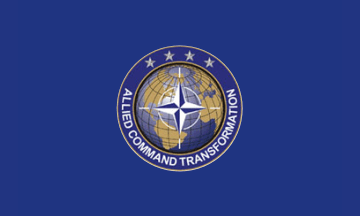
NATO ACT HQ Flag
|
Allied Command Transformation (ACT) Flag
Allied Command Transformation (ACT) is leading at the strategic command level the transformation of NATO's military structure, forces, capabilities and doctrine. It is enhancing training, particularly of commanders and staffs, conducting experiments to assess new concepts, and promoting inter-operability throughout the NATO. ACT was initially formed as Allied Command Atlantic (ACLANT) at Norfolk, Virginia, in 1952. During the 2002 Prague Summit, NATO's military command structure was reorganized. One Strategic Command was focused on NATO's operations - Allied Command Operations (ACO/SHAPE), and the other on transforming NATO - Allied Command Transformation (ACT).
HQ SACT locating in Norfolk, Virginia, USA is the only NATO command in North America and the only permanent NATO headquarters outside of Europe. Its commander, Supreme Allied Commander Transformation (SACT) is currently a French Admiral. This is the first time when a non-American admiral has been appointed to this position. Even he is the first European to be appointed permanently as head of a NATO strategic command. |
| Top of Page | Strategic Commands | Operational Commands | Component Commands | Other Commands |
| Military Missions | Rapid Deployable Corps | Military Centers | Centers of Excellence |
| NATO Signal Flags | Related Non-Military Flags |
NATO Operational Commands
(under subordination of strategic command ACO)
NATO military commands and some other organization also have flags. Almost all commands have their own flags (or banners), which have a great importance in all military units, and they have a special role during ceremonies held in occasions of changes of commanders. It is a subject of hand-over ceremony when former commander gives the flag into new commander's hand. It is a formal moment of transfer of his authority to new one.
All commands and other organizations have a badge or crest, generally it is placed on a monocolored (blue, white, or green) flag as a command's flag. .
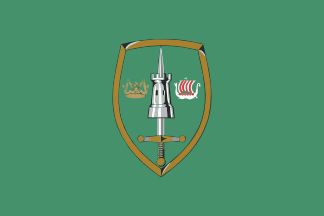
JFC Brunssum Flag
|
Allied Joint Force Command - Brunssum
(AJFCB) Flag
Allied Joint Force Command Brunssum (JFC Brunssum), is located in Brunssum, Limburg, the Netherlands. JFC Brunssum was built upon the former HQ Allied Forces Central Europe's (HQ AFCENT) infrastructure, which has been in use since 1967 and former RHQ AFNORTH. On July 1, 2004, Allied Forces North Europe (AFNORTH) ceased to exist, and became Joint Force Command (JFC)in subordination of Allied Command Operations (ACO). It has three component commands.
|
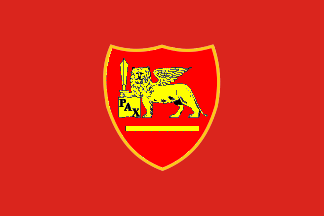
JFCN Flag
|
Joint Force Command - Naples (JFCN) Flag
The Allied Joint Force Command Naples (JFC Naples) is a NATO military command. It was activated in 2004, after what was effectively a redesignation of its predecessor command, Allied Forces Southern Europe (AFSOUTH), originally formed in 1951. The Commander of JFC Naples reports to the Supreme Allied Commander Europe at Supreme Headquarters Allied Powers Europe, Casteau, Belgium.
|
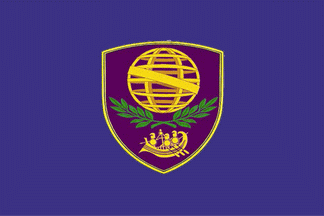
JFCL Flag
|
Joint Force Command - Lisbon (JFCL) Flag
The Joint Command Lisbon (JFCL) is one of the three main subdivisions of NATO's Allied Command Operations. It is based in Oeiras, near Lisbon, Portugal. In 2009, a French lieutenant general took command from the previous US Navy admiral who had filled the post for a number of years.
JFC Lisbon is currently responsible for providing assistance to the African Union, principally as regards airlift for the mission in Darfur; preparing staff to command the NATO Response Force; mounting a sea-based Combined Joint Task Force Headquarters; and support for cooperation and dialogue under the "Partnership for Peace and Mediterranean Dialogue" programs. |
| Top of Page | Strategic Commands | Operational Commands | Component Commands | Other Commands |
| Military Missions | Rapid Deployable Corps | Military Centers | Centers of Excellence |
| NATO Signal Flags | Related Non-Military Flags |
NATO Component Commands
(under subordination of operational commands)
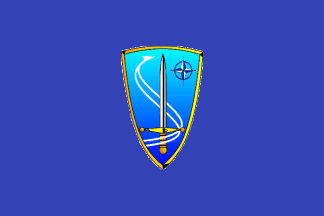
CC-Air Ramstein Flag
|
Allied Air Component Command - Ramstein (AACCR) Flag
The Allied Air Component Command Ramstein is a successor of Allied Air Forces Central Europe (AAFCE) which was originally established on June 28, 1974 at Ramstein Air Base, as a principal subordinate command under Allied Forces Central Europe (AFCENT). On 1 July 2004, the former HQ AIRNORTH was renamed Component Command-Air Headquarters Ramstein, Germany. It is a subordinate component command of Joint Force Command Brunssum.
|
CCLM Flag
|
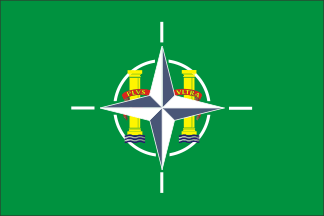
Allied Land Component Command - Madrid (CCLM) 2004-present
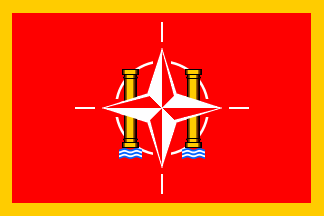
In 2004, the Component Command - Land Madrid was organized as a part of the Joint Force Command in Naples. Their new flag was similar to that of their predecessor, the Joint Command Southwest (JCSW), but its field is green (instead of red) with a slightly modified emblem in the center, and golden border of flag has been removed.
|
JCSW Flag
|
Joint Command Southwest (JCSW) Flag 1999-2004
This is the flag of Joint Command Southwest (JCSW) of NATO, located in Madrid between. Originally, it was activated in 1999, but it was transferred into the new military NATO structure in 2004 as Component Command - Land Madrid (see above).
|
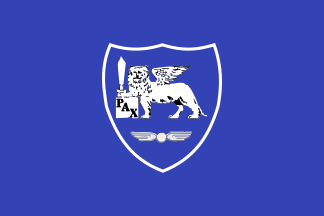
CCAI Flag
|
Allied Air Component Command - Izmir (CCAI) Flag
The main mission assigned to Allied Air Component Commander Izmir (CC-Air Izmir) is to be prepared to conduct the full range of air operations throughout the NATO Area of Operations (AOR) and beyond.
The Component Command Air – Izmir, Turkey was activated on 11 August 2004, inheriting the mission, the emblem and the traditions of Allied Air Forces Southern Europe, which was deactivated in Naples, Italy the day before. |
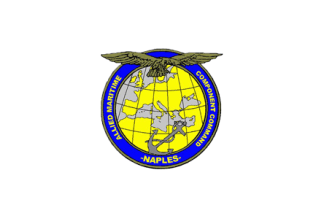
CC Mar Naples Flag
|
Allied Maritime Component Command - Naples (CC Mar Naples)
The Maritime Component Command Naples is one of the three Component Commands of Allied Joint Force Command Naples. The Commander of CC Mar Naples, also known as Mar-COM Naples is responsible for the oversight, planning, coordination and execution of all Maritime-related tasks.
The Headquarters, inaugurated in 2004, replaced the Headquarters Allied Naval Forces Southern Europe (HQ NAVSOUTH) which was established as a separate headquarters in 1967, upon dissolution of Headquarters Allied Forces Mediterranean, a major NATO Subordinate Command. It is situated on the Island of Nisida, Naples, Italy. Mar-COM NAPLES is an Italian three-star Admiral with an international staff provided by Bulgaria, Canada, Germany, Greece, Italy, the Netherlands, Norway, Poland, Portugal, Romania, Slovenia, Spain, Turkey, the United Kingdom and the United States. Albania and Israel are represented by liaison officers.
Since 2001, Mar-COM NAPLES has commanded Operation Active Endeavour, NATO’s maritime contribution to the fight against terrorism.
|
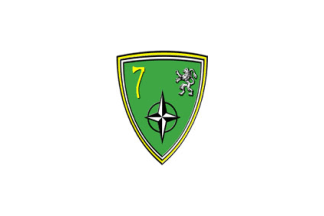
ALCC HQ HD Flag
|
Allied Land Component Command - Heidelberg (ALCC HQ HD)
Allied Land Component Command Headquarters Heidelberg (ALCC HQ HD) is a multinational NATO Headquarters with an established strength of more than 500 military personnel from 20 NATO nations and 3 Partnership for Peace (PfP) nations.
|
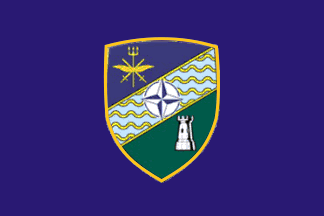
CCMN Flag
|
Allied Maritime Component Command - Northwood
Allied Maritime Component Command Headquarters Northwood is based at Northwood in the United Kingdom and provides specialist Maritime expertise to the Joint Force Commander in Brunssum, The Netherlands.
This command has three subordinate maritime groups that are permanently available to NATO to perform a wide range of tasks, from participating in exercises to crisis response and real world operational missions. They are the Standing NATO Mine Countermeasures Group 1 (SNMCMG1), the Standing NATO Maritime Group 1 (SNMG1), and the Standing NATO Maritime Group 2 (SNMG2).
|
| Top of Page | Strategic Commands | Operational Commands | Component Commands | Other Commands |
| Military Missions | Rapid Deployable Corps | Military Centers | Centers of Excellence |
| NATO Signal Flags | Related Non-Military Flags |
Other NATO Staffs and Commands
(Responsible to SACEUR)
These forces and commands provide NATO with a continuous military presence and are a constant and visible reminder of the solidarity and cohesiveness of the Alliance. They are an immediately available deterrent force and make an important contribution to the Alliance's operational capabilities.
There are two Maritime Immediate Reaction Forces operating in ACE. The Standing Naval Force Mediterranean (STANAVFORMED) consists of destroyer or escort ships and provides the core of SACEUR's multinational maritime force in periods of tension or crisis. A Standing Naval Force for mine countermeasures (STANAVFORCHAN), consisting of minehunters and minesweepers, operates primarily in the AFNORTHWEST area and provides NATO with a continuous mine countermeasures capacity. Both are under the operational command of SACEUR. They can be deployed NATO-wide, when required.
Several other land-based multinational forces, including air support, are also maintained that can be quickly despatched to any part of ACE's command area - from North Norway, to Germany, to eastern Turkey - to demonstrate the solidarity of the alliance and its ability to resist all forms of aggression against any member state.
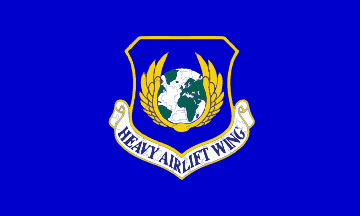
SAC HAW Flag
|
Strategic Airlift Capability - Heavy Airlift Wing (HAW)
The Heavy Airlift Wing (HAW) is the operational arm of the multinational Strategic Airlift Capability consortium (SAC). HAW operates a fleet of three C-17 Globemaster III long-range cargo jets and it is stationed in Pápa Air Base, Hungary. The Strategic Airlift Capability (SAC) consists of ten NATO nations Bulgaria, Estonia, Hungary, Lithuania, the Netherlands, Norway, Poland, Romania, Slovenia and the United States joined by two Partnership for Peace nations, Sweden and Finland.
This small specialized unit is composed of 131 personnel from the SAC participating nations. When HAW reaches full operational capability, it will be a combat-capable C-17 airlift unit designed to perform the full spectrum of airlift missions. The HAW´s core competencies will include for example air refueling, single ship airdrop, assault landings and all-weather operations day or night into low to medium threat environments. |
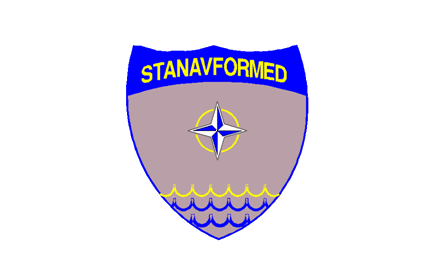
STANAVFORMED Crest
|
Standing Naval Forces Mediterranean - STANAVFORMED
NATO maintains standing maritime Immediate Reaction Forces in the Atlantic and the Mediterranean. The Standing Naval Force Mediterranean (STANAVFORMED) is organized and operates along similar lines to STANAVFORLANT, with destroyers and frigates provided by Germany, Greece, Italy, the Netherlands, Spain, Turkey, the United Kingdom, and the United States.
STANAVFORMED is an operationally ready NATO Immediate Reaction Force established in 1992, under the operational control of Commander Allied Naval Forces Southern Europe (COMNAVSOUTH). It typically consists of eight warships, normally destroyers and frigates, from the United States, the United Kingdom, the Netherlands, Germany, Greece, Italy, Turkey and Spain. Each nation has one ship continuously assigned to the force. They train and operate together as a collective unit under the commander, Allied Naval Forces Southern Europe. |
STANAVFORCHAN Flag
|
Standing Naval Forces - Channel (STANAVFORCHAN) Flag 1973-1998
It is composed of destroyers and frigates contributed by those nations operating naval forces in Allied Command Europe (ACE)
The Mine Countermeasures Force North Europe (MCMFORNORTH) replaced the Standing Naval Force Channel (STANAVFORCHAN) in 1998 and is composed of units primarily from countries in the Northern Region. The naval forces of other nations also join the force from time to time. MCMFORNORTH provides a continuous NATO Mine Countermeasures (MCM) capability, primarily for regional use. However, they are under the operational command of SACEUR and can be deployed NATO-wide, when required. |
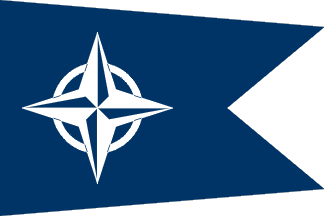
STANAVFORCHAN Flag
|
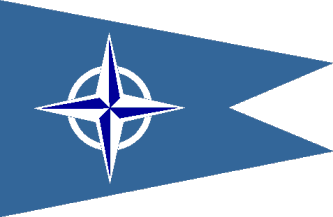
STANAVFORCHAN Commander's Pennant 1973-1998
This flag was used for the Commander of the Standing Naval Force Channel (STANAVFORCHAN).
|
STANAVFORCHAN Flag
|
STANAVFORCHAN Commander's Pennant (Dutch) 1973-1998
The Netherlands navy uses a similar flag, but with two shades of blue. According to Dutch navy regulations (VVKM 19 bijlage O, p.65), this is the commander ensign of STANAVFORLANT or STANAVFORCHAN.
|
STRIKFORNATO Flag
|
Naval Striking and Support Forces - Naples (STRIKFORNATO) Flag
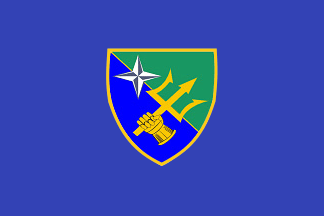
Naval Striking and Support Forces NATO (STRIKFORNATO) is a maritime formation, its headquarters is located in Naples. This command originally was established in 1953 as a Principle Subordinate Command under CINCSOUTH.
The Naval Striking and Support Forces' mission is to conduct maritime striking and multi-national amphibious/expeditionary operations to deter aggression against NATO, promote inter/intra-regional stability, participate in multi-national military crisis management and plan/execute command and control for expanded NATO missions.
The Commander was also the Commander of the U.S. SIXTH FLEET, a dual assignment that continues to this day. This force is subordinated directly to SACEUR. |
STANAVFORLANT Crest
|
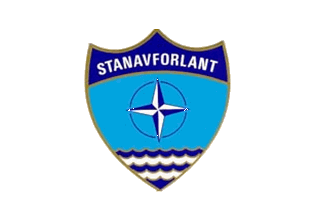
Standing Naval Force Atlantic - STANAVFORLANT
NATO's Standing Naval Force Atlantic (STANAVFORLANT) is the world's first permanent peacetime multinational naval squadron. STANAVFORLANT was established in January 1968. Flying the NATO flag continuously for over 30 years, some 150,000 men and women have served aboard 600 STANAVFORLANT ships. Each year the Force steams more than 50,000 miles, participating in a series of scheduled NATO and national exercises and making goodwill visits.
Under the Supreme Allied Commander, Atlantic (SACLANT), headquartered in Norfolk, Virginia, USA, it is an immediately available reaction force which can rapidly respond to a crisis. |
Commodores's Flag
|
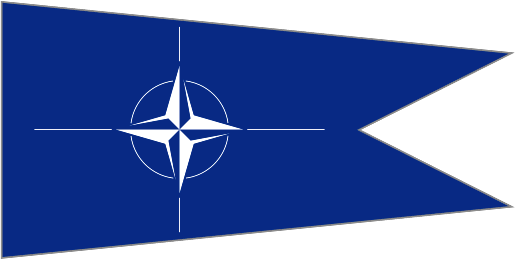
STANAVFORLANT Commodore's Flag
The Commanders of the Standing Naval Forces are naval officers from the participating nations, normally of the rank of Commodore in the case of the Standing Naval Force Mediterranean and the rank of Commander for the Standing Naval Force Channel.
|
No unique NATO flag image nor crest image is yet available for this NATO organization |
|
ACE Mobile Force - AMF - Heidelberg (Germany)
The Allied Command Europe Mobile Force - Land (ACE Mobile Force-Land or AMF-L) was a small NATO quick reaction force, headquartered at Heidelberg, Germany, active from 1960 to 2002. It formed part of Allied Command Europe, headquartered at SHAPE at Casteau, Belgium.
The AMF-L was intended as a multinational force that could be quickly despatched to any part of ACE's command area - from North Norway, to Germany, to eastern Turkey. During the Cold War the AMF-L did frequent exercises in North Norway (Exercises Adventure Express, Arctic Express & Ardent Ground, among others) and in other areas, but was first deployed operationally in 1991 during the Gulf War, when part of its air component was despatched to watch the Turkish borders, in the face of a potential threat to a member's territory. The land component of the force, consisting of a brigade-sized formation of about 5,000 personnel, was composed of units from 14 NATO states. |
No unique NATO flag image nor crest image is yet available for this NATO organization |
|
The Reaction Forces (Air) Staff - RF(A)S - Kalkar - (Germany)
The RF(A)S was created to facilitate detailed planning for Reaction Forces Air. The staff of approximately 80 personnel is located at Kalkar, Germany and is headed by a three-star German Air Force general as Director.
This Air staff is directly responsible to the NATO European Supreme Allied Commander (SACEUR) for planning the responses of his NATO reaction forces to sudden tactical and operational needs within the Supreme Headquarters Allied Powers Europe Headquarters. |
No unique NATO flag image nor crest image is yet available for this NATO organization |
|
NATO Airborne Early Warning Force (NAEWF)
The NATO Airborne Early Warning Force was established following a NATO Defence Planning Committee decision in 1978 to acquire a NATO-owned Airborne Early Warning air defence capability to provide air surveillance and command and control for all NATO commands.
The NAEWF is a fully operational, multinational force consisting of two components: the E-3A component, which comprises 18 NATO E-3A aircraft and operates from a Main Operating Base (MOB) at Geilenkirchen in Germany, and the E-3D component which consists of seven UK-owned and operated E-3D aircraft based at RAF Waddington in the United Kingdom. The NAEWF provides an air surveillance and early warning capability which greatly enhances effective command and control of NATO forces by enabling data to be transmitted directly from Airborne Warning and Control System (AWACS) aircraft to command and control Centers on land, sea or in the air. Each aircraft is equipped with sophisticated radar systems capable of detecting aircraft at great distances over large expanses of territory. |
| Top of Page | Strategic Commands | Operational Commands | Component Commands | Other Commands |
| Military Missions | Rapid Deployable Corps | Military Centers | Centers of Excellence |
| NATO Signal Flags | Related Non-Military Flags |
NATO Military Missions
(Past and present)
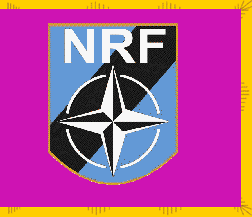
NRF Flag
|
NATO Response Force Flag
The new NATO Response Force (NRF) was formally inaugurated at Brunssum (the Netherlands) on 15 October 2003. The NRF is a tri-service rapid response force with contributions of Spain, France, Germany and U.S.A.
For the first time in its history, NATO will have a combined air, land, sea and special operations force under a single commander. The NRF colors were also presented. Purple field with the NRF logo in the center and a gold fringe all around except hoist. The NRF logo consist in NRF letters and the NATO star over a blue background and a black diagonal stripe. |
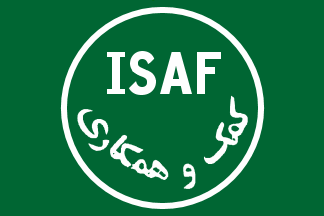
ISAF Flag (Type 1)

ISAF Flag (Type 2)
|
International Security Assistance Force in Afghanistan Flags 2001
These are the flags of the International Security Assistance Force, or ISAF, in Afghanistan. This force, also known as the International Security Assistance Force 10, is a multinational peace keeping force supervised by NATO. The ISAF is a NATO led security and development mission in Afghanistan established by the United Nations Security Council in 2001.
In 2003, NATO took command of the 5,000-strong international peace keeping force in the Afghan capital, a historic move that marks the alliance's first operation outside Europe since it was created 54 years ago.
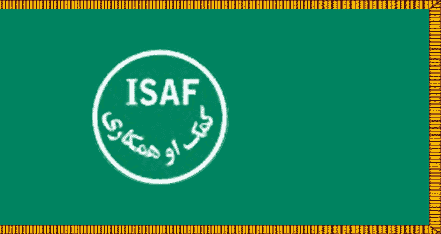 ISAF Flag (Type 2) In 2012, a new variant (Type #2) of the ISAF flag (A smaller green badge placed on a white field) was in use in Kabul, Afghanistan.
|
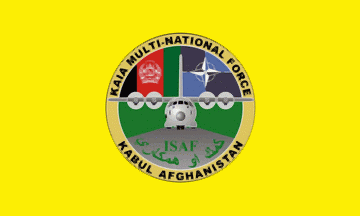
ISAF-KAIA Flag
|
Kabul International Airport (KAIA) Multinational Force 2010
The Kabul International Airport (KAIA) Multinational Force covers practically the full spectrum of tasks involved in the control and management of the Kabul airport, ranging from logistic tasks to EOD support and Force Protection duties. To illustrate the variety of their roles, on a most ordinary weekday, the volume of air traffic at KAIA is comparable to that of Ferihegy Airport, Budapest. Moreover, the Hungarian staff is also tasked with providing accommodation, catering and security on a daily basis for thousands of co-located units and guests in transit.
In September 2010, Hungarian military personnel took command of Kabul International Airport (KAIA) for the second time. The Kabul International Airport Multinational Force has an own flag, which is yellow with its emblem in the middle of the flag. |
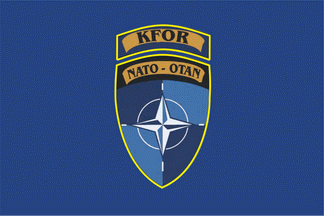
KFOR Flag 2009

KFOR Commander
This flag shows that the current Commander of KFOR is a three-star general. Naturally, this would change with any change of the rank of the KFOR Commander.
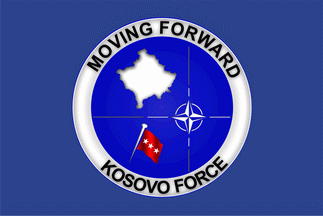
KFOR HQ Flag 2009
This HQ Flag also changes with any change of commander, as can be seen here
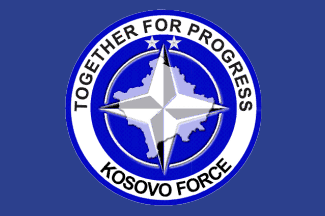
KFOR HQ Flag 2010
|
KFOR mission in Kosovo 1999-
The Kosovo Force (KFOR) is a NATO-led international force responsible for establishing a safe and secure environment in Kosovo, the self-proclaimed, independent and partially recognized landlocked country in the Balkans, which has been under United Nations administration since 1999. As of 2007, KFOR consisted of approximately 16,000 troops.
The KFOR troops entered Kosovo in 1999 under a United Nations mandate, because Kosovo was being invaded by military and paramilitary forces from the Federal Republic of Yugoslavia (FRY) and the Kosovo Liberation Army (KLA). Nearly one million people had fled Kosovo as refugees. According to some international organizations Kosovo has become a major destination country for women and young girls trafficked into forced prostitution. According to Amnesty International, most women trafficked into Kosovo from abroad are from Moldova, Romania, Bulgaria and Ukraine.
|
|
|
KFOR Flag 1999 |
|
KFOR Flag 2008-2009 |
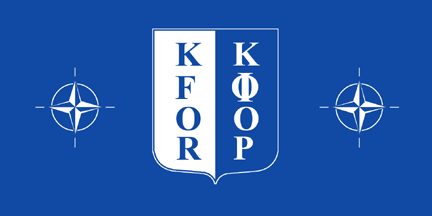
Regarding the flags, KFOR has always used the standard NATO flag outdoors at any NATO installation. Until the mid-2008, the one with the two compasses could only be seen indoors in some offices. A slightly different KFOR flag was used between 2008 and mid-2009. The two compasses were removed, and only the white-blue shield placed on it.
Interestingly enough, in 2007, KFOR had already adopted a new badge replacing the former one, but its use on a flag only began somewhere in mid-2009 replacing the previous flag. Since then this flag is the official KFOR flag, but is only used on ceremonial occasions, and is not hoisted on any permanent outdoor flagstaffs except in front of the KFOR Headquarters in Prishtina. Four flagpoles stand in front of the headquarter's building displaying in order, the UN flag, the KFOR flag, the HQ flag, and the Commander's three-star rank flag.
The Flag of the Headquarters of KFOR is blue with a large centered emblem representing the headquarters. In this case, it is a circle with a Kosovo map, an off-centered NATO compass, and a red flag, with three stars, representing the rank of the commander. The inscription around the disk is the current motto of KFOR "Moving Forward" and "Kosovo Force." The Crest of HQ Flag is modified with any change of KFOR commander, because it represents the actual commander of KFOR himself.
A new commander of KFOR was inaugurated in September of 2010. Next day a new HQ KFOR emblem was introduced and a new HQ KFOR flag was hoisted in front of the main building. It is blue (as previous one), but the new emblem is placed in the center of the flag. It shows Kosovo map, NATO compass, two-star (new commander is a German two-star general) and new motto for commanders mission |
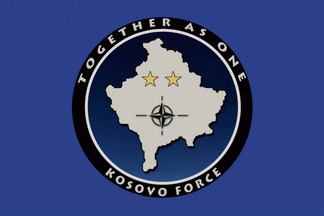
KFOR Flag
|
KFOR mission in Kosovo 2011
With the arrival of a new commander to KFOR also came the unveiling of a new KFOR HQ logo and flag. The new logo incorporates the motto "Together as One," which identifies KFOR's dedication to provide safety and security for all the people of Kosovo by close cooperation with local authorities and international organizations. The two stars represent the rank of the new COM KFOR commander, Major General Erhard Drews, and has the NATO symbol (the four pointed compass rose) symbolically embedded within the boundary of Kosovo.
The New logo was also placed on new flag of KFOR HQ, and has been used since September of 2011. |
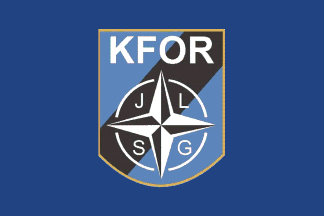
KFOR-JLSG Flag
|
KFOR Joint Logistics Support Group (KFOR-JLSG) 2010
The Joint Logistics Support Group (JLSG) is the newest KFOR unit and is going to establish a new position in the logistic support for KFOR. While in all areas adjustments to the KFOR structure are being prepared, the JLSG starts building up its logistics capabilities in and outside Kosovo. In KFOR the JLSG will bring new transportation units, an engineer unit, a Reception Staging and Onward Movement (RSOM) with the capabilities to support all the deployments and redeployments. KFOR-JLSG was established in January of 2010.
Its flag is blue with its emblem in the center of the flag. The emblem consists a yellow bordered blue shield with diagonal black stripe, white a compass rose, and JLSG letters around it. KFOR letters are placed on the upper part of the shield. The shield is similar to those of NRF, because it is part of this concept. |
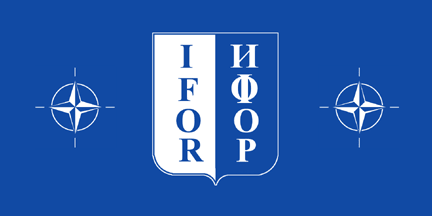
IFOR Flag
|
Implementation Force (IFOR) Mission in Bosnia 1995-1996
NATO troops (called Implementation Forces, with the task to implement the agreement) were part of the United Nations International Forces in Bosnia, deployed according to the Dayton agreement. This flag is interesting because both the dark blue (as in NATO flag), and light blue (as in UN flag) was used. In 1996, this flag with this emblem was reported being used, together with the UN flag and the national flags of the respective countries providing troops.
This mission was a predecessor of SFOR mission in Bosnia and Herzegovina. |
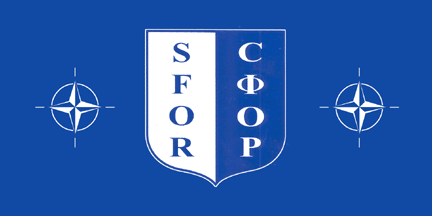
SFOR Flag
|
Stabilization Force (SFOR) - Bosnia and Herzegovina 1996-2004
The Stabilization Force (SFOR) was a NATO-led multinational peacekeeping force in Bosnia and Herzegovina which was tasked with upholding the Dayton Agreement. It replaced the previous force IFOR. The SFOR operated under the code names Operation Joint Guard (1996-1998) and Operation Joint Forge (1998-2004).
Troop levels were reduced to approximately 12,000 by the close of 2002, and to approximately 7,000 by the close of 2004. During NATO's 2004 Istanbul Summit the end of the SFOR mission was announced. |
| Top of Page | Strategic Commands | Operational Commands | Component Commands | Other Commands |
| Military Missions | Rapid Deployable Corps | Military Centers | Centers of Excellence |
| NATO Signal Flags | Related Non-Military Flags |
NATO Rapid Deployable Corps
(Past and Present)
The NATO Rapid Deployable Corps is a type of military organization within NATO, each capable of commanding about 60,000 troops and intended to be deployed rapidly within or outside Europe. Formed from October 2003, these are designated High Readiness Forces (HRF) to react on short notice, and are responsible to the Allied Command Operations (ACO) within the Supreme Headquarters Allied Powers Europe Headquarters. Although these forces can not deploy on five days warning like the NATO Response Force (NRF), they have a longer than 30 days sustainment capability in combat than the NRF.
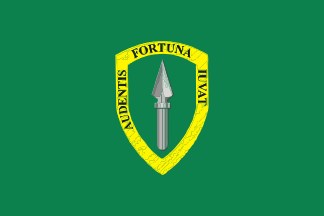
ARRC Flag
|
Allied Rapid Reaction Corps - Rheindalen (ARRC)
Allied Rapid Reaction Corps is a multinational NATO Headquarters, currently located in Rheindalen, Germany. But headquarters of ARRC and its intimate supporting elements are going to move to Innsworth, UK in the summer of 2010.
It is one of the NATO certified six High Readiness Forces. This Corps is a main element of NATO Rapid Reaction Forces (NRF), and it is subordinated directly to Allied Command Operations. The Corps is involved in ISAF mission in Afghanistan, and some elements were deployed in IFOR and KFOR missions in the Balkan and Corps had some duties in Iraq as well. |
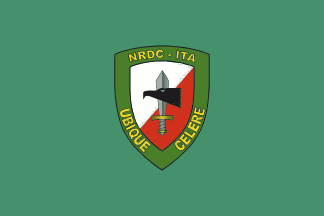
NRDC-ITA Flag
|
NATO Rapid Deployable Corps - Italy (NRDC-ITA)
NRDC-ITA is a multinational HQ based in Solbiate Olona (Varese Province), close to Milan, with Italy as the framework nation. It is one of NATO designated corps could be formed as a NRF formation. It is involved in ISAF mission in Afghanistan.
The sword is historically based on the one adopted by the CELERE Division during World War II. The eagle head represents the strength and the Headquarter´s ability to quickly deploy. The colors are the same adopted by the Projection Forces HQ. The shield is framed by another shield, which is green and carries the international acronym NRDC-ITA and the motto "CUBIQUE CELERE," which is the Latin for "everywhere rapidly." |
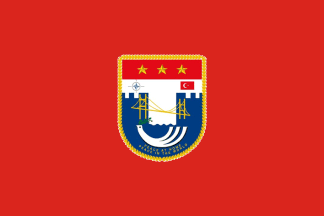
NRDC-T Flag
|
NATO Rapid Deployable Corps - Turkey (NRDC-T)
The NATO Rapid Deployable Corps - Turkey, is one of the NATO high readiness force HQ. It is to be prepared to deploy to an area of operation designated by SACEUR, and assume command of assigned units to conduct combined, joint military operations across NATO's entire mission spectrum including NRF and Combined Joint Operations (CJFLCC) in order to support crisis management options or sustain extant operations. It is located in Ayazaga, north from Istanbul.
|
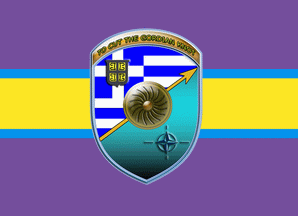
NDC-GR Flag
|
NATO Deployable Corps - Greece (NDC-GR) Flag
NATO Deployable Corps-Greece (NDC-GR) is one of the NATO certified Readiness Forces. The C Army Corps (parent HQ of NDC-GR) is a historic Hellenic Army formation. It was first established in 1913 in the city of Ioannina and in the same year moved its HQ to Thessaloniki. Since then it has successfully participated in all national campaigns, including World War I, World War II, etc. In recent times, C Corps units have participated in NATO, United Nations, and European Union peace operations in the Balkans.
Following the NATO Military Committee (MC) and the Niece's European Union summit decisions in November and December 2000 respectively, the Hellenic Army General Staff (HAGS) decided to offer the C Corps HQ as a Deployable Land Headquarters for Forces at Lower Readiness (FLRHQ), renamed NATO Deployable Corps (NDC-GR) HQ. |
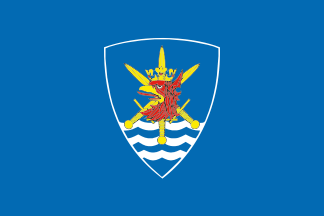
MNE HQ Flag
|
Multinational Corps Northeast - Szczecin (MNE HQ)
Multinational Corps Northeast was founded in 1999 in Szczecin, Poland. There were many factors that contributed to the establishment of a new NATO Corps and its headquarters in Poland. Apart from geographical and military reasons, the Corps was also to serve as a political symbol that would significantly accelerate the integration of the Armed Forces of Poland and other new partners into the multinational NATO structure, thus fostering the stability in Europe.
It became a NATO Graduated Readiness Forces (Land) in February 2006. |
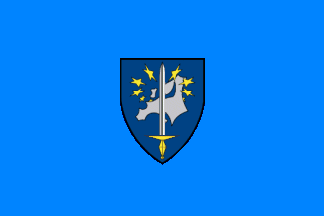
Eurocorps Flag
|
EUROCORPS HQ - Strasbourg (France)
Eurocorps is a multinational army corps within the framework of the Western European Union common defence initiatives. Eurocorps comprises approximately 1,000 soldiers stationed in Strasbourg and up to 60,000 troops pledged for deployment in EU or NATO rapid-response missions. The nucleus of the force is the Franco-German Brigade established in 1987. Headquartered in Strasbourg, France, the force was established in 1992 and declared operational in 1995, though it draws from European defence initiatives as far back as the 1960s.
Six countries participate in Eurocorps as "framework nations": Belgium, France, Germany, Luxembourg, Poland and Spain. A further seven countries have pledged troops or contribute operational staff: Austria, Greece, Italy, Romania, Turkey, and the USA. Most of these countries are members of the EU (with the exception of Turkey and the USA) and of NATO (with the exception of Austria). |
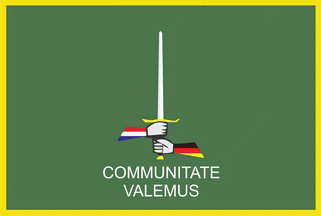
NRDC-G Flag
|
NATO Rapid Deployable German-Netherlands Corps - Münster
(NRDC-G)
The 1st German-Netherlands Corps is a multinational formation with 12 participating countries. The leading participants are the German and Dutch armies. The Corps headquarters, which developed partly out of the I Corps of the Bundeswehr, is located in Münster in North Rhine-Westphalia (Germany).
The Corps is one of the Rapidly Deployable Corps Headquarters of NATO's central command, Supreme Headquarters Allied Powers Europe. As such, the Corps is empowered to lead multinational missions such as ISAF. By rotation, the Corps also provides units to the NATO Response Force. The different national units are still operationally led by their countries, which for the German contingent means that it is led by the Heeresführungskommando.
The Corps crest consists of a sword held by two hands on an olive-green background, the color of the army. The sword symbolises the sovereignty of the states and the combat power of the Corps. The Latin motto "Communitate Valemus" means "together we are strong." |
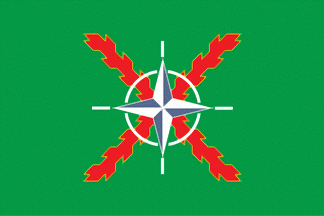
NRDC-SP Flag
|
NATO Rapid Deployable Spanish Corps - Valencia (NRDC-SP)
The Rapid Deployable Spanish Corps HQ based on the Spanish Corps HQ in Valencia (Spain), is kept in a high state of readiness and availability, one of the so-called High Readiness Forces (HRF) ready to react on short notice. The Spanish Rapid Deployable Corps is actually based in Bétera near to Valencia and was first activated at the beginning of the year 2000. The Full operational capability has achieved in November of 2002.
Its flag has a green field with a yellow-edged red Burgundy cross and a NATO compass, both in the center of the flag. The Corps crest is a blue shield charged with a red burgundy cross superimposed by the NATO compass. Under the shield, there is a yellow ribbon with abbreviation of this HQ. |
| Top of Page | Strategic Commands | Operational Commands | Component Commands | Other Commands |
| Military Missions | Rapid Deployable Corps | Military Centers | Centers of Excellence |
| NATO Signal Flags | Related Non-Military Flags |
NATO Military Centers
(Those under direct subordination of ACT)
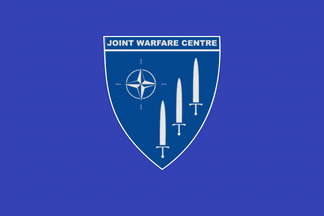
JWC Flag
|
Joint Warfare Center (JWC) - Stavanger (Norway)
The Headquarters Allied Forces North Europe was established in 1994 in the same location where Vikings defended themselves against aggressors hundreds of years earlier. Following numerous efforts to reshape NATO's command structure, in 2000, the Command was renamed the Joint Command North (JCN) to reflect its new role as a third level headquarters, subordinate to Allied Forces North Europe (AFNORTH) in Brunssum, the Netherlands.
In 2003, the Alliance Defence Ministers approved the establishment of the Allied Command Transformation (ACT) headquartered in Norfolk, Virginia, and in turn, the ACT commands the Joint Warfare Center (JWC) in Stavanger, Norway.
The Joint Warfare Center (JWC) is to promote and conduct NATO's joint and combined experimentation, analysis, and doctrine development to maximize transformational synergy and to improve NATO's capabilities and inter-operability. It assists Allied Command Transformation's developmental work on new technologies, modelling and simulation.
|
JFTC Flag
|
NATO Joint Force Training Center (JFTC) - Bydgoszcz (Poland)
The Joint Force Training Center (JFTC) is NATO's focal point for tactical level training and transformation. JFTC is part of Allied Command Transformation's (ACT) training network together with the Joint Warfare Center (JWC) in Norway and the Joint Analysis and Lessons Learned Center (JALLC) in Portugal.
Together with the two other Centers they are committed to providing the Alliance with up-to-date training support for exercises and preparation for live missions. They support the Alliance transformation through training, experimentation and doctrine development. It is located in Bydgoszcz, Poland. |
No unique NATO flag image nor crest image is yet available for this NATO organization |
|
NATO Maritime Interdiction Operational Training Center (NMIOTC) - Souda Naval Base (Crete)
The NATO Maritime Interdiction Operational Training Center was established in 2007 to lead the efforts of NATO to improve the Alliance's capability to conduct interdiction operations at sea. NMIOTC’s mission is: "To conduct the combined training necessary for NATO forces to better execute surface, sub-surface, aerial surveillance, and special operations activities in support of Maritime Interdiction Operations (MIO)"
The establishment of the NMIOTC was granted by the NATO Defense Ministers in 2003. The first staff members were posted to the NMIOTC Project Office in 2005. In NMIOTC there is a Command Group and three subordinate Directorates. The Command Group’s main role is to advance the operational level of the combined and joint training that is offered. The Education and Training Directorate has as a Head Officer, a Commander of the Hellenic Navy and its primary goal is to improve the ability of the ships' crew to perform Maritime Interdiction Operations. The Support Directorate is responsible to provide to the Commander throught the COS (Chief of Staff) planning, direction, coordination, integration and execution of Logistics, Personnel, Financial, Security and Host Nation activities. |
NURC Flag
|
NATO Undersea Research Center (NURC) - La Spezia (Italy)
The NATO Undersea Research Center (NURC), based in La Spezia, Italy, is a research organization under NATO's Allied Command Transformation, which is headquartered in Norfolk, Virginia. NURC conducts research and develops products to support NATO maritime operations and to support the continuous improvement of NATO military capabilities. Its focus is on the undersea domain and on solutions to maritime security problems. NURC maintains a strong reputation for bringing the best and brightest researchers together through rotational scientific staffing and through extensive partnering with NATO member nations. NURC also collaborates with other NATO organizations and with institutions from the 28 NATO member nations, such as universities and research centers.
NURC was formerly known as the SACLANT ASW Research Center from 1959 to 1986 and as the SACLANT Undersea Research Center from 1987 to 2003. The name change reflected a change in role, from a research center focused primarily on antisubmarine warfare (ASW) to a broadening emphasis on underwater research. NURC’s role continues to expand and evolve. New areas of research include the development of tools and processes to counter new threats in the maritime environment from rogue nations or radical individuals.
|
NATO School Flag
|
NATO School - Oberammergau (Germany)
The NATO School is located in Oberammergau, Germany. It is NATO's primary training and education Center on the operational level, the only one of its kind in the world. The school started with two courses in 1953 and now offers over 90 different courses to Alliance members and partners on subjects related to NATO's policies, strategies, missions and operations.
Allied Command Transformation (ACT) provides guidance for NATO School’s curriculum. A Board of Advisors consisting of members of ACT and Supreme Headquarters Allied Powers Europe(SHAPE) staffs provides assistance and guidance to the school. Since 1953, more than 162,000 officers, non-commissioned officers (NCOs) and civilians from all allied and national military commands within the NATO alliance have attended courses at the school.
|
JALLC Flag
|
The Joint Analysis and Lessons Learned Center (JALLC) - Monsanto (Portugal)
The Joint Analysis and Lessons Learned Center (JALLC) is NATO's lead agency for the analysis of operations, exercises, training and experiments, and for the collection and communication of lessons learned. JALLC deploys teams worldwide to support NATO, analysing all aspects of the Alliance's work at the operational and strategic levels. JALLC's base in Monsanto, near Lisbon in Portugal. It is a subordinated agency of Joint Warfare Center - JWC.
JALLC currently works with NATO's operations in Kosovo, Iraq and Afghanistan and on maritime security operations in the Mediterranean. They support NATO exercises for the NRF, and the training of troops prior to deployment on NATO operations. JALLC has also contributed analysis expertise during NATO's humanitarian relief efforts following the Pakistan earthquake in 2005, and security operations during the Olympic Games in Athens in 2004. |
| Top of Page | Strategic Commands | Operational Commands | Component Commands | Other Commands |
| Military Missions | Rapid Deployable Corps | Military Centers | Centers of Excellence |
| NATO Signal Flags | Related Non-Military Flags |
NATO Centers of Excellence
(Those not part of the NATO command structure.)
The NATO "Centres of Excellence" (CoEs) are nationally or multinationally sponsored educational programs, which trace their roots back to the reorganization of NATO´s military command structure following the Prague Summit in 2002. After the summit, the ACT (Atlantic Command Transformation) was made responsible for transforming NATO so that it would be able to face future challenges by enhancing training, testing new concepts, and promoting interoperability within the alliance members. In line with these goals, ACT has used its links with educational institutions to redirect this transformation. The Centers of Excellence are educational facilities in the Euro-Atlantic area recognized by NATO for their high-quality training, with ACT coordinating the relationship between the educational facilities and NATO. They are not offically part of the NATO military structure and their focus is providing more (intellectual) capabilities to NATO in the form of training programs, seminars, and so on. At present there are 18 recognized NATO "Centres of Excellence."
C2 Flag
|
Command and Control Centre of Excellence (C2) Ede, The Netherlands
The main focus of the Command and Control (C2) COE is improving joint and combined interoperability. It offers several seminars, workshops and conferences to transfer knowledge to NATO member countries and Supporting Nations. Other focus areas include assisting NATO exercises and assessment processes, supporting HQ SACT with policy, doctrine, strategy and concept development, providing C2 and NNEC training, investigating and authenticating C2-related NATO concepts through testing and simulation, and stabilizing and sustaining C2-focused relationships. In order to achieve its aims, C2 divides its responsibilities between several branches: the Operations Assessment Branch, the Analysis and Concepts Branch, the Expertise Management Branch and the Support Branch.
Founded by the Netherlands, C2 received NATO accreditation as a COE in 2008. In addition to the Netherlands, sponsoring nations include Belgium, Germany, Norway, Slovakia, Spain, Turkey and the United States.
It is located in Ede, the Netherlands. Its flag is white with its purple emblem in the middle of the flag. |
CCD Flag
|
Cooperative Cyber Defence Centre of Excellence (CCD) Tallinn, Estonia
A major cyber attack in Estonia that hit banks, the government, national ministries, the media, the police and emergency services in 2007 highlighted the importance of cyber security. To address this need, several countries came together to establish the Cooperative Cyber Defence (CCD) COE. Based in Tallinn, Estonia, CCD´s mission is to foster cooperation, capabilities and information sharing between NATO countries regarding cyber security.
Composed of experts from several NATO member countries, CCD also conducts research and training on several areas of cyber warfare. In particular, CCD focuses its research on four key areas: Legal and Policy, Concepts and Strategy, Tactical Environments and Critical Information Infrastructure Protection.
The founding nations of Estonia, Germany, Italy, Latvia, Lithuania, Slovakia and Spain came together to establish the CCD in 2008. In addition to the seven founding countries, Hungary is noe a sponsoring nation, and Turkey and the United States are in talks to become sponsoring nations in the near future. The CCD flag is white with its NATO-like emblem in the middle. |

CIMIC Flag
|
Civil-Military Cooperation Centre of Excellence (CIMIC) Enschede,
The Netherlands
The Civil-Military Cooperation (CIMIC) COE focuses on improving civil-military interaction and cooperation between NATO, sponsoring Nations and other military and civil groups. CIMIC offers basic courses on civilian-military cooperation, a course geared towards staff who work in civilian-military cooperation, training for liaison officers and a course for functional specialists. The CIMIC is available not only to NATO members, military and civil groups, but also to other international organizations, such as the European Union, non-governmental organizations and scientific institutions.
Founded by Denmark, Germany, the Netherlands and Poland, the CIMIC sought NATO accreditation as a COE and received it in 2007. Sponsoring Nations include all of the founding nations, plus Latvia, Slovenia and Hungary. Belgium is a contributing nation. It is located in Enschede, the Netherlands. Its flag is white with its logo in the center of the flag. |
DAT Flag
|
Defense Against Terrorism Centre of Excellence (DAT) Ankara, Turkey
The Defence Against Terrorism (DAT) COE provides subject matter expertise on how best to defend against terrorism. It also provides training on how best to counter terrorism, assists in the development of doctrine and helps improve NATO´s capabilities and interoperability. The Defence Against Terrorism school holds conferences, workshops, symposiums and advanced training courses relating to defence against terrorism.
Founded by Turkey received NATO COE accreditation in 2006. Sponsoring nations now include Bulgaria, Germany, Netherlands, Romania, Hungary, the United Kingdom and the United States. It is located in Ankara, Turkey, and the DAT flag is white with its blue disc emblem in the middle. |

EOD Flag
|
Explosive Ordinance Disposal Centre of Excellence (EOD) Trencín, Slovakia
The Explosive Ordinance Disposal (EOD) COE provides training and expertise in the field of explosive ordinance disposal for NATO and Partnership for Peace countries Like other COEs, EOD will also work with NATO in the areas of standardization, doctrine development and concepts validation. It will support NATO operations in the field of explosive ordinance disposal by improving interoperability and cooperation between NATO member countries, partner countries, international organizations and the NATO command structure.
Created in 2007 the Founding Nation of Slovakia signed a MOU with the Sponsoring Nations of the Czech Republic, France, Hungary, Poland, Romania and the United States on 5th May 2010. It is currently in the process of receiving NATO accreditation. It is located in Trencín, Slovakia. Its flag is white with its red disc emblem in the middle. |
JAPCC Flag
|
Joint Air Power Competence Center (JAPCC) Kalkar, Germany
The Joint Air Power Competence Centre (JAPCC) seeks to improve the space, land and maritime air power operations of the Alliance. JAPCC has several branches to help it achieve its goals, including Combat Air, Combat Support, Combat Service Support, Policy and Concept Development, Future Capabilities and Command, Control, Communications, Computers, Intelligence, Surveillance, Target Acquisition and Reconnaissance. It is also responsible for developing and maintaining relationships with external agencies and educational institutions that specialize in their field of expertise, in addition to giving advice regarding JAPCC support of NATO, Partnership for Peace (PfP), and European Union relationships.
JAPCC received COE accreditation in 2005. It has multinational support from Belgium, Canada, the Czech Republic, France, Germany, Greece, Hungary, Italy, the Netherlands, Norway, Poland, Portugal, Spain, Turkey, Romania, the United Kingdom and the United States. It is located in Kalkar, Germany, and uses a flag of light blue with its disc shaped emblem in the middle of the flag. |
JCBRN Flag
|
Joint Chemical, Biological, Radiation and Nuclear Defence
Center of Excellence (JCBRN) Vyskov, Czech Republic
The Joint Chemical, Biological, Radiation and Nuclear (JCBRN) Defence COE develops defence doctrines, standards and knowledge with the goal of improving interoperability and capabilities. It also provides education and training opportunities, assists and advises NATO, Supporting Nations and other international organizations and institutions in the area of CBRN defence. In addition to developing and circulating lessons learned, JCBRN also trains and certifies the CBRN Defence Task Force of the NATO Response Force.
It was founded by the Czech Republic, JCBRN Defence sought COE accreditation in 2006, which it received in 2007. Sponsoring nations include Germany, Greece, Italy, Hungary, Poland, Romania, Slovakia, Slovenia and the United Kingdom. It is located in Vyskov, Czech Republic, and its flag is light blue with its emblem in the middle of the flag. |
MILMED COE Flag
|
Military Medical Center of Excellence (MILMED) Budapest, Hungary
The Military Medical (MILMED) Center of Excellence purpose is to improve military medical practices through multinational interoperability and standardization. MILMED focuses on several areas of military medical practices, including medical training and evaluation, standards development and lessons learned in handling emergency medical treatment. To achieve these goals the Medical Center of Excellence not only gives medical courses, it also supplies the necessary certification process for mobile training teams of the sponsoring nations to aid in the certification process for deployable multinational medical units.
MILMED-COE was created in May 2009. Although based in one country, MILMED has several founding nations, including Hungary, the Czech Republic, Germany, Italy, the Netherlands and Romania. Its flag is white with its emblem in the middle of the flag. |
| Top of Page | Strategic Commands | Operational Commands | Component Commands | Other Commands |
| Military Missions | Rapid Deployable Corps | Military Centers | Centers of Excellence |
| NATO Signal Flags | Related Non-Military Flags |
NATO Flags (Non-Military)
(Organizations related to NATO, but not part of the official NATO military structure)
The North Atlantic Treaty Organization not only has its military structure, but also has some civilian organizations and agencies that not only support its activities, but help with the planning and managing of NATO itself.
NATO PA Flag
|
NATO Parliamentary Assembly
The NATO Parliamentary Assembly serves as the consultative inter-parliamentary organization for the North Atlantic Alliance. Bringing together legislators from all the member states of the Atlantic Alliance, the NATO PA provides a link between NATO and the parliaments of its member nations. It provides greater transparency of NATO policies, and fosters better understanding of the Alliance’s objectives and missions among legislators and citizens of the Alliance. The Assembly is institutionally separate from NATO, but serves as an essential link between NATO and the parliaments of the NATO nations.
The NATO PA consists of 257 delegates from the 28 NATO member countries. Delegates from 14 associate countries; the European Parliament; 4 regional partner and Mediterranean associate member countries; as well as parliamentary observers from 7 other countries and 3 inter-parliamentary assemblies also take part in its activities. It was founded in 1955.
Flag of NATO Parliamentary Assembly is white with its logo, combined the NATO star with a parliamentary hemicycle, the compass is embraced in a stylized, three-tiered chamber.
|
NACMA Flag
|
NATO Air Command and Control System Management Agency (NACMA)
NATO Air Command and Control System Management Agency (NACMA) is an independent NATO Agency whose principal task is to conduct the central planning, system engineering, implementation and configuration management for the NATO Air Command and Control System (ACCS) Program. The Program is intended to replace the existing air defence systems in NATO Europe, with a single system which, at the tactical level, will provide the capability to plan, task and execute defensive, offensive and support air operations.
The Agency employs upwards of 100 people from all NATO nations, the majority of whom have backgrounds in the following disciplines: software and systems engineering, operations, logistics, quality assurance, configuration management, communications, test and evaluation, information technology, information security, administration, human resources management and finance. NACMA currently occupies purpose-built accommodation close to NATO HQ. |
NCSA Flag
|
NATO Communication and Information Systems Services Agency (NCSA)
The NATO Communication and Information Systems Services Agency, (NCSA) is a service provider to its NATO and national customers. Wherever NATO deploys on operations or exercises, NCSA is there, providing communication and information systems (CIS) services in support of the mission. Equally important, NCSA supports NATO's ten major headquarters in Europe, North America, and Asia.
NCSA is part of the NATO Consultation, Command and Control Organization reporting to the North Atlantic Council. NCSA works very closely with the NATO Consultation, Command and Control Agency, whose mission is to provide NATO with scientific support and common funded acquisition of Consultation, Command, Control, Communications, Intelligence, Surveillance and Reconnaissance capabilities. |
NAMSA Flag
|
NATO Maintenance and Supply Agency (NAMSA)
NATO Maintenance and Supply Agency is NATO's principal logistics support management agency. It was established in 1958.
NAMSA's main task is to assist NATO nations by organizing common procurement and supply of spare parts and arranging maintenance and repair services necessary for the support of various weapon systems in their inventories. This assistance is available whenever two or more nations operate the same system and have made a conscious decision to use NAMSA's support facilities. |
NPC Flag
|
NATO Programming Center (NPC)
The NATO Programming Center (NPC) is responsible for system support and maintenance of NATO's Air Command and Control Systems. Amongst these systems is also the NATO Air Command and Control System ACCS.
Its mission is to provide efficient and effective system and advisory support to ensure maximum operational capability of the Air Command and Control (C2) assets entrusted to the NPC. In the past the NPC mission was limited to software maintenance of in-service NATO Air C2 systems, it was expanded in 2006 to permit provision of all activities required for system support for these systems. This includes the following areas: system engineering, obsolescence management, Commercial-off-the-Shelf (COTS) software management and technical training.
The center is located close to the city of Glons, Belgium. It employs nearly 200 people. It works closely with the NATO ACCS Management Agency NACMA for the ACCS Program and with NATO Maintenance and Support Agency NAMSA for the maintenance of various Air C2 buffer systems. |
EAPC Flag
|
Euro-Atlantic Partnership Council (EAPC) 2002
The Euro-Atlantic Partnership Council was a political, advisory, consultative body of NATO members and non-NATO countries that met in 2002 in Prague, where expansion of NATO was discussed.
The flag was designed by Janis Krievs from Latvia as part of an international competition. The flag was first seen on the BBC as President Bush addressed the NATO Prague Prague Summit attendants. |
- My thanks to Lt. Col. Zoltan Horvath for all his expert help, research, advise, and images used on this page -
| Top of Page |
|