Note: If an image ever fails to appear - refresh your page, it really is there
Flags of Britain and the United Kingdom - Page 1
Historical Flags 1189 to 1800
| Page #1 (c800-1800) | Page #2 (1800-1900) | Page #3 (1900-present) | English County Flags |
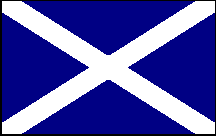
Cross of Saint Andrew |
The Cross of Saint Andrew (Scotland) c800
The flag of Scotland features a white X-shaped cross representing the Cross of Saint Andrew, the patron saint of Scotland, on a blue field. The flag of Scotland is one of the oldest flags in the world, traditionally dating back to the 9th Century, and is the oldest national flag still in modern use. The Scottish flag sometimes has different shades of blue.
Soldiers of King James VI of Scotland (House of Stuart) used this flag fighting the English soldiers of his cousin Queen Elizabeth I of England (House of Tudor) until her death in 1603. Lacking an heir when she died, ironically the English throne eventually passed to King James VI, who became King James I of England, thus uniting the two countries.
|
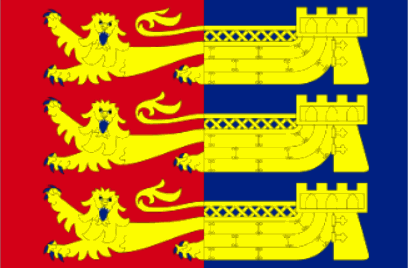
Cinque Ports c1155?
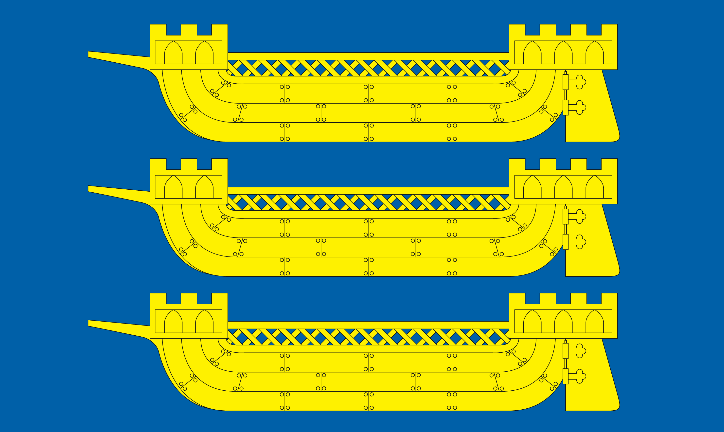
Cinque Ports 2017
|
The English Cinque Ports
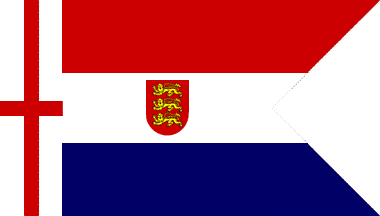
The Cinque Ports in East Sussex and Kent, bordering the narrowest part of the English Channel, were granted rights and privileges, and in return provided the king with ships for a limited period each year. The system began before the Norman Conquest, when individual ports were given various entitlements to compensate for annual ship-service, but it was not until the 13th century that the Cinque Ports became a corporate body, which also advised the king on maritime matters. The ports of Winchelsea and Rye, were included with the five original ports of Hastings, Romney, Hythe, Dover and Sandwich, at the end of the 12th century in 1191.
The original flag comprised the forequarters of three golden lions on red joined in the middle to the stern sections of three gold ships on blue. The "first use" dates can range between c1155-1297 and only relates to that of the forming of the Cinque Port's organization, not their flag, for which there seems to be no recognized date of actual first use. It appears, however, that this flag may be one of the oldest in use in early England based on the use of the royal Norman and Plantagenet-like lions in its design.
In 2017, a new Regional Flag of the English Cinque Ports, designed by Philip Tibbetts, was approved by the Admiralty. Since the modern Cinque Ports are now entirely ceremonial, the Royal Lions were removed from the modern design which shows the three full golden ships on blue symbolizing the Ports' maritime traditions and ancient ship's service.
|
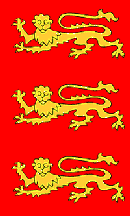
Plantagenet Coat of Arms |
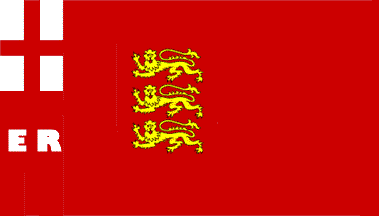
The Royal Standard of England 1189-1307
This standard was used during the reigns of Richard I (1189-1199), John (1199-1216),
Henry III (1216-1272), and Edward I (1272-1307). Prior to Richard the Lionhearted it is suggested that there was a Norman royal standard introduced by William the Conqueror (1066-1087) which had "two lions, passant gardant" for Normandy and England. Richard added a third lion for Aquitaine.
Richard I (House of Plantagenet) is a prime example of an overrated king. His fame mainly comes from the story of Robin Hood, a young man who fought against Prince John in order to save England while Richard is kept hostage in Germany. Actually Richard was a terrible and irresponsible king. He only spent six months of his ten-year reign in England doing his job. He joined the Third Crusade, departed for glory in the Holy Land in 1190, and basically never returned.
He actually failed in his attempt to capture Jerusalem in 1191. He returned to the coast, massacred a bunch of civilians, then when he realized he would never take Jerusalem, he worked out a deal with Saladin to allow Christian pilgrims to safely travel to visit the Holylands. After that he left for home, leaving the remaining Crusaders with only a fringe of coastline.
On his way home, Richard managed to get himself captured in Germany and his Brother Prince John then had to heavily tax the English people to ransom him. He finally returned to England, stayed for six months, then went off to France to wage another costly war, until he was killed in battle. For all this, he is remembered as "Richard the Lionhearted," and the "Good King Richard." Go figure...
|
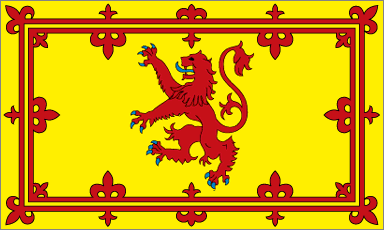
Banner of Arms of Scotland |
The Royal Standard of Scotland c1249
The first King of Scots known to have used this standard was Alexander III (1249-1286), who added the border, described in heraldry as the "double tressure flory counter-flory", to the standard of his father Alexander II (1214-1249). The introduction of lion as the royal emblem is usually attributed to William I (1143-1214), known as William the Lion, although there is no solid evidence for that. The standard in its final form was used by all the successive Kings until James VI inherited England and Ireland in 1603, when a new standard was introduced, combining the heraldic devices of all British kingdoms.
The original standard remained in use in Scotland, being flown over the royal residences while the Sovereign is not present (otherwise the combined standard is flown), as well as by several Great Officers of State, authorized to use it as the royal representatives, such as the Lord Lyon, in charge of the heraldic matters, or the First Minister of Scotland, as the Keeper of the Great Seal of Scotland. The use outside these restrictions is illegal and subject to legal persecution, but the Royal Warrant of 1934 authorized the use of hand-held flags as a mark of loyalty to the Sovereign, so they are freely used at the state events like the opening of the Scottish Parliament. The use at sporting events, although not originally specified, has also come to be considered as covered by this.
|
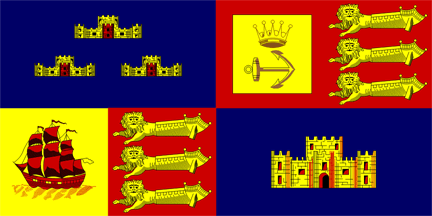
Standard of the Lord Warden
19th Century
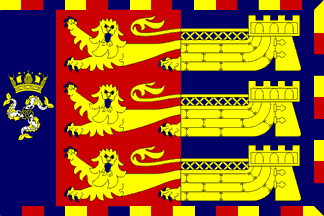
Standard of Lord Boyce
2005
|
Keeper of the Coast/Warden of the Cinque Ports
The title of Lord Warden of the Cinque Ports, originally called simply the "Keeper of the Coast", originated after the Cinque Ports sided with the Earl of Leicester against King Henry III in the Second Barons' War (1264-1267). The acknowledged leader of the barons' cause was Simon de Montfort, Earl of Leicester. The Royalist forces were led by Prince Edward (later Edward I of England), in the name of Henry III.
After the death of Leicester, the office of Lord Warden of the Cinque Ports was appointed by Edward to provide some central authority over the Cinque Ports. It was combined in 1267 with the office of Constable of Dover Castle, with powers to collect taxes for the monarchy. The Lord Warden also holds the office of Admiral of the Cinque Ports with a maritime jurisdiction extending to the middle of the English Channel. The Standard itself is almost certainly a 19th Century creation, since it has a fully-rigged sailing ship on its design.
In 1915, the Standard was described by W. G. Gordon, in his "Flags of the World", as "the most curious frolic in all heraldry", since the role of the Lord Warden of the Cinque Ports has become mainly an honorary title. It is often bestowed on members of the Royal Family, or in one case, a Prime Ministers who defended Britain in times of war. That Prime Minister was Winston Churchill, who was named Lord Warden from 1941 to 1965. Churchill additionally flew the Standard at Chartwell, his private residence, and on his car.
Today the Standard, is flown at Walmer Castle, the official residence of the Lord Warden. Admiral of the Fleet Lord Boyce is the present Lord Warden of the Cinque Ports, and in 2004, a new standard was approved for him.
|
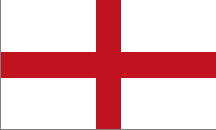
Cross of Saint George |
The Cross of Saint George (England) c1277
The idea of using a flag was first brought back to England by the returning Crusaders who saw red pennants with white crosses being used in Genoa. The legend that Richard the Lionhearted was the first to use the red cross of St. George is probably untrue. In fact, in Richard's time the English Crusaders wore white crosses, the French red, and the Flemings green. However, the Cross of St. George became one of the national emblems of England as early as 1277. In 1497, the St. George's Cross flag was flown by John and Sebastian Cabot on their voyages from England to explore Newfoundland and the North American continent, as well as by other English explorers including Sir Francis Drake, Sir Humphrey Gilbert, and Sir Walter Raleigh. This flag was used by English ships for over 400 years.
|
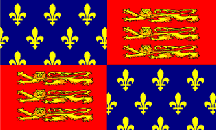
Royal Standard 1307
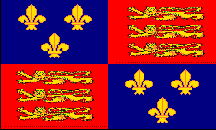
Royal Standard 1405 |
The Royal Standard of England 1307-1405
Royal Standards had the place now taken by national flags. This particular standard was used during the reigns of Edward II (1307-1327), Edward III (1327-1377), Richard II (1377-1399) and the first part of the reign of Henry IV (1399-1413). The first quarter of a flag, top left if the hoist is at the left, is the position of greatest importance. The French fleur-de-lis in the first quarter show that the Plantagenet Kings still thought that their claim to the throne of France was more significant than their occupation of the throne of England. In 1365, the fleur-de-lis on the French Royal Standard were changed from a "scatter" across the whole field, to a symmetrical arrangement of just three flowers. In 1405, Henry IV had the English Coat of Arms redesigned to reflect the change.
The Royal Standard of England 1405-1603
The Royal Standard of 1405-1603 was the same basic design, but used the new fleur-de-lis arrangement. It was used for the reigns of Henry IV (1399-1413), Henry V (1413-1422), Henry VI (1422-1471), Edward IV (1461-1483), Edward V (1483), Richard III (1483-1485), Henry VII (1485-1509), Henry VIII (1509-1547), Edward VI (1547-1553), Mary I (1553-1554), and Elizabeth I (1558-1603).
|
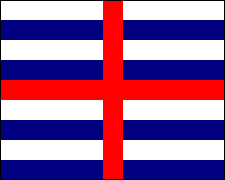
Without canton
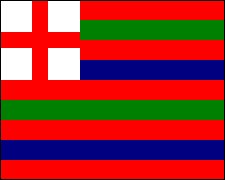
With canton
|
House of Tudor Ensigns 1485-1603
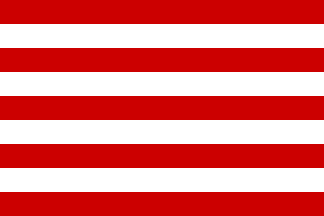
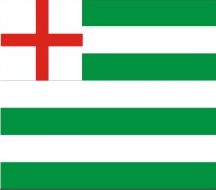
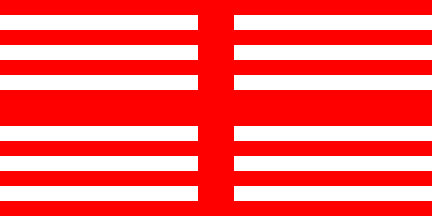
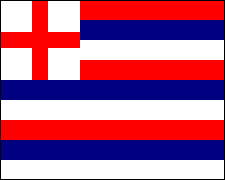
These five ensigns are typical examples of the ensigns that were used during the Tudor Period. The House of Tudor was a English royal dynasty that lasted 118 years and ruled between 1485 to 1603. The Tudors emerged from the Wars of the Roses as England's new rulers. The first Tudor to rule England was Henry VII (1485-1509). Born Henry Tudor, he married Elizabeth of York of the House of Plantagenet thus uniting the two families. He was followed on the throne by his son, the powerful Henry VIII (1509-1547), then Edward VI (1547-1553), Mary I (1553-1558), and finally the legendary Queen Elizabeth I (1558-1603). The Tudor's transformed the English navy into the most powerful naval force of its day.
|
|
|
A Tudor Ensign
number of stripes varied between 5-13 |
|
A Tudor Ensign
using the Tudor livery colors |
English naval ensigns did not begin to be standardized until shortly before the Civil War. Therefore, Tudor ensigns varied from ship to ship. Each was hand made and thus tended to be made in different materials and styles with no two exactly alike. They usually had horizontal stripes, in various colors, some with a canton, some without a canton, some with an overall Saint George's Cross, some with the Saint George's Cross in the canton, and some with no cross at all, just the stripes.
|
Muscovy Company Flag
|
Muscovy Trading Company 1555-c1917
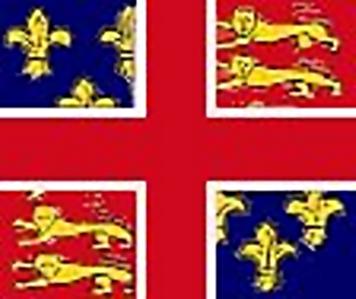
This flag of the Muscovy Trading Company, sometimes called the "Russian Company" or simply "Muscovy Company," is one of the oldest and most unusual British Trading Company houseflags. Queen Elizabeth I granted the Muscovy Company a charter in 1555 to trade with Russia, especially for furs and whaling, and allowed the English Company to use the St. George's Cross and the English arms on their flag. The Muscovy Company had this monopoly on trade between England and Muscovy until 1698, and it survived as a trading company until the Russian Revolution of 1917. Several well-known English explorers were associated with the company including Henry Hudson and William Baffin. Since 1917, a Russian offshoot of the company has operated as a charity within Russia.
The flag is very heraldic in origin and shows the French pattern of the royal standards, with the leopards/lions of England quartered with three fleur de lis of France, the whole is superimposed by the red centered cross of St. George fimbriated white. Rarely would a design featuring a Royal English Standard be defaced in this manner to cover the Royal Lions of England. This very obscure flag had probably gone out of use by the end of the 1600s, even though the Muscovy Trading Company lasted until the Russian Revolution of 1917. |
EEIC Ensign 1801
Type #1
EEIC Ensign 1820
Type #2
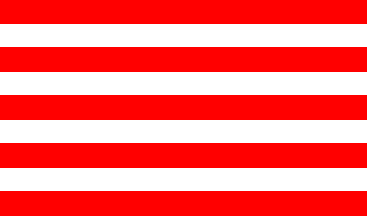
EEIC Jack early-1800s
Type #1
|
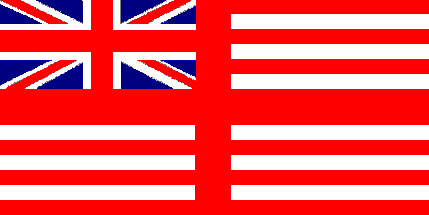
English East India Company 1600-1874
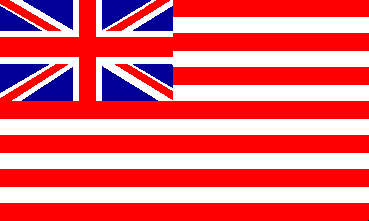
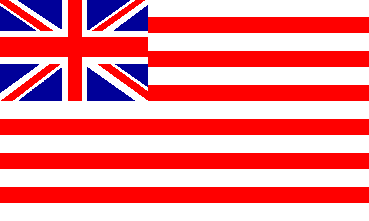
The English East India Company (EEIC) was originally chartered in London for trading in the East Indies. It was also referred to as either the Honorable East India Company or the British East India Company. It was first granted a Royal Charter by Queen Elizabeth in 1600. Shares of the company were owned by wealthy merchants and British noblemen. The Company ruled large areas of India with its own private armies between 1757-1858. The company traded mainly in cotton from the West Indies, and from the East - silk, indigo dye, salt, saltpeter, tea and opium. The company was dissolved in 1874 and its military and governmental functions taken over by the British Crown. The companies failure to control India and need for funding may have led in part to the American Revolution. (See British East India Company Flags c1678-1800 on the "Flags of the American Revolution Era" page to learn more of this.)
|
|
|
EEIC Jack - Type #2
mid-1860s |
|
EEIC Jack - Type #3
mid-1860s |
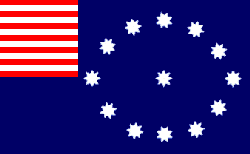
The flag of the EEIC began very much in the traditional Tudor Naval Ensign format with a red Saint George's Cross on white in the canton, and with red and white alternating strips in the field. These flags came with nine, ten, eleven and even thirteen stripes; with various cantons of varying size, since each was hand-made by the crews of the EEIC ships, and no clear instructions given by the company. (See examples of the earlier Tutor influenced EEIC flags on the "Early North American Colonies" page.)
When the House of Stuart gained the throne in 1603 the Cross of Saint George was replaced with the Union of the King's Colours and the EEIC flags reflected this change. In 1801, the cantons where once again changed to reflect the new Union design (Type #1 and #2), with the Union Jack in the ensign's canton updated with the Cross of St Patrick. Other interesting flags reported in limited use in India and China in the 1860s were the two EEIC Jacks (Types #2 and #3) used prior to 1874 by armed EEIC vessels. |
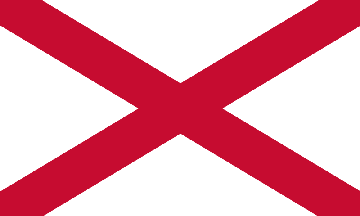
Irish Red Saltire flag
|
The Cross of Saint Patrick (Ireland) 1601
The earliest known use of the "Red Saltire" flag was at the Battle of Kinsale in 1601, fought against the English who carried the Cross of Saint George. It is interesting to note that the two "warring crosses" were destined to be united on the Union Jack 200 years later in 1801. |
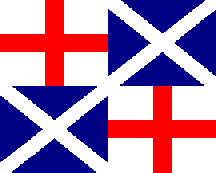
English Naval Ensign
|
The First Union Jack 1603-1606
James VI, became King of Scots in 1567, then in 1603 inherited the English and Irish thrones as James I of England, which he ruled until his death in 1625. This was an early version of the Union Jack in the years 1603 to 1606 just after James I became King of both England and Scotland. It probably saw little use before being replaced by the new
British Union Flag in 1606. However, there are reports it was temporarily used again in 1623, and also in 1659-1660, probably in short intervals between the fall of the Protectorate and the Restoration.
This was the first known English flag to combine together both the Cross of Saint Andrew of Scotland with the Cross of Saint George of England. |
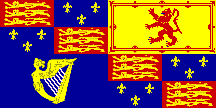
Royal Standard
1603, 1660, 1702
|
The Royal Standard of England 1603-1649, 1660-1689, 1702-1707
This version of the Royal Standard is sometimes called The "Union of the Crowns" Royal Standard because it united both the Kingdoms of England, Scotland, Wales and Ireland under one royal family. James VI, King of Scots, inherited the English and Irish thrones in 1603, and became James I. In honor of this they quartered the Royal Arms of England with those of Scotland on the Royal Coat of Arms, and for the first time, the Royal Coat of Arms of Ireland is added to represent the Kingdom of Ireland.
It was used during three different periods of time as indicated above. Because of the loss of the throne during the Civil Wars this Royal Standard was replaced in 1649, first by the Commonwealth Flag, and then by the Flag of the Protectorate. In 1660, Charles II restored the Royal Standard once he was recognized as the new king. It was changed once again during William and Mary's reign, but restored a third time in 1702.
|
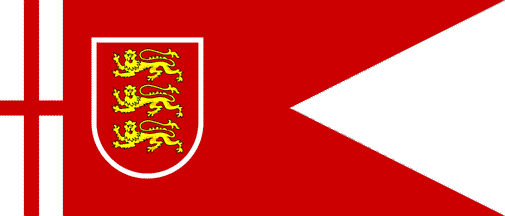
English People Type #1
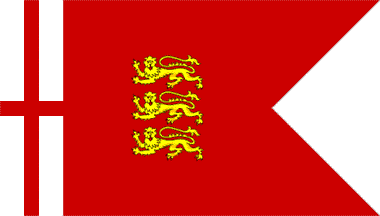
English People Type #2
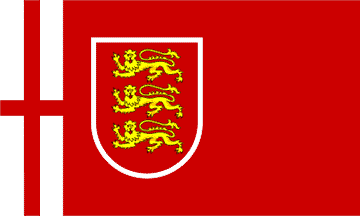
English People Type #3
|
Flags of the English People c1600-c1700
These flags have appeared in a number of continental publications during the 16th, 17th, and 18th centuries, but only in foreign publications, and never in any British publications. Therefore, it has been suggested that these flags were only decorative banners or "processional" parade route flags, perhaps put-up for such national events as the coronation of William and Mary in 1689.
|
|
|
English People Type #4
(only tri-color version reported) |
|
English People Type #5
(used on ship White Bear c1564) |
Whatever the original source of the information used for these various "Flags of the English People," they have been copied from one publication to the next, modified, and re-interpreted by various authors and publishers, based on previous claims.
The Dictionary of Vexillology, found on the "Flags of the World" website explains that a flag which is accepted as factual because of repeated usage, but has no real evidence of actual use or existence, is called Suppositious Flag. It could certainly be argued that such is the case of these so-called Flags of the English People. |

Red Squadron 1620-1707

Blue Squadron 1630-1707

White Squadron 1630-1702
|
Royal Navy Red-Blue-White Squadron Ensigns 1620-1707
The Royal Navy was organized into three squadrons, which flew either red, white or blue ensigns with a Saint George's cross canton. The oldest was the Red Ensign that had been a general flag from about 1620, even before the squadron system was introduced in 1630. In 1674, the Red Ensign was also approved as the merchant ensign. In 1701, an overall St George's cross was added to the white ensign to distinguish it from the French flag, which was mainly white. The "1606 Union Flag" replaced the "Saint George's Cross" in the canton in 1707, only to be replaced by the "Union Jack" in 1801. To avoid confusion, Nelson used the White Ensign for both the White and Blue Squadrons at Trafalgar in 1805, and in 1864 an Admiralty Order in Council ordered the Royal Navy to discontinue using the Red and Blue Ensigns completely, and made the White Ensign the only official Royal Navy ensign. ( Click here to see text of the Admiralty Order in Council )
Phases of transition of the Royal Navy Squadron Ensign after 1701
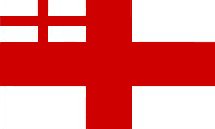 |
|
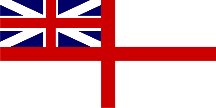 |
| White Squadron Ensign 1702-1707 |
|
White Squadron Ensign 1707-1801 |
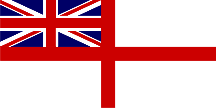
White Squadron Ensign 1801-1864
The only Royal Navy Ensign after 1864
|
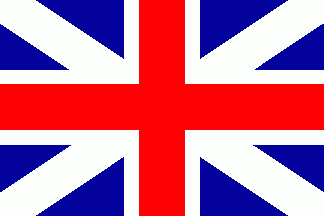
The "King's Colours" |
The British Union Flag 1606-1649, 1660-1801
With King James inheritance of the English throne in 1603, the Cross of Saint George was placed over the Scottish Cross of Saint Andrew to form the British Union Flag. Although the traditional St. George's Cross flag continued to be used as an English flag for some years, all seagoing ships began using the new Union flag (better known today as the Union Jack). It is also important to note here that the St. George's Cross flag might have been, in effect, the English national flag, but was not called a national flag. As noted flag scholar, W. G. Perrin, said in his British Flags (1922) "By the end of the sixteenth century...the flag of St George had taken the lead as the distinguishing characteristic of English ships, both men-of-war and merchantmen." This would change, however, with the introduction of the King's Colours.
In 1634, the Union Jack made the official ensign of the Royal Navy, and its use by merchant ships was forbidden. It's use was restricted to only the King's government and officials However, after 1707, the Union flag also became a de facto British national flag. In 1801, the St. Patrick’s Cross of Ireland was added to the Union Jack.
In British English, today the "King's Colours" are specifically colors presented to a regiment during the reign of a king. They were usually defaced with the regimental badge and the battle honors of the regiment. |
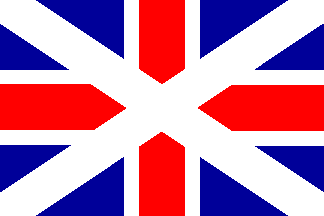
Union Jack (Scottish Type #1)
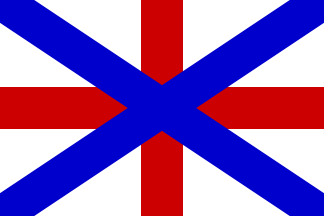
Union Jack (Scottish Type #2)
|
The Union Flag, Scottish variants 1606-1649, 1660-1801
Shortly after the Union flag was adopted, objections to its design appeared in Scotland and complaints were submitted to the King, requesting a new design, which would not place the English cross over that of Scotland.
While no accompanying images of an alternative proposal were saved, there is other contemporary evidence, written reports as well as images, that an unofficial flag was used with the cross of St Andrew placed over that of St George, at sea as well as on land. It was also one of the proposals for the flag of Great Britain which were presented to Queen Anne and her Privy Council in 1707, before the Acts of Union came into effect, to be rejected in favor of already used official flag.
Another variant seems to have been in use, with the Scottish saltire in blue superimposed over the red English cross on white field. It is shown on a ceiling boss from Linlithgow Palace, currently exhibited in the National Museum of Scotland, where it is depicted as being held by a unicorn, the supporter of the Scottish royal arms. The boss is dated c. 1617, not long after the original Union Jack was adopted, and clearly suggests that the Scottish variants of the flag, this one at least, might have had some official use, since this depiction of it comes from a royal palace.
|
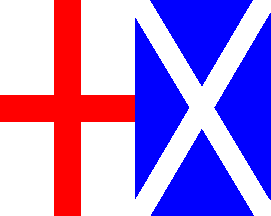
The Loyalist Flag and Jack |
The Loyalist Flag and Jack 1643-1660
In 1604, several proposals for the future Union Flag were submitted, combining English and Scottish charges in different ways. One of these displayed the crosses of England and Scotland "impaled" - side by side. It was recommended by Earl of Nottingham, who wrote that two flags were combined "like husband and wife" - that is, like the arms of a married couple after the wedding. Although the proposal did follow the rules of heraldry, it was rejected in favor of the flag of 1606, which applied the rules in a different way.
The rejected flag was not forgotten, though: in 1643, it appeared on the ships of forces loyal to the exiled King and remained in use until the Restoration in 1660.
|
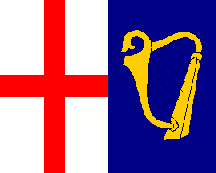
First Commonwealth Flag |
The Commonwealth Jack and Command Flag 1649-1658
This flag with the harp of Ireland and the red cross of England replaced the British Union Flag during during the Interregnum (1649 to 1660) when the royal coat of arms, along with monarchy, was removed from the English flag. After the English Civil War the Parliament had declared England to be a Commonwealth on May 19, 1649. The Union Jack was abolished in 1649 after the execution of Charles I, but would be revived as a flag solely for the King's ships in 1660 when the monarchy was restored. The Commonwealth of England had a republican government which ruled first England and Wales (1649-1653), then Ireland and Scotland (1653-1659). The government during 1653 to 1659 is properly called "The Protectorate," and was ruled by the Lord Protector, Oliver Cromwell, with dictatorial powers until his death. |
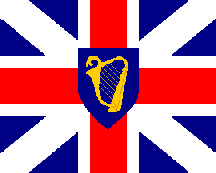
Second Commonwealth Flag
|
The Union Flag and Jack 1649-1660
The use of the Union Jack was abolished in 1649 after the execution of Charles I. This flag replaced it until 1660 and acted as the Union flag and Naval Jack. On April 4, 1660, Charles II accepted of the crown of England, the Commonwealth ceased to be, and the traditional "King's Colours" British Union Flag (see above) was once again used by the King's ships.
To clarify, it should be noted here that the Commonwealth, or Commonwealth of England, was the period of time between 1649 and 1653 when a republic was declared after the Second English Civil War and the execution of the English king. The Commonwealth was first ruled by the Rump Parliament, but after 1653 became essentially a dictatorship under Oliver Cromwell, who was declared Lord Protector of a united Commonwealth of England, Scotland and Ireland. This lasted until 1660 and the restoration of the monarchy and Charles II. |
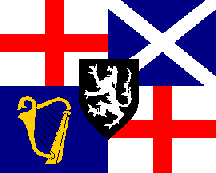
Cromwell's Personal Standard
|
The Flag of the Protectorate 1653-1659
This flag was used by Oliver Cromwell as his personal standard as Lord Protector. The top two quarters had a red cross on white background to represent England and a white saltire on a blue background to represent Scotland. The first quarter of the bottom two quarters was blue with a gold harp with silver strings to represent Ireland and in the final quarter another red cross on a white background representing Wales. A small shield in the middle of these quarters was black with a silver lion on it - the arms of Oliver Cromwell.
After Cromwell's death in 1658, it became officially known as the "Standard for the General of His Highnesse fleet." His son Richard became the new Lord Protector, but only ruled about a year until 1659. Richard Cromwell failed to win the support of the New Model Army and was replaced by a new Rump Parliament which negotiated a return of the monarchy. |
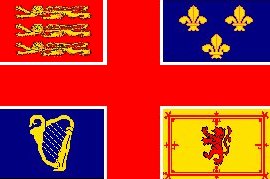
First Regiment of the
Royal Foot Guards of Ireland
(speculative design)
|
Royal Regiment of the Foot Guards of Ireland 1662
The Royal Regiment of the Foot Guards of Ireland, consisting of twelve companies, was formed in 1662 as one of the regiments of foot guards raised by King Charles II, shortly after the 1660 Restoration. Each company of the Foot Guards regiments had its own colors. When the system of company colors was abolished for the Army as a whole by the Royal Warrant of 1751, the Guards regiments were exempted. Uniquely, the 1st Regiment of Foot Guards also had a Royal Standard: described as crimson, charged with the crowned Royal Cypher, and with crowned royal badges in the corners. How this standard was used or looked is uncertain, but probably it was paraded only in the presence of the sovereign and never taken into battle. Since 1815, Regiments of Foot Guards have been known by such names as Grenadier Guards and Coldstreams.
According to Hayes-McCoy's interpretation the regimental colors of the Foot Guards of Ireland was "the royal colours of England, St George's cross, and the arms of the four kingdoms" as illustrated. It must be pointed out that this Hayes-McCoy's interpretation is rather suspect. All that can be said for sure is that the English Foot Guards all carried regimental colors which were defaced flags of St George. The older style, of Charles II's day, was red with a St. George the length of the hoist and a Royal badge in the fly. |
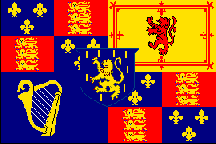
Royal Standard 1689
|
The Royal Standard of England 1689-1701
Between 1689-1702 William III and Mary II added a golden lion rampant on a blue shield to the center of this standard representing the royal house to which William belonged, but in 1702, Queen Anne returned it to the 1603 version. (see above)
Because this version of the Royal Standard was only used during William and Mary's reign, it is sometimes called "William and Mary's Standard." |
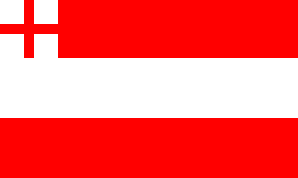
White Squadron Ensign
February-May 1702
|
Royal Navy White Squadron Ensign 1702
This obscure short-lived Naval ensign was the brain-child of the Earl of Pembroke (the Lord High Admiral in 1702) who sent the Navy Board instructions for its use with the fleet then being fitted out at Chatham and Portsmouth to operate against the French. His instructions were that the ships of the Admiral of the White were to wear "Ensignes with the usual Cross in the Canton, with this distinction: that a third part of the said Ensignes for himself and the Flaggs and private Ships of his Squadron are to be White in the middle of the Flye...and this to be in the whole length of the Ensigne."
This unusual ensign only saw brief use between February and May of 1702 before being replaced with the better known White Squadron Ensign 1702-1707. |
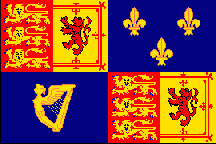
Royal Standard 1707
|
The Royal Standard of Great Britain 1707-1714
In 1707 the Acts of Union created the Kingdom of Great Britain (1707-1800). Queen Anne had the Royal Arms of England and Scotland "impaled" together and moved to the first and fourth quarters, France moved to the second quarter and Ireland to the third quarter.
Because this version of the Royal Standard was only used until Queen Anne's death in 1714 it is sometimes called "Queen Anne's Standard." |
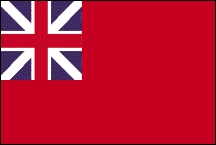
Queen Anne's Flag |
The British Red Ensign 1707
The British Red Ensign, also called the "Colonial Red Ensign" and the "Meteor" Flag, was adopted by Queen Anne (1702-1714) as the new flag for England and her colonies in 1707. The term "meteor" seems to imply the color red and originally comes from a poem by the Scottish poet Thomas Campbell ("Ye Mariners of England") where he first mentions the "The meteor flag of England."
This was the best known of the British Maritime flags, or ensigns, which were formed by placing the Union flag in the canton of another flag having either a field of white, blue or red. This red flag was widely used on ships during the Colonial period. This was the first national flag of the English colonies, and Cornwallis surrendered at Yorktown under this flag.
It was not intended that the Red Ensign should be used on land, and the extent to which it was used on land is difficult to determine. The Union Jack/Flag was a semi-royal flag that was probably flown only on the very most important military buildings, and it seems that the Red Ensign was used on land overseas by default.
|
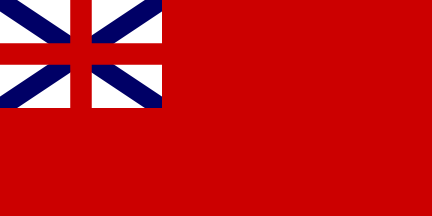
British Red Ensign
(romanticized variant)
|
Trumbull's Bunker Hill Flag 1775
On the nights of June 16-17, 1775, the American rebels fortified Breeds and Bunker Hills which overlooked Boston Harbor. Although they had not officially declared their independence, a fight for control of the hills became necessary. When British Marines advanced up the slope the next day, according to American legend they carried a red ensign into battle. John Trumbull, whose paintings of Revolutionary War scenes were produced during the period, talked to eye-witnesses and his subsequent painting included a variant of the Red Ensign.
In the painting "The Battle of Bunker Hill," Trumbull depicts the British forces attacking the defenders at Bunker Hill as American General Warren lies dying. An unusual British Red Ensign is seen being carried by the attacking British Marines. The ensign features a red Saint George's Cross superimposed over a blue Saint Andrew's Cross on the plain white field in the canton. Speculation has suggested that this was a regimental flag, but no such British colors were known to be carried at the battle, and the Trumbull painting must be viewed as a romanticized view of the battle and a good example of artistic license. |
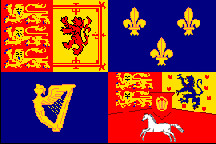
Royal Standard 1714
|
The Royal Standard of Great Britain 1714-1801
George, the Elector of Hanover, inherited the throne following the death of Queen Anne under the provisions of the Act of Settlement 1701, thus becoming King George I of England.
To show this the fourth quarter of the royal arms was changed to reflect the new king's domains in Hanover (Brunswick-Lüneburg-Westphalia), surmounted by the Imperial Crown of the Holy Roman Empire for the Holy Roman office of Archtreasurer (Archbannerbearer). |
- My thanks to David Prothero and Michael Faul for their invaluable help on this page -
| Page #1 (1189-1800) | Page #2 (1800-1900) | Page #3 (1900-present) | English County Flags |
|