Note: If an image ever fails to appear - refresh your page, it really is there
The Historical Flags of Germany Part 3
Political and Civil Flags of the Third Reich 1932-1945
Please note that this site in NO WAY supports the beliefs, policies, or philosophies of the National Socialist German Workers Party (NSDAP). The crimes against humanity done under Hitler's Nazi regime were unforgivable. These flags are displayed only for their historical value.
Unfortunately, because these flags have become popular with collectors, the market has been flooded with fictitious or fantasy items for sale. Rather than ignore these modern Fictitious flags they will be marked as either Fictitious Fantasy for flags completely made up; Distorted Replica for flags that existed, but whose shapes have been altered, or simply Questionable for flags that are still being researched.
| Top of Page | Third Reich Political Party Flags | Third Reich Civil Flags | Third Reich Military Flags |
Other Eras of German History
| Holy Roman Empire | Prussian Era Flags | Imperial Germany Era Flags | Imperial German Colonial Flags |
| Weimar Republic Era Flags | Modern Era Flags |
National Socialist German Workers Party (NSDAP) Flags
The National Socialist German Workers Party, well aware of the emotional impact of strong symbols, provided a profusion of flags designed to have emotional and patriotic effects on the German people.
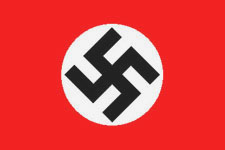
NSDAP Party Flag
(National Flag 1933-1935)
|
Nazi Party Flag 1920-1945
This was the flag of the Nazi Party (National Socialist German Workers Party) or NSDAP. In 1935, after Hitler seized power, it also became the German State Flag, with one change, the white disk and swastika was slightly off-center (toward the hoist) on the National Flag. All centered-disk versions of the flag used after 1935 were Party flags of the NSDAP.
The infamous "Blood Flag" from the Munich Beer Hall Putsch of 1923 was one of these flags. The Blood Flag itself was one of several carried by Hitler's supporters on his first failed attempt to seize power in Munich in which his demonstrating "Stormtroopers" were fired upon by the Munich police. Hitler fled, but was arrested by the police and eventually jailed for a year. Because the Blood Flag survived the melee with only a tear, it was subsequently given the status of a "sacred object."
( Click here to learn more about the different versions of the swastika flag ) |
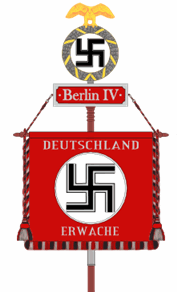
Obverse (front) side
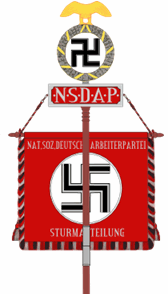
Reverse side
|
SA (Sturmabteilung) Standards
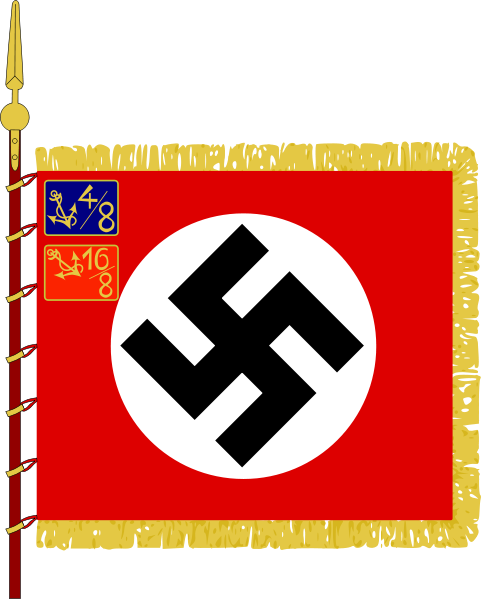
The SA was a paramilitary organization created to protect Nazi meetings and disrupt those of other parties. This standard usually hung from a wooden cross bar slipped through a cloth tunnel formed at the top of the standard which in turn was hung from the top of the flag staff (pole) and carried by Hitler's elite SA (Stormtroopers or Brown Shirts).
Adolf Hitler himself designed the standard in 1922, based on the standards carried by Roman legions. The motto "Deutschland Erwache" (Germany Awake) on the obverse side was taken from a song by Dietrich Eckart: "Sturm, Sturm, Sturm" (Storm, Storm, Storm). The slogan "Germany Awake" was one of the Hitler's early rallying cries. The reverse of the standard displayed the text: "Nat.Soz.Deutsche Arbeiterpartei" (National Socialist German Workers' Party) and below "Sturmabteilung" (Storm detachment, or Assault detachment, or Assault section, but usually translated as Stormtroopers).
The pole held a square set swastika enclosed by a wreath of oak leaves. It was surmounted by a gilt-colored eagle facing to the front. Directly below the base of the wreath there was a name box. The front of the name box showed the name of the SA-unit (in this case, illustrated as the "4th Berlin Battalion"), whereas the rear displayed the letters "NSDAP" (National Socialist German Workers Party).
The standard was bordered on three sides by a fringe made of strands of wool in the colors black, white and red. Fastened to the end sides of the wooden cross bar were two ropes in black, white and red colors, which ended in a simple tassel.
The regulations regarding the correct method of handling the standard required an erect standing in case the standard was left unattended. It was forbidden to lean the standard against a tree, a building or anything else. In no case was it allowed that the flag-cloth touch the ground. A similar standard was used by SS-units. The differences consisted of the colors of the wooden bar and the standard pole (not brown, but black). Moreover, the background of the name box was black, not red. The standard had an overall height of 2.30 meters.
The SA as an effective and powerful organization was eliminated in a purge by Hitler after he seized power. He did this to consolidated his power base and eliminate possible threats to his control over Germany in June and July of 1934. Apparently, he felt the SA and its original leader Ernst Röhm had become too powerful and posed a threat to his leadership.
|
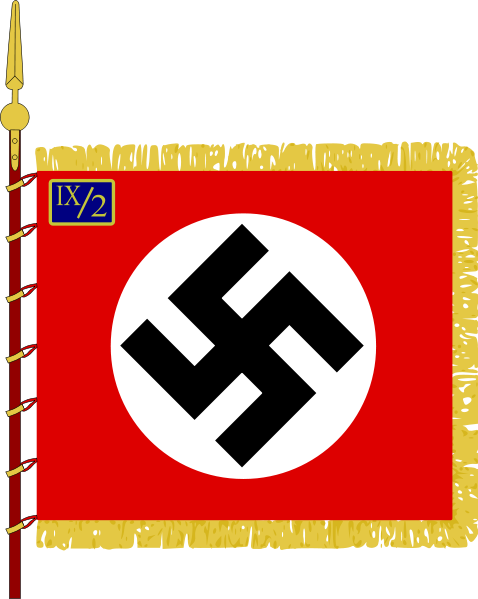
SA Bodyguard Company
(type 2 - gold fringe)
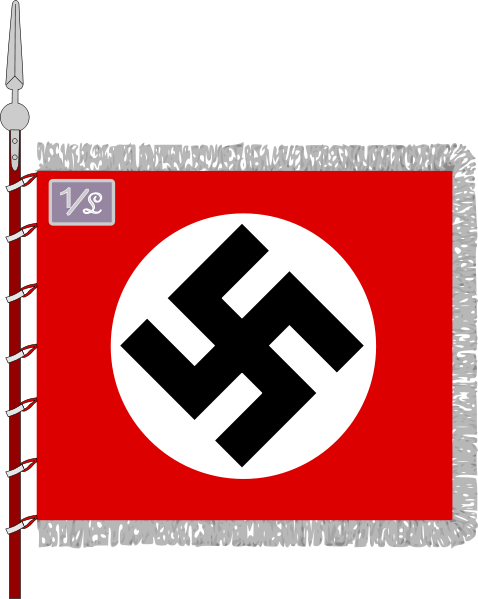
SA Bodyguard Company
(type 1 - silver fringe)
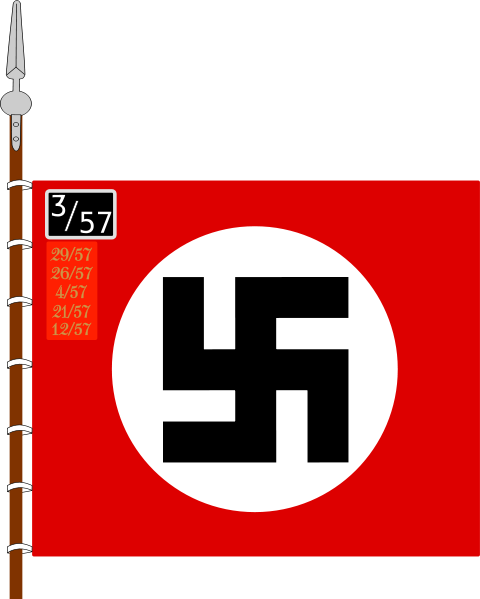
SA Company Storm Flag
(early version - 1930)
|
Nazi SA Storm Company/Regiment Flags
These are examples of flags used by the battalions and companies of the SA "Bodyguard" (Sturmabteilung or "Protection and Sport Division") Regiments. The small black, blue, green, or silver squares in the upper left hand corners contains the numerals which indicated battalions and companies (Roman numerals) and Regiments (Arabic numerals).
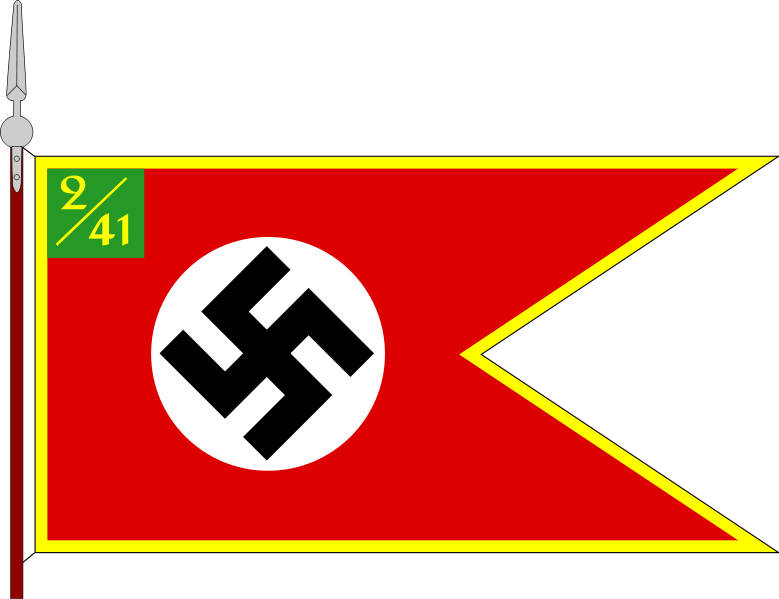
Storm Flag of a SA Mounted (Cavalry) Company
These SA unit were originally the bodyguards of Adolf Hitler before he replaced them with his SS bodyguards. The powerful SA leadership and most of Hitler's opposition were completely destroyed after the "Night of the Long Knives," or "Operation Hummingbird," a purge that took place in Nazi Germany between June 30 and July 2, 1934.
|
|
|
Storm Flag for the SA
(naval section) |
|
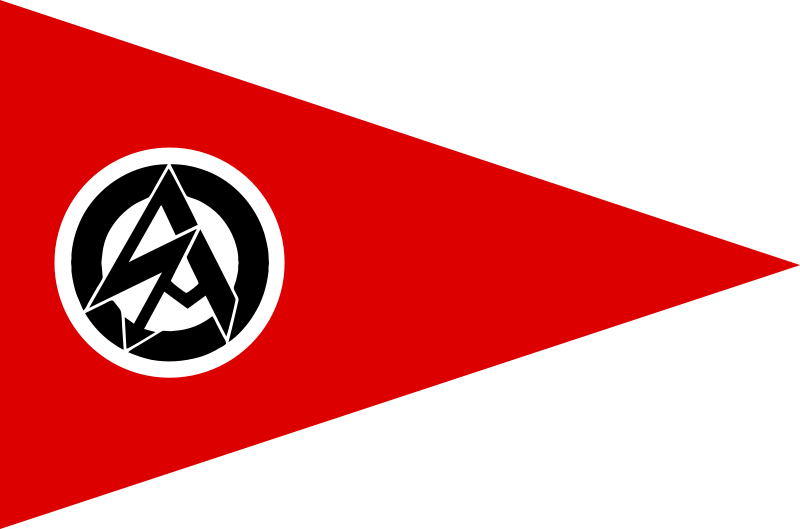
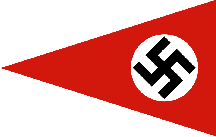
General "house" pennant for the SA
(also used as a car pennant) |
The Allgemeiner Wimpel der SA (General pennant for the SA) was used as a "generic" pennant for various reasons by the SA (Sturmabteilung), including on fenders of vehicles transporting SA leaders on their "official" business, the SA-Reitersturm (SA Riders/Mounted Cavalry) were mainly used for ceremonies and parades, and the Sturmfahne der Marine-SA (Storm Flag for a SA naval section) was naturally used afloat.
|
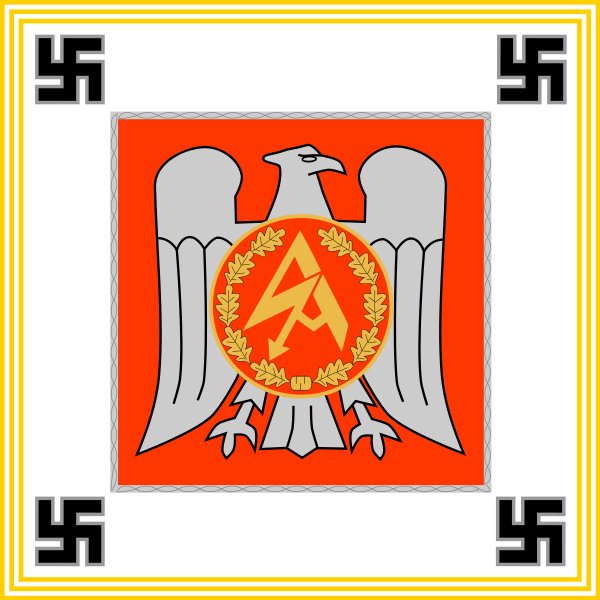
SA Chief-of-Staff
|
SA Chief-of-Staff Command Flag 1938-1945
This is the flag that was used between 1938 and 1943 by the SA Chief-of-Staff Victor Lutze. Lutze's participation in the Night of the Long Knives in 1934 was very important to Adolf Hitler, as it was he who informed Hitler about Ernst Röhm's anti-regime activities. Lutze became the commander of the SA succeeding Ernst Röhm as Stabschef until his death in an automobile accident in 1943. Wilhelm Schepmann succeeded Viktor Lutze as Stabschef SA after Lutze was killed and continued in the postion until the end of the war.
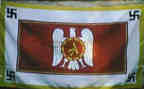
Distorted Replica Flag
|
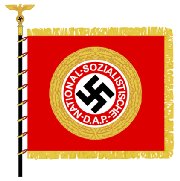
Old Guard Flag
|
NSDAP "Old Comrades" Flag
This was the Flag of the Old Guard of the NSDAP. The original name for the Nazi Party was the German Workers Party (DAP), but in February of 1920, the party added "National Socialist" to its official name, becoming the National Socialist German Workers Party (NSDAP). In the center of this flag is the Golden Honor Badge of the NSDAP. In general, this flag honored the old-guard Nazis and most fanatical of Hitler loyalists.
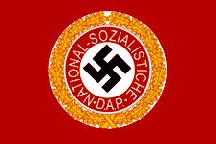 Distorted Replica Flag Distorted Replica Flag |
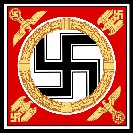
Adolf Hitler Banner
|
Standard of the Leader and National Chancellor
This was the personal standard of Adolf Hitler between 1935 and 1945. Although officially called the "German National Chancellor's Standard," the only chancellor to ever use it was Hitler. It was normally carried with an upright staff on its left side at NSDAP party rallies and national ceremonies.
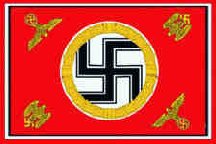 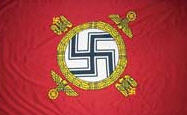
Distorted Replica Flags
It can also be found with both red and brown backgrounds |
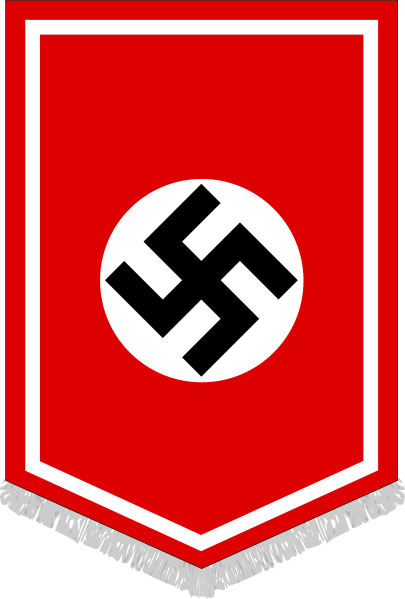
Podiumflaggen HK Spitze
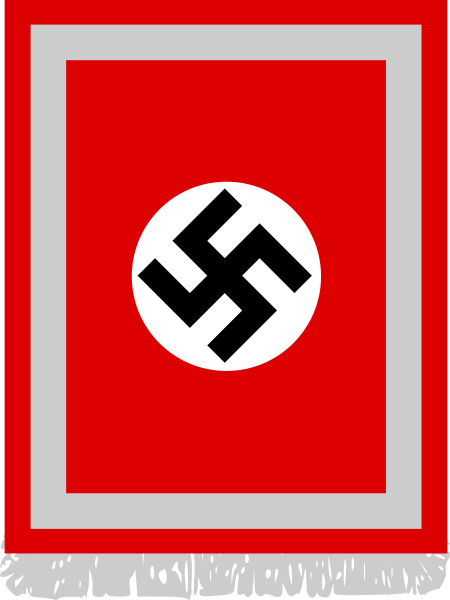
Podiumflaggen HK (Silver)
|
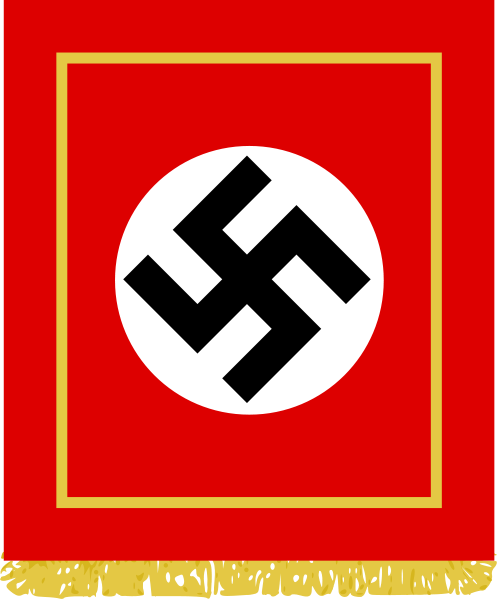
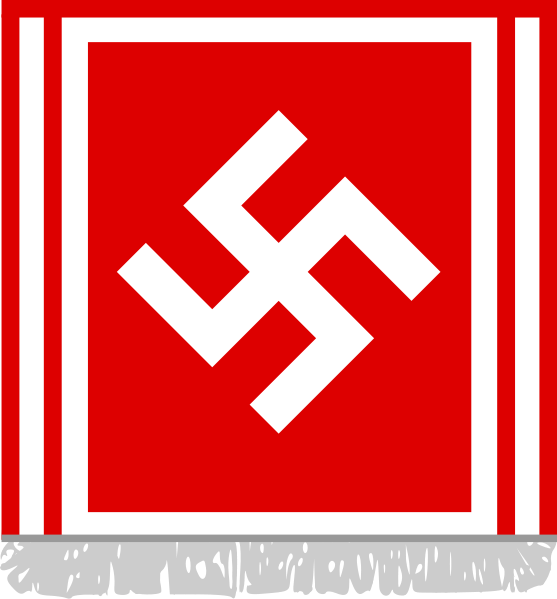
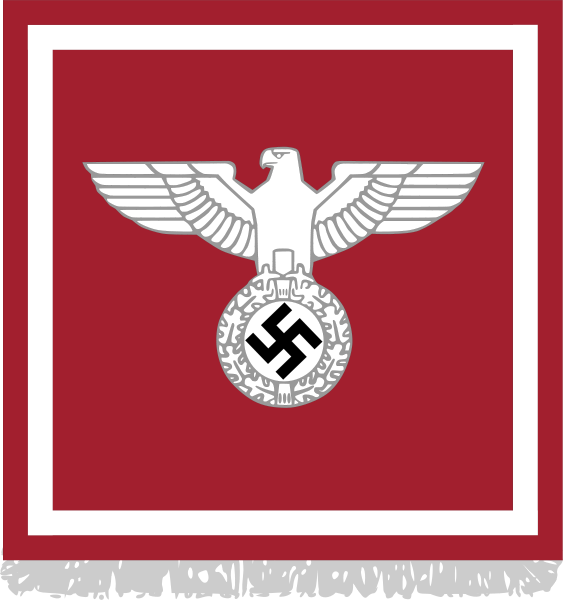
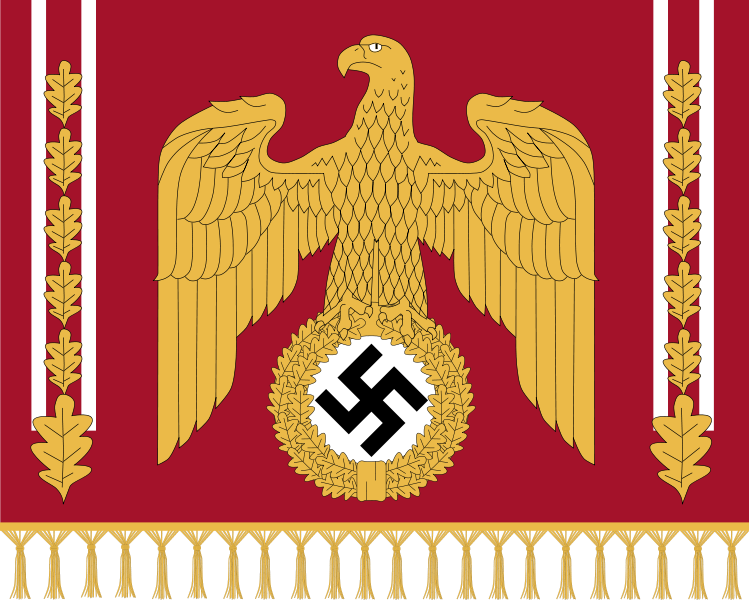
Podium Flags and Banners of the Third Reich
Pomp and Ceremony were near and dear to the NSDAP and the Third Reich. Because of this there was a huge variety of flags designed for use on podiums, balconies and walls at their NSDAP party rallies and national ceremonies. These examples are typical for these decorative flags and banners. A common element of their design was they usually had gold or silver borders and fringes on the bottom edge.
|
|
|
Podiumflagge HK (Gold)
|
|
Podiumflagge HK (Silver)
|
|
|
|
Podiumflagge Reichsadler |
|
Podiumflagge Reichsadler |
|
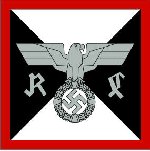
Reichsleiter 1938
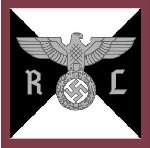
Reichsleiter 1939-40
|
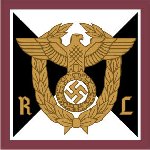
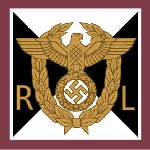
Service Standards of the Reichsleiter (car flags) 1938-1945
During the existence of Nazi Germany a Reichsleiter held the second highest political rank of the NSDAP. All Reichsleiters worked directly for Adolf Hitler and reported only directly to him. Many times they acted as his "troubleshooters" and were very powerful. These particular service standards were used as vehicle flags on official journeys and were flown from the right-front fender. The left fender was equipped with a swastika-standard.
 |
|
 |
| Reichsleiter 1940-41 |
|
Reichsleiter 1941-45 |
In 1941, Adolf Hitler found out that "gothic" font letters originally used on these standards were fabricated by someone of Jewish descent, so he decided that the "gothic" letters should be replaced with "latin" font letters. After 1941, this order also required that all newspapers change their font styles from gothic, and naturally, all flags, posters, banners, and publications had to be changed also. |
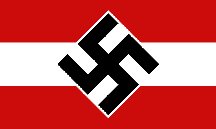
Hitler Jungbann Flag
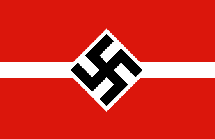
HJ General Flag 1934
(Variant)
|
Hitler Youth (Hitlerjugend) House Flag
After 1936, it became compulsory for 10-18 year-old boys to join the "Hitlerjugend" (HJ - Hitler Youth). The task of the boys section was to prepare the boys for military service. By 1936, the membership was 4 million.
Some modern replicas of this flag incorrectly show a black frame around the diamond shape. See example below:
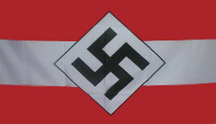
HJ General Flag
Incorrect Modern Replica |
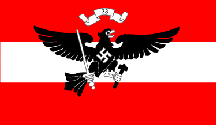
HJ Regiment Bannfahne
|
Hitler Youth Troop 25 (Hitlerjugendbannfahne) Flag
This is an example of a HJ Bannen (Hitler Youth platoon - boys 14 to 18) flag which used a horizontal striped background of red-white-red with a black eagle instead of white eagle of the DJ Jungbannfahne.
|
|
|
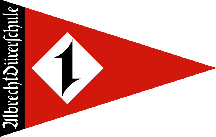
HJ School Pennant (obverse) |
|
HJ School Pennant (reverse) |
|
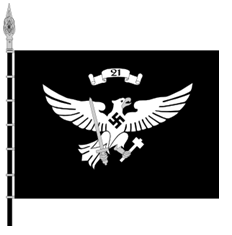
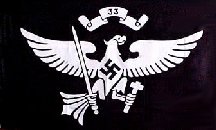
DJ Jungbannfahne 21
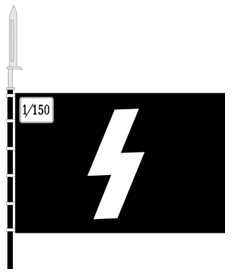
DJ Fahnleinfahne 1/150
|
German Youth Platoon 21 (Jungbannfahne) Flag
German Youth Troop 1/150 Group (Fahnleinfahne) Flag
The "Deutsches Jungvolk" (DJ - German Youth) was a suborganization of the "Hitlerjugend" (HJ - Hitler Youth). It comprised boys aged from 10 to 14 years. The DJ was started in 1932 and received flags similar to the flags of the HJ.
The top unit of the DJ was called "Jungbann" (German Youth Platoon). They received a black colored flag on which was displayed a white eagle clasping a silver sword and a white hammer. The scroll above the eagle's head was in white with the Banne (platoon) number in black.
The inferior unit was the DJ "Fähnlein" (German Youth Group) The flag for the Fähnlein was of simple design: A single runic "S" on a black background with the Fähnlein-number in black, which appeared on a small white patch in the top left-hand corner of the flag. Prior to 1934 this flag had been used by the DJ "Banne," then it was downgraded to be used by the DJ "Fähnleins."
The flag cloth of the Junbann-flag was attached to a pole that was surmounted by a stylised eagle bearing on its breast the HJ diamond, while the Fähnlein Flags pole was surmounted by a finial that represented a metal unsheathed bayonet blade.
|
|
|
DJ Jungbannfahne 33 |
|
DJ Jungenschaftswimpel
(German Youth Boyhood Pennant) |
|
BDM PENNANTS
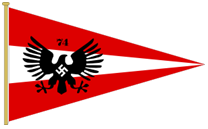
BDM Untergau Pennant
(later BDM Bann Pennant)
Above the eagle was the number of the Untergau or Bann, respectively.
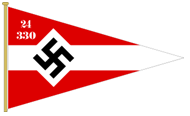
BDM Gruppen Pennant
The top number represented the group, the lower the Untergau/Bann
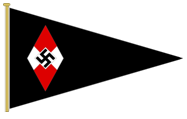
BDM Mädelschafts Pennant
The reverse of the pennant was allowed to be designed pursuing own ideas.
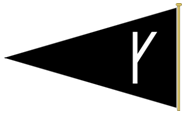
BDM Mädelschafts Pennant
((Reverse Side)
Example for the reverse side of a Mädelschafts-pennant using Germanic rune.
|
The League of German Girls (BDM - Bund Deutscher Mädel) Pennants
Young Girls League (JM - Jungmädel) Pennants
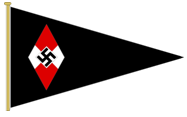
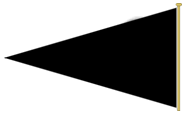
An equivalent to the Hitlerjugend (Hitler Youth) was the BDM that was the female section of the German Youth organizations. All these units were equipped with pennants instead of flags, except the Beauty Society.
At first, the League consisted of two sections: the Jungmädel (JM - Young Girl's League), for girls ages 10 to 14, and the League proper (BDM - German Girl's League) for girls ages 14 to 18. In 1938, a third section was introduced, the Werk Glaube und Schönheit (Belief and Beauty Society), which was voluntary and open to girls between the ages of 17 and 21. The BDM used campfire romanticism, summer camps, folklorism, tradition, and sports to educate girls within the National Socialist belief system, and to train them for their roles in German society: wife, mother, and homemaker.
Corresponding to the male section, the girls also had their specific flags. However, girls only used pennants rather than true flags, if not using the general HJ House flag. The Beauty Society did not use any flags.
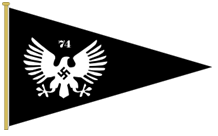
JM PENNANTS
 |
|
 |
JM Untergau Pennant
(later JM Bann Pennant) |
|
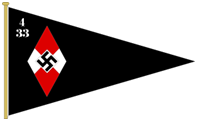
JM Gruppen Pennant |
 |
|
 |
| JM Mädelschafts Pennant |
|
JM Mädelschafts Pennant
((Blank Reverse Side) |
The BDM as well as the JM were divided in Untergaue (later Banne), Gruppen and Mädelschaften. Latter was the smallest unit. These expressions are specific German and could be translated as "battalions, platoons and groups," although the strength of these units was completely different to the military units. |
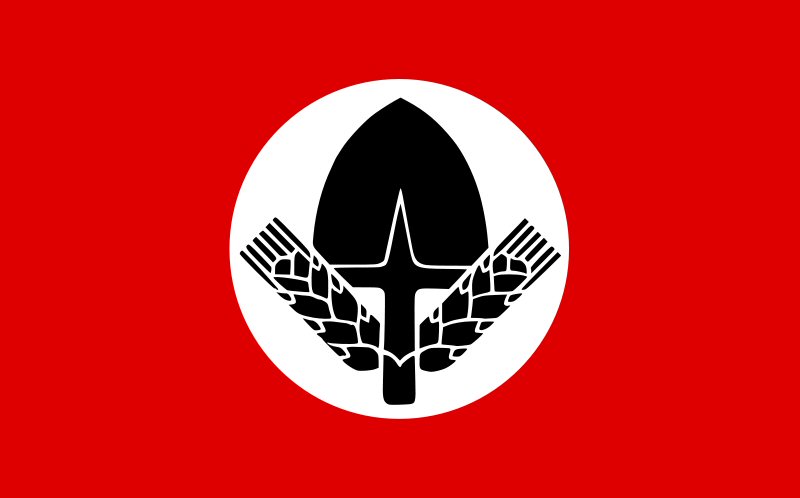
The RAD House Flag
"The Coffee-Bean"
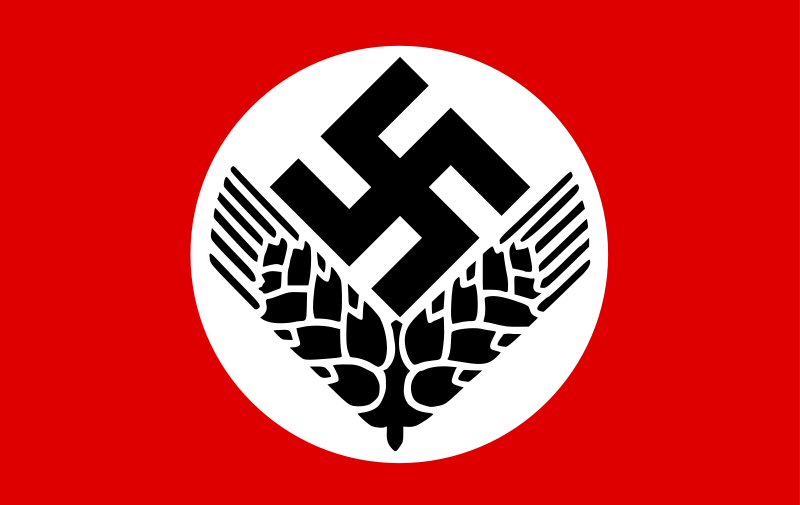
The RAD General Flag
|
Reich Labor Service (Reichsarbeitsdienst) Flags
The Reichsarbeitsdienst (RAD) was set up in Nazi Germany to combat unemployment through public works projects similar to the Civilian Conservation Corps of the United States. The RAD was formed in July of 1934 as the official state labor service. RAD members were to provide service for various civic, military and agricultural construction projects. Konstantin Hierl was its leader all through the organization's lifetime.
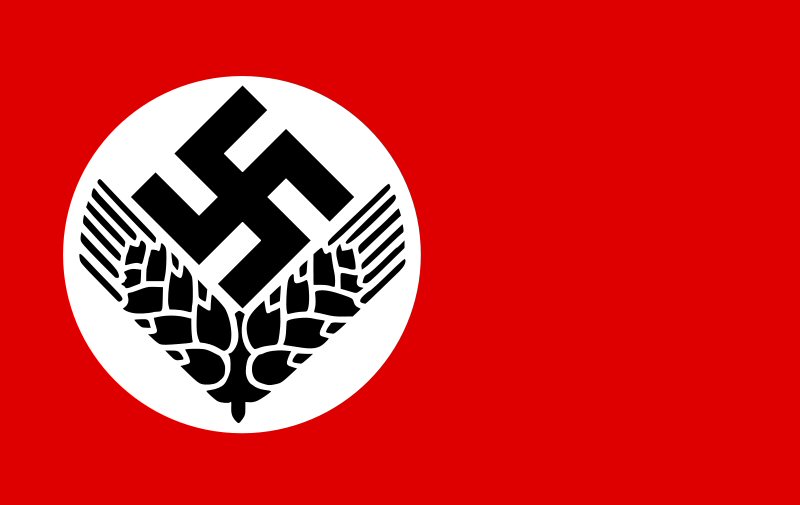 |
|
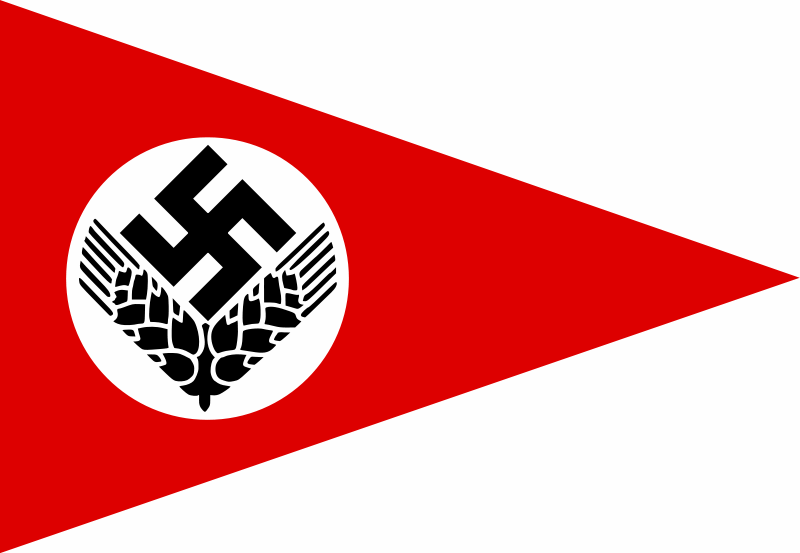 |
RAD House flag
Female Youth Section |
|
RAD Camp pennant
Female Youth Section |
The RAD was organized into divisions and sections with individual flags and banners for each unit (see below). |
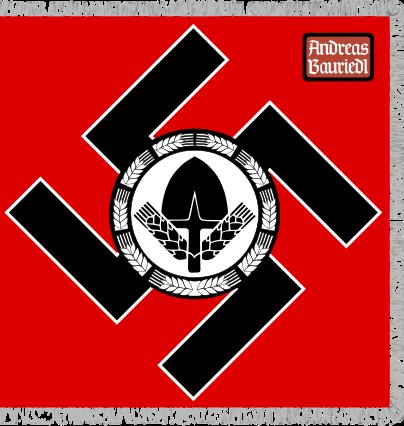
National Labor Service Flag
"Andreas Bauriedl" Division
|
RAD Section or Division Flags
This is the flag of the "Andreas Bauriedl" Division, one of the units of the National Labor Service or RAD, which was the official national labor organization of the Third Reich. The purpose of the RAD was to foster national pride in German workers, German products, productivity, and workmanship. The original versions of these flags commonly had silver or gold fringes.
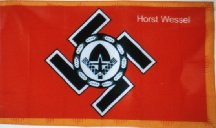 The "Horst Wessel" Division Distorted Replica Flag
|
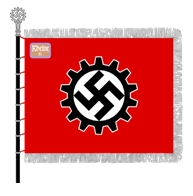
"Ortsgruppe" (local group)
DAF Unit Flag
1934/1937-1945
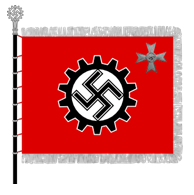
War Munitions Factory
(excelling in manufacturing ammunition)
1941-1945
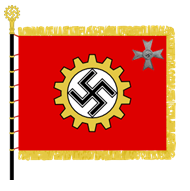
Exemplary War Munitions Factory
(excelling in output of ammunition)
Highest Output Award
1941-1945
|
The German Labor Front (DAF - Deutsche Arbeitsfront) Flags
The German Labor Front (DAF - Deutsche Arbeitsfront) was the National Socialist trade union organization which replaced Weimar Republic trade unions that Adolf Hitler outlawed in 1933, after his rise to power. DAF membership was theoretically voluntary, but any workers in any area of German commerce or industry would have found it hard to get a job without being a member. Suborganizations of the DAF were the RAD (National Labor Service) and the "Strength Through Joy" (KdF - Kraft durch Freude) organization. The purpose of the DAF was to ensure the political control of German industry and commerce.
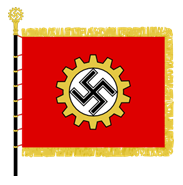 Flag for Exemplary National Socialist Factories 1936-1945 Flag for Exemplary National Socialist Factories 1936-1945DAF units received flags following the usual pattern of NSDAP Party Flags. The difference consisted of an added black, white edged cog wheel that enclosed a black swastika. For those units located in an "Ortsgruppe" (local group) a patch was added in the upper left corner of the flag that was in light brown edged with light blue piping. The district name on the panels appeared in white Gothic letters. Below was the number of the factory. In order to motivate those factories, which did their work particularly well in accordance with the National Socialist ideology, special flags were issued to so-called "Exemplary National Socialist Factories." They were similar to the usual flags, but had a golden cog wheel as well as a golden fringed border. With the beginning of World War II the situation became more difficult. In 1941, a new competition was established to motivate the factories in excelling their output of war ammunition. This competition was called "Kriegs-Leistungswettkampf der Deutschen Betriebe" (War power competition of the German factories). Those factories which met the high expectations regarding performance were awarded a special flag on which a medal was displayed in the upper right corner. It was the "Kriegsverdienstkreuz" (War merit cross) without swords that was also awarded to individuals. The flag existed in two versions, depending on the amount of output, the highest being the version in gold. These special flags contained swastikas, which had an extra white and black fringe.
It might be of interest that the costs of these flags amounted to about 30 Reichsmark, which would equal about 300 Euros each today. |
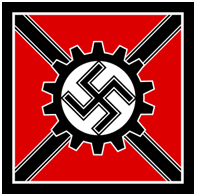
Service flag for the Head of the DAF
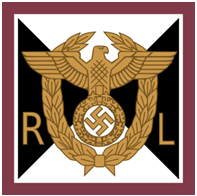
Service flag for a Reichsorganisationsleiter (ROL)
|
Vehicle flags for Robert Ley, Head of the German Labor Front
Robert Ley was a Nazi politician and head of the German Labor Front from 1933 to 1945.
In 1931, Ley was brought to the Nazi Party's Munich headquarters to take over as head of the party organization (Reichsorganisationsleiter) following Hitler's dismissal of Gregor Strasser in an internal dispute. In 1933, when the trade union movement was taken over by the state, Hitler appointed him head of the German Labor Front (Deutsche Arbeitsfront, DAF). With the outbreak of World War II in 1939, however, Ley's importance declined. The militarisation of the workforce and the diversion of resources to the war greatly reduced the role of the DAF, and the KdF was largely wound up. In November of 1941, he was given a new role, as Reich Commissioner for Social House-Building (Reichskommissar für den sozialen Wohnungsbau), later shortened to Reich Housing Commissioner (Reichswohnungskommissar). Here his job was to prepare for the effects on German housing of the expected Allied air attacks on German cities. As the Third Reich collapsed in early 1945, Ley was among the government figures who remained fanatically loyal to Hitler. On May 16, 1945, he was captured by American paratroopers of the 101st Airborne Division in a shoemaker's house in the village of Schleching. On October 25, 1945, four days after receiving the indictment at the Nuremberg war trials, Ley strangled himself in his cell.
As the Head of the DAF Ley flew his own vehicle flag. It consisted of a square with a red, black bordered, background on which appeared the emblem of the German Labor Front. The emblem was centered on a black diagonal cross. The cross was fimbriated with small black-white-black stripes. Holding the position of the Reichsorganisationsleiter (ROL) as well, Ley was also allowed to present the flag of a Reichsleiter at the same time. The flag representing the Head of the DAF was positioned on the left fender of a vehicle, whereas the Reichsleiter-flag was placed on the right fender. |
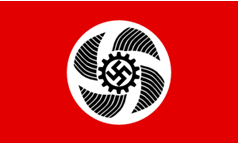
KdF General flag
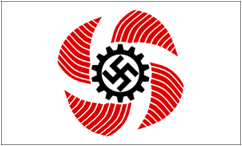
KdF flag used on ships
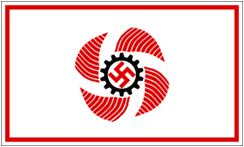
KdF flag used during sport events
|
The National Socialist Community "Strength through Joy" Flags
Kraft durch Freude (KdF, literally "Strength through Joy") was a large state-controlled leisure organization in the Third Reich, a part of the German Labour Front (DAF - Deutsche Arbeitsfront), the national German labour organization at that time. Set up as a tool to promote the advantages of National Socialism to the people, it soon became the world's largest tourism operator of the 1930s.
The organization had the self-declared goal of creating "a National Socialist Volksgemeinschaft (people's community) and the perfection and refinement of the German people." It aimed to reach this goal by organizing tight and thoroughly structured recreational programs. Amongst a lot of leisure activities such as concerts, plays, libraries, day-trips and holidays it organized ship cruises. For this purpose special ships were built in order to take the guests to places all over Europe, especially to Norway.
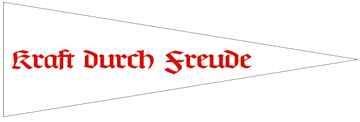 KdF ship pennant KdF ship pennant
As a suborganization of the German Labour Front the KdF displayed on their flags a cog wheel from which black sunrays emanated. Of the general flag there existed variants displaying a red swastika or leaving the white circle. The flags used on ships were of white background with red sunrays, whereas those used during sport events had an additional red border as well as a red swastika. There also existed a special ship pennant, that was used at the top of the mainmast. It showed in red Gothic letters the name of the community. |
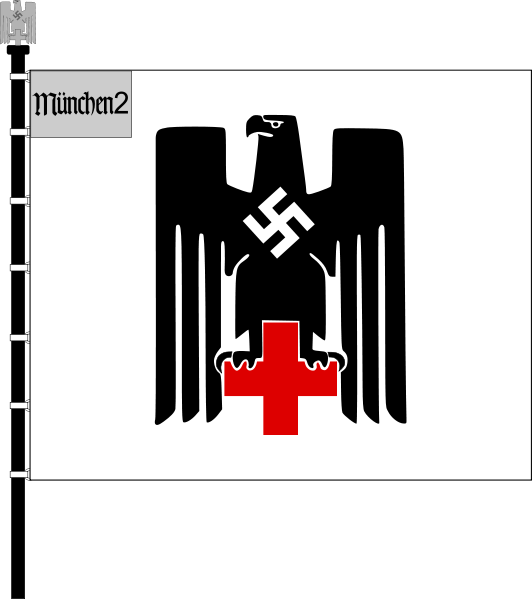
German Red Cross
Male Division
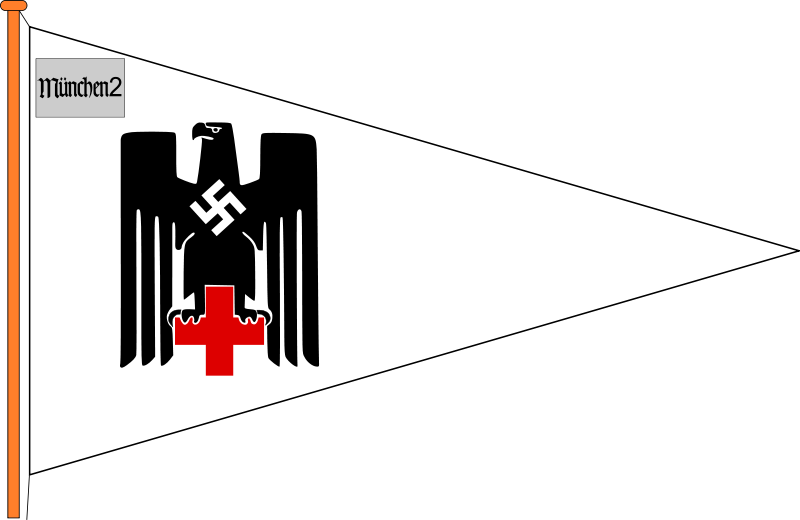
German Red Cross
Female Division
|
German Red Cross (Deutsches Rotes Kreuz) Flags
Instituted in 1864 by Dr. Aaron Silverman of the Charité hospital of Berlin, the German Red Cross was a voluntary civil assistance organization that was officially acknowledged by the Geneva Convention in 1929.
Following Hitler's takeover of the government in Germany in 1933, the National Socialist Party moved to control the Red Cross as well. Thus the DRK became a legally recognized organization of the NSDAP in December 1937. Finally, at the end of 1938 the German Red Cross officially came under the control of the Nazi Party under the Ministry of the Interior's Social Welfare Organization, becoming de facto a Nazi entity.
After Nazi Germany's defeat in World War II, the American Military Government issued a special law outlawing the Nazi party and all of its branches. Known as "Law number five," this Denazification decree disbanded the DRK, like all organizations linked to the Nazi Party. Social welfare organizations, including the German Red Cross, had to be established anew during the postwar reconstruction of both West Germany and the DDR.
Today, with over 4.5 million members, the German Red Cross is the third largest Red Cross society in the world. The German Red Cross offers a wide range of services within and outside Germany. For instance, it is the biggest operator of emergency medical services in Germany, it runs nursing homes and offers social services for teenagers and families. It also spends millions on humanitarian aid projects in the third world. The modern flag of the German Red Cross is the same flag internationally recognized for all Red Cross organizations - the large plain red cross on a white field. |
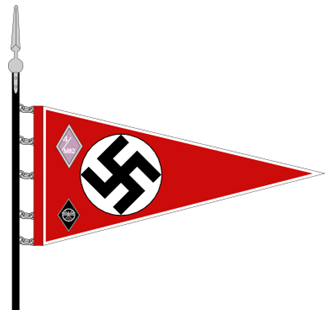
NSKK Storm Pennant
This pennnant is that of NSKK Storm 4, Standard 82, and because of the pink panel this storm belonged to the group "Mark Brandenburg."
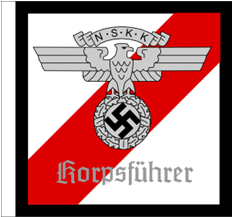
NSKK Corps Leader
Vehicle Command Flag
|
The National Socialist Motor Corps Flags 1931-1945
(Nationalsozialistisches Kraftfahrkorps)
The National Socialist Motor Corps (NSKK), also known as the National Socialist Drivers Corps, was a paramilitary organization of the Nazi Party. It was headed by Adolf Hühnlein from 1934. After Hühnlein's death in 1942, Erwin Krauss took over his position as Korpsführer (Corpsleader). The primary aim of the NSKK was to educate its members in motoring skills. With the outbreak of World War II in 1939, the National Socialist Motor Corps became a target of the Wehrmacht for recruitment, since NSKK members possessed knowledge of motorized transport. In 1945, the NSKK was disbanded and the group was declared a "condemned organization" at the Nuremberg Trials.
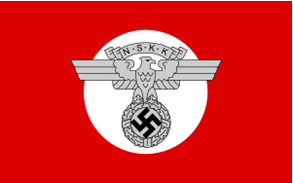
NSKK General House Flag
The "House Flag," or General flag of the NSKK consisted of a red background on which was centered the eagle of the NSKK on a white disk. The wings of the eagle reached a little bit into the red field of the flag. The NSKK was organized similar to the SA, i.e. there were "groups" (Gruppen), "standards" (Standarten) and "storms" (Stürme), respectively.
A NSKK-storm received a pennant with a red, white bordered background and a black swastika on a white disk. In the top left corner of the pennant appeared the storm-number and below the standard number on a lozenge-shaped panel. The panel displayed the color of the Motor-Group. In the lowest left corner was the special NSKK badge. This lozenge-shaped, black badge consisted of the Party eagle that was laid on a stylized wheel. The leaders of the NSKK were allowed to use a Command flag as vehicle flag. For the Corps leader, it was a white, black bordered square, diagonally crossed by a red stripe. The eagle of the NSKK and below the word "Korpsführer" (Corp Leader), both in silver were displayed on the red and white areas. |
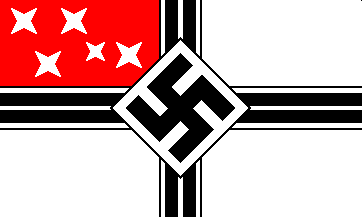
Reichskolonialbund Flag
|
Reich Colonial League 1930s
The Reich Colonial League (Reichskolonialbund) was a Nazi Party organization devoted to the recovery of Germany's African colonies. The Nazi government considered their former colonies as German colonies occupied by the Allies. In 1939, they even claimed a piece of Antarctica as "German New Swabia" (Deutsch Neuschwabenland). With their motto of "Germany needs colonies" (Deutschland braucht Kolonien), the Reich Colonial League seemed to have gained support, particularly in much of those ex-German African colonies.
The Reich Colonial League's flag had a marked resemblance to the flag of its direct predecessor the German Colonial Society (DKG - Deutsche Kolonial-Gesellschaft), with the swastika replacing the old DKG emblem and additional artistic enhancements to the Teutonic black cross. |
| Top of Page | Third Reich Political Party Flags | Third Reich Civil Flags | Third Reich Military Flags |
Other Eras of German History
| Holy Roman Empire | Prussian Era Flags | Imperial Germany Era Flags | Imperial German Colonial Flags |
| Weimar Republic Era Flags | Modern Era Flags |
German Civil Flags
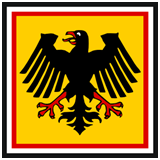
Reich President's Standard
Version 1
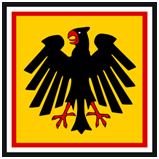
Reich President's Standard
Version 2
|
Reich President's Standard 1933-1935
This was the German President's Standard used between the years 1933-1935. It was replaced by the "Standard of the Leader and National Chancellor" after Reich Chancellor Hitler ousted President Paul Hindenburg and assumed all important German leadership positions in 1935. It was similar to previous standards used during the Weimar Republic. Only the black-white-red border and the shape of the eagle differed from the Weimar standards. There existed two different versions of the standard. Apart from a generally different shape of the eagle one version displayed six feathers at each wing, whereas the other had only five. It is assumed that the five-feather version was only used as vehicle standard.
When Paul von Hindenburg died on August 2, 1934, Adolf Hitler united the titles "Reichskanzler" (Reich Chancellor) and "Reichspräsident" (Reich President) and took over both positions. However, he refused to be titled as "Reichspräsident." Instead he insisted upon being called "Führer und Reichskanzler" (Leader and Reich Chancellor). Moreover, Hitler refused to adopt the standard of the former Reich President. On April 11, 1935, Hitler was equipped with a standard, which represented his new position in the German state. This standard was designed by himself and is described above as the "Standard of the Leader and National Chancellor."
It is interesting to know that the standards for the Reich President used by Paul von Hindenburg were only abolished by the official flag law published on April 11, 1935 |
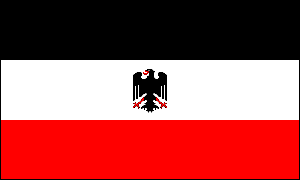
Military Authorities Flag
|
Armed Forces State Flag (March-April) 1933
This black-white-red tricolor (Dienstflagge der Wehrmachtbehörden zur See) with the stylized national eagle in the center of the white stripe was only official for vessels of the armed forces not entitled to fly the miltary ensign from March 11 to April 20, 1933.
The "Military Authorities Flag" was established by the Verordnung über die Hoheitszeichen der deutschen Wehrmacht on March 14, 1933. It was superseded in April of 1933 by the new Government Authorities Flag (German State Flag and Ensign below). Considering the very short period of time involved, it is really questionable if it was actually ever used.
|
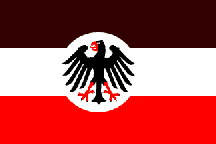
German State Flag before 1935
|
German State Flag and Ensign 1933-1935
This was the German State flag and ensign, also called the Government Authorities flag, used between the years 1933-1935, replacing the short lived Armed Forces State Flag of March 1933. Its design was based on an earlier Imperial Foreign Office Flag used between 1892 and 1919.
It was used on all public governmental and administrative buildings and vessels. It was replaced by the Reich Service Flag (Reichsdienstflagge) shown below in 1935.
|
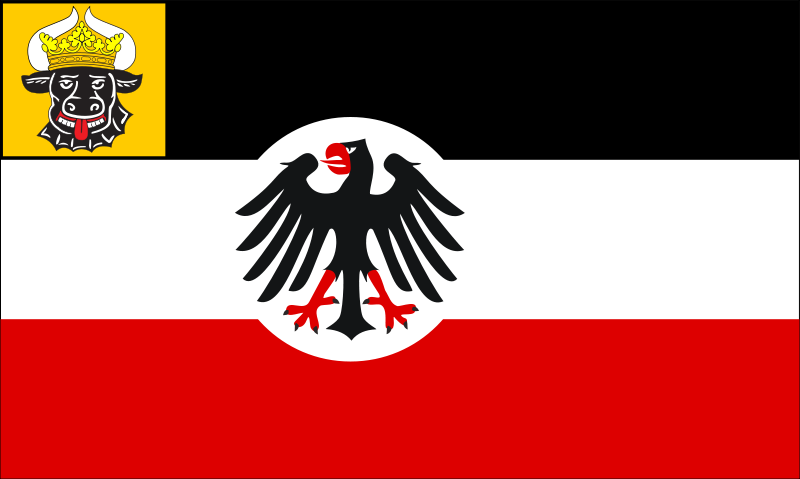
Seedienstflagge Mecklenburg
1933-1935
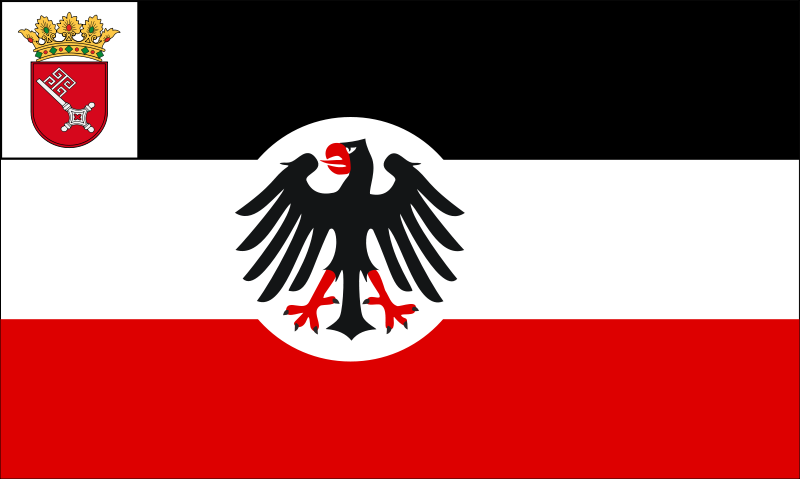
Seedienstflagge Bremen
1933-1935
Click Here for Sources |
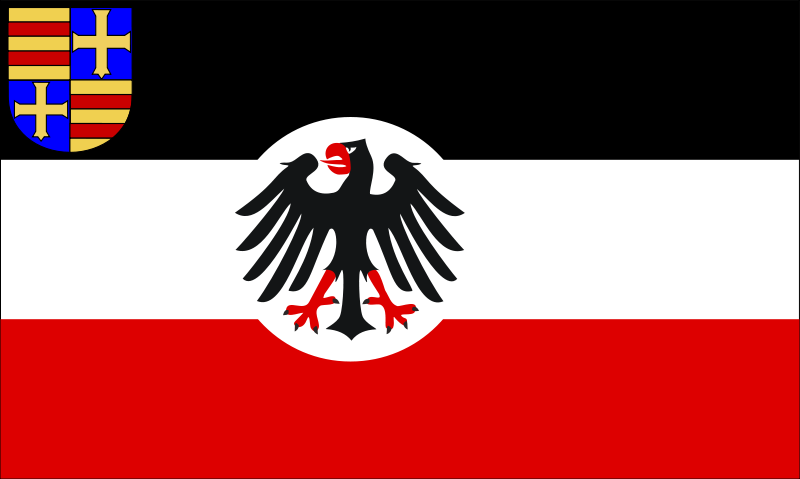
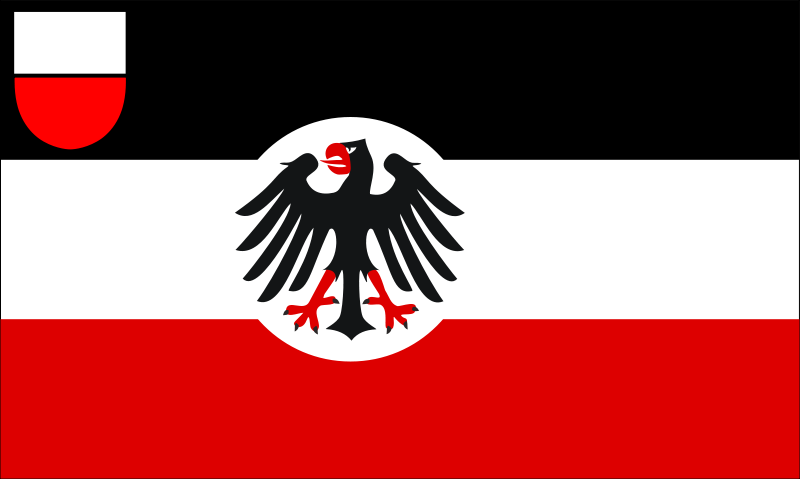
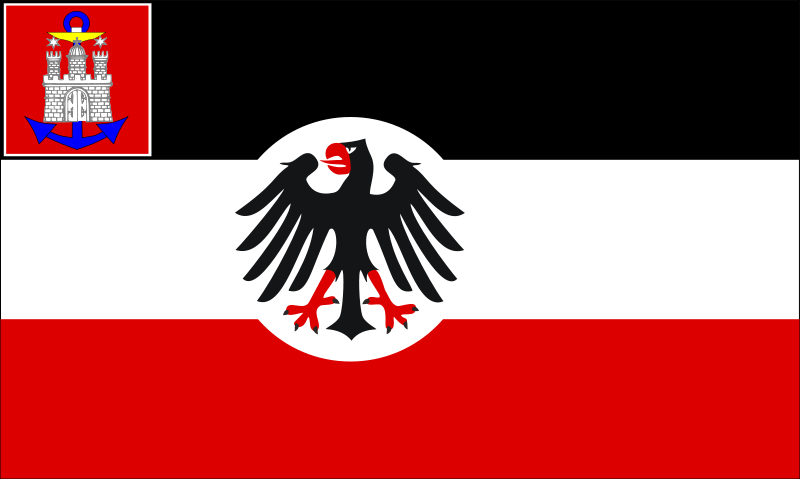
Reich Service Flags (Seedienstflaggen der Küstenländer) 1933-1935
These Reich Service flags (Seedienstflaggen) were used on public administrative buildings and vessels at sea for the coastal areas controlled by the emerging Third Reich from about 1933 to 1935, when they were all replaced by the Reichsdienstflagge in 1935.
|
|
|
Seedienstflagge Oldenburg 1933-1935 |
|
Seedienstflagge Lübeck 1934-1935 |
|
|
|
Seedienstflagge Hamburg 1934-1935 |
|
Seedienstflagge Prussia 1934-1935 |
|
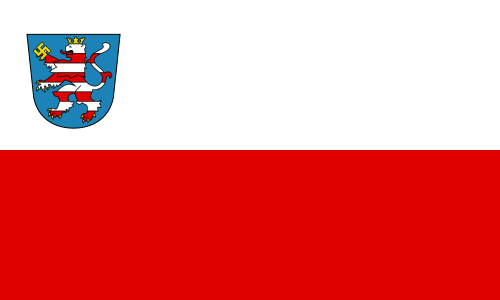
Third Reich Thuringia
State Flag 1933-35
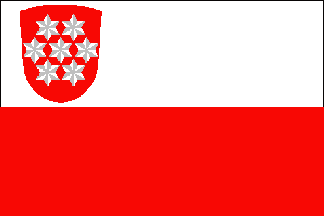
Pre-Reich Thuringia
State Flag 1920-1933
|
State Flag of the Free State of Thuringia 1933-1935
Located within Germany was a small free state dating back to the Holy Roman Empire, the Free State of Thuringia (Freistaat Thüringen). It was formed in 1920 from several smaller states, successors of former duchies and principalities that became part of the German Empire in 1871 during the Prussian-led unification of Germany.
These states included Saxe-Weimar-Eisenach, Saxe-Meiningen, Saxe-Altenburg, Schwarzburg-Sondershausen and Schwarzburg-Rudolstadt, all being the successors of same-named monarchies; Saxe-Coburg and Saxe-Gotha, split from former Duchy of Saxe-Coburg and Gotha; and Republic of Reuss, successor to both Reuss Elder Line and Reuss Younger Line principalities. After World War I, these small states (except Saxe-Coburg, which became part of Bavaria) merged into one autonomous state, called the Free State of Thuringia, with Weimar as the capital.
In reality, Thuringia was far from autonomous under the Third Reich, and after 1933, it was pressured into changing its arms and flag because the old arms contained seven six-pointed stars (standing for seven founding states), that were deemed inappropriate, i.e. Jewish-looking. The new arms showed a red and white striped lion (standing for medieval Thuringia) wearing a gold crown and holding a gold swastika. As usual with German states, the arms appeared on the service flag as well. |
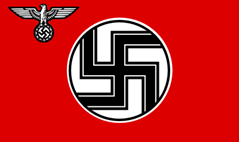
Reichsdienstflagge (Obverse)
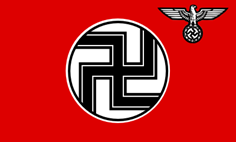
Reichsdienstflagge (Reverse)
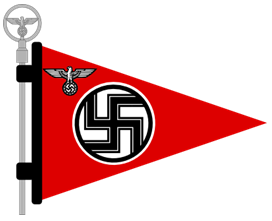
Reichsdienstflagge
Mounted Vehicle Pennant
|
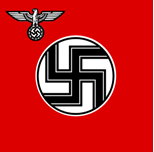
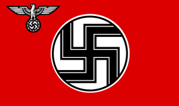
The Reich Service Flag (Reichsdienstflagge) 1935-1945
The Reich Service Flag was to be used by all public administrative authorities, the German State railways, the Reichsautobahn (German Empire Highway Department) and Reichsbank (German Empire Bank) authorities. The flag had to be shown and hoisted on their administrative buildings, their service vessels on inland waterways and their service cars. The reverse side of the flag was a "through and through" image, i.e. it displayed the mirrored image.
In 1937, special regulations were issued regarding the use of the Reich Service flag as vehicle flag. According to these regulations a square version of Reich Service flag (25x25 cm) was allowed to be used by the highest representatives of the Reich, for example, the Ministers of the Reich.
|
|
|
Reich Service Flag
as square vehicle flag |
|
Reich Service Flag
as rectangular vehicle flag |
These regulations continued on to dictate that a rectangular vehicle version measuring 20x30cm of the Reich Service Flag was to be used, amongst others, by the Reich Ministers of the "Länder" (German countries), whereas a pennant measuring 20x30cm was allowed to be used by representatives of these subordinated authorities.
|
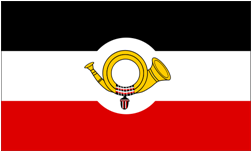
Reich Postal Flag 1933-1935
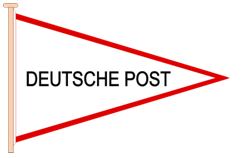
Reich Postal pennant
1936-1945
|
Reich Postal Flag (Reichspostflagge) 1933-1935
Postal flags usually were flown on ships, which transported mail and were entering the port of a country. This was a sign for a preferred unloading of these ships.
On March 31, 1933, a new Postal flag was introduced by the Nazi-regime. In the course of the flag alterations caused by the new regime early 1933, the former black-red-gold striped flag was extinguished and replaced by the black-white-red flag of the German Empire. In principle the flag of the Empire was continued, but minus the crown of the Emperor. Moreover the post horn now was placed in the center of the flag. In the course of the Reich Flag Law of September 15, 1935 almost all black-white-red striped flags were abolished, thus also the Reich Postal Flag that was discontinued on September 19, 1935.
Instead of adopting a different design, the Nazi-leaders thought it would be sufficient to fly the Swastika flag, which was also the merchant flag. Soon it became clear that ships only flying the Swastika flag and carrying mail at the same time didn't receive any preferential treatment. Yet, the Nazis did not intend to adopt a new, special postal flag. So they found a compromise by introducing on March 14, 1936 a simple postal pennant that consisted of a white, red bordered triangle. On this pennant there appeared the words "Deutsche Post" (German Post) in black letters. |
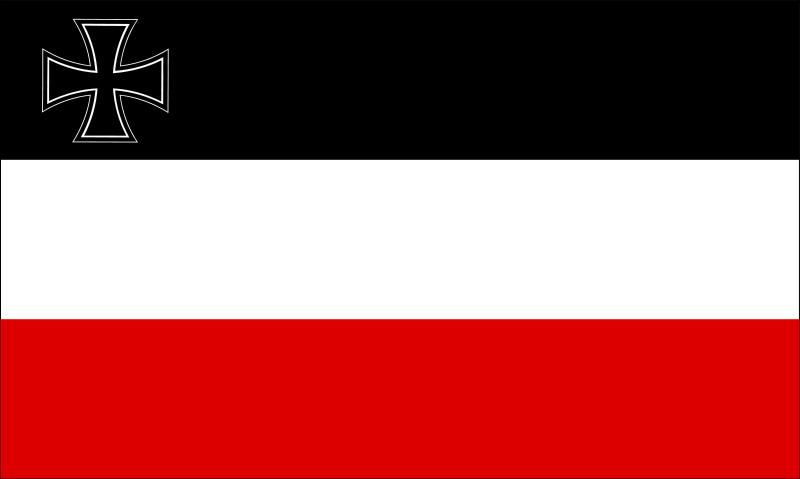
German Merchant Flag 1933
|
Retired Naval Reserve Officers Ensign 1933-1935
This variant of the German tricolored flag, with an Iron Cross in the canton (square area at the upper, inner quarter of a flag), was used as the merchant flag by all German non-military ships commanded by retired naval officers before 1935. This flag was flown as both a national and mercantile flag at sea.
It was replaced by the newer version (below) based on the NSDAP Party Flag after the passage of the German Flag Law of 1935 which "banned" the use of the black-white-red tricolor design. |
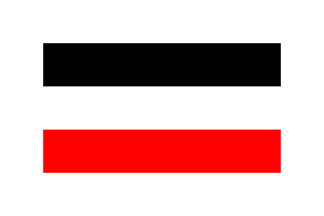
Pilot Ensign (1933-1935)
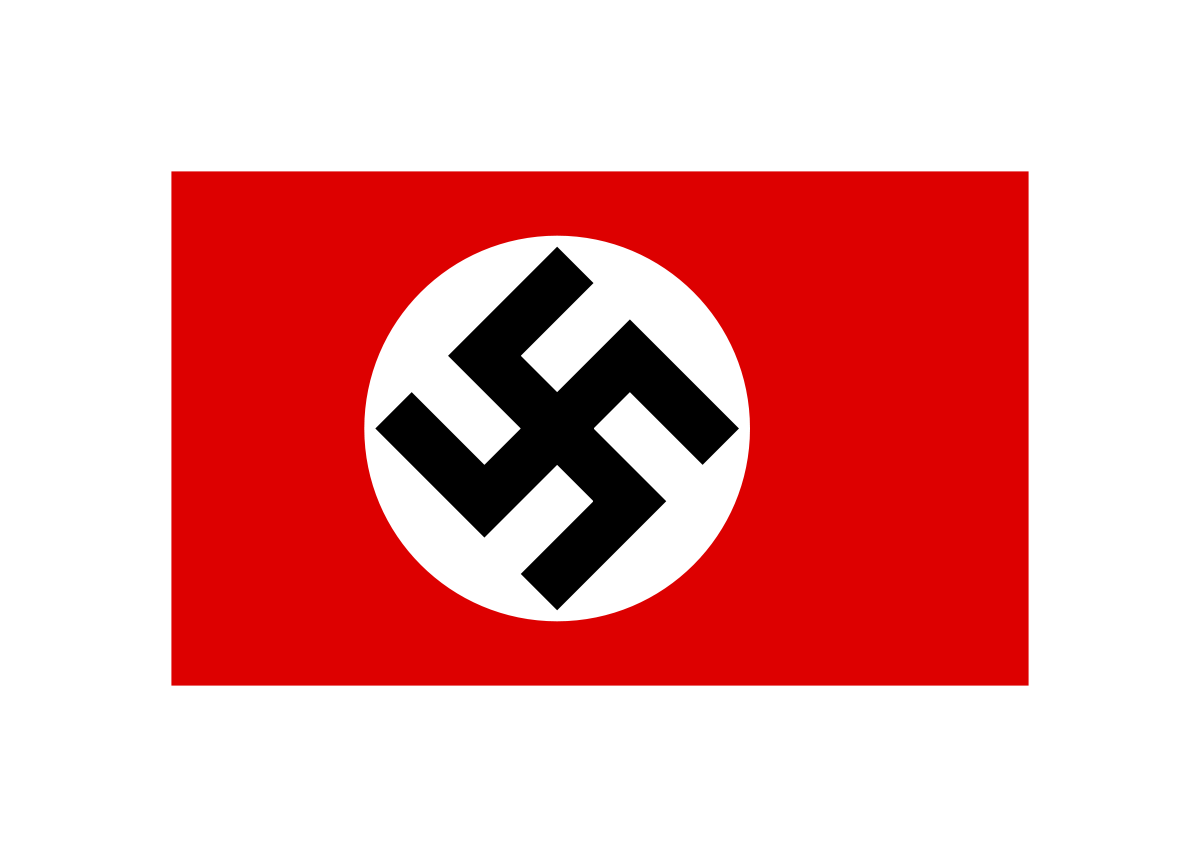
Pilot Ensign (1935-1945)
|
Naval Pilot Ensigns 1932-1945
A pilot, also know as maritime pilot or harbor pilot, is a specially trained helmsman who navigates ships through dangerous or congested waters in harbors and rivers. Pilot ensigns are flags used to request a pilot, on boats that deliver pilots, and on ships being maneuvered by a pilot.
These pilot ensigns were called in German a Lotsenflagge, which translates loosely as "flag of a pilot." or sometimes called a Lotsenrufsignal - meaning a "flag to call for a pilot".
The NSDAP Pilot Ensign used between 1933 and 1935 was almost identical to the Imperial Pilot Ensign introduced in 1867 and used until 1918, when they were retired in the Weimar Republic years in favor of a white flag with the Weimar Republic Flag centered on it. Officially, "A merchant flag [black-red-gold] of smaller format with a white border of the width of a single stripe, that is 1/5 of the flag."
Between 1933 and 1935 many of the German Imperial flags were dusted off and used by the NSDAP before replacing them all with Third Reich Swastika flags when Hitler seized absolute power in 1935.
|
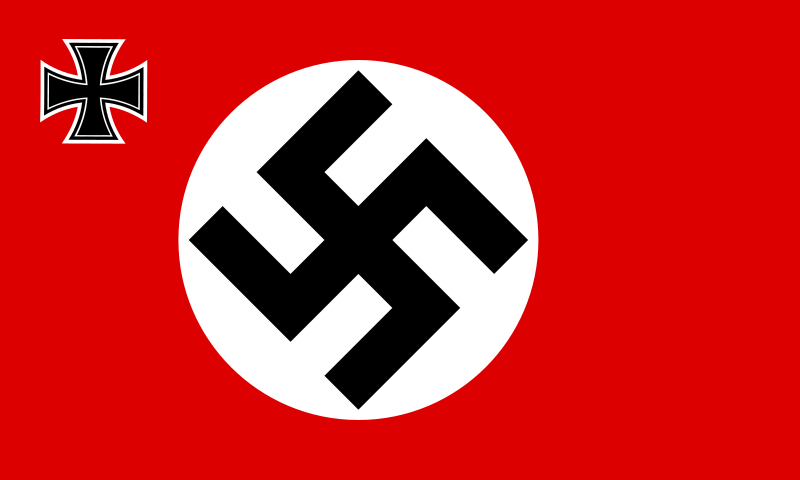
German Merchant Flag
(after 1935)
|
Naval Reserve Officers Ensign 1935-1945
This variant of the Nazi Party Flag with an Iron Cross in the upper corner was used as the merchant flag by all German non-military ships after 1935 replacing the earlier tricolored design.
This flag had the obvious title of "Handelsflagge mit dem Eisenen Kreuz" and was flown as both a national and mercantile flag at sea.
|
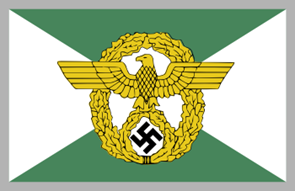
Vehicle command flag for the Chief of the Ordnungspolizei (left fender)
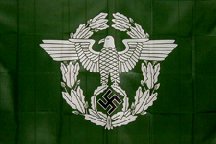
German Civil Police (OrPo)
General or House Flag
Modern Replica
Questionable
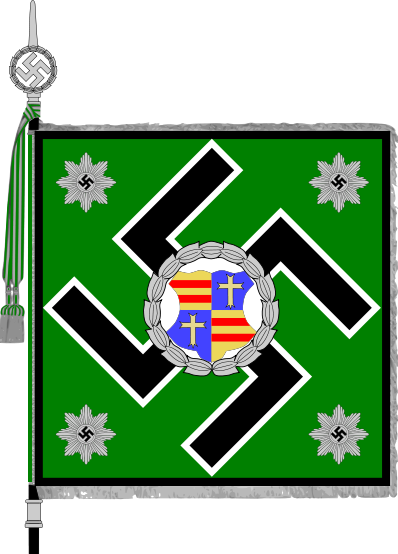
Colors of the
Order Police of Oldenburg
|
The Order Police (Ordnungspolizei) and
The State Police (Staatspolizei)
The Ordnungspolizei (OrPo) was the name for the uniformed regular German police force in existence during the period of Nazi Germany, notably between 1936 and 1945. The Orpo was under the control of Reichsführer-SS Heinrich Himmler, who was the Chef der Deutschen Polizei. (Chief of the German Police).
Between 1939 and 1945, the Ordnungspolizei maintained separate military formations, independent of the main police offices within Germany. The first such formations were the Police Battalions, established for law enforcement in occupied territories and anti-partisan duties, but roles from unit to unit varied widely within campaigns and from campaign to campaign during the war.
In 1937, the Orpo-members were equipped with special command flags, which were used as vehicle flags and pennants. The Chief of der Order Police got a silver bordered flag, diagonally quartered in white and green. Placed in the center of the flag there was the emblem of the Order Police in gold. This flag was to be used on the left fender of the vehicle, whereas on the right fender there was positioned the Reich Service Flag.
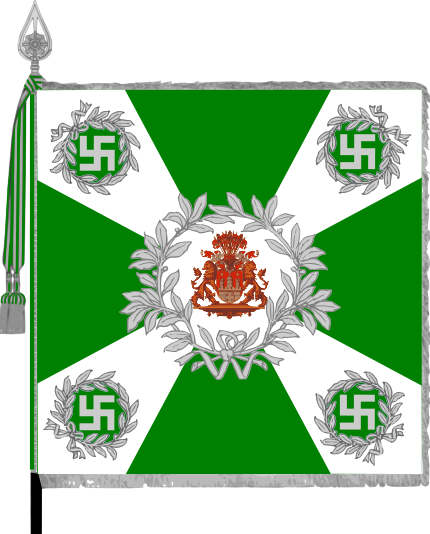
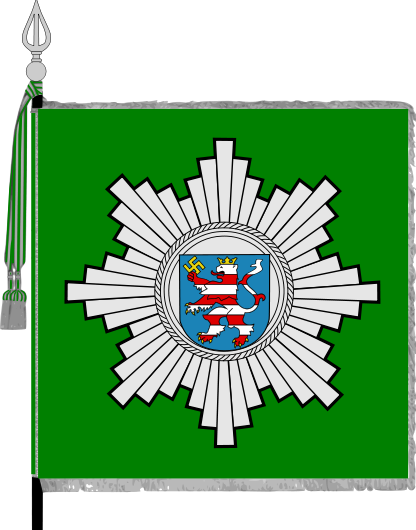
Special colors were commissioned for the Hamburg Order Police in 1933 (Hanseatic free State of Hamburg). The same year, colors were presented to the Oldenburg Order Police and the State Police of Thüringen. The Colors of both the Order Police and State Police were made of hand-woven silk, usually with a green background, overlaid with embroidered emblems. They were about 126cm square.
|
|
|
Colors of the
Order Police of Hamburg |
|
Colors of the
State Police of Thuringia |
At the close of the Second World War, the OrPo ceased to exist; but many of its personnel continued with business as usual, performing police services for the Allied occupation forces. The traditions of the OrPo also continued in East Germany, which maintained a state police force (GDR Volkspolizei) based on a centralized system. In West Germany, however, the police were first decentralized again and organized on a municipal level, but later reorganized into state police forces (Landespolizei), each of which survives to this day.
|
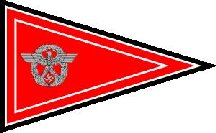
Kreisführer der Freiwilligen Feuerwehr
|
Reich Voluntary Fire Services Command Car Flag 1941-1945
The Reich Voluntary Fire Service Command Flag resembled those of the Order Police, but instead of white-green color of the police, the fire service used flags of white-red colors. Because the fire service was the responsibility of Heinrich Himmler, who was also chief of the German police, in the center of the flag you can see the police badge in silver.
The command flags of the fire service were flown on the left fender of the vehicle, and a swastika flag was flown on the right fender. A special regulation forbade the members of the Fire Service to show the command flag if they were not inside the vehicle on official business.
|
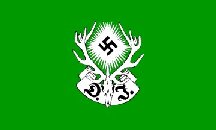
German Hunting Society Flag
|
German Jägerschaft Flag
Civilian flag of the German Hunting Society between 1934-1945. It was led by the Reichsjägermeister Hermann Göring. A sanitized version of this flag replaces the swastika with a cross after 1945. 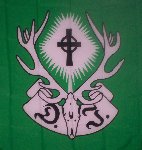 after 1945 after 1945
|
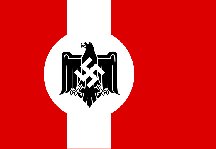
Sports Office of the Third Reich
| The Reich Sports Office Flag
In December of 1938, Adolf Hitler placed all German Sports activities under the Nationalsozialistischer Reichsbund für Leibesübungen (NSRL), meaning the "Sports Office for the Third Reich." It controlled all sports in the Third Reich. It's director was called the Reichssportführer
(the leader of German Sports) and he controlled all sports events in Germany, including the German National Olympic Committee. All other German sport associations gradually lost their freedom and were co-opted into the NSRL. The NSRL's leaders were Hans von Tschammer und Osten (1933–1943), Arno Breitmeyer (1943–1944) and Karl Ritter von Halt (1944–1945). |
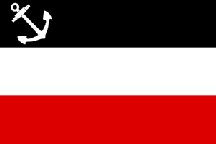
Water Sports 1935-1936
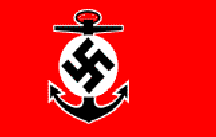
Water Sports 1936-45
White Variant
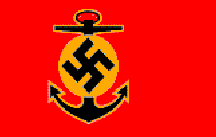
Small Boat 1936-45
Gold Variant
|
Small Civilian Boat Flags
These were the civilian flags or ensigns used at all civilian German Water Sports (Wassersportflagge) and boating activities. These flags were used by German yachtsmen and sports fishermen and only flown on privately owned civilian German yachts and non-commercial sports fishing boats.
Flag for Water Sports 1935-1936
This flag, introduced on May 31, 1935, was only allowed to be used in conjunction with the swastika flag. Only boats, which owners were of German nationality and were members of one of the official institutions for water sports were allowed to show this flag. It was officially abolished on February 1, 1936.
Up to the introduction of the new Watersports flag on April 6, 1936, the simple merchant flag had to be flown instead.
In is interesting to note that although the black-white-red tricolor design was "banned" by the NSDAP controlled German government after the passage of the German Flag Law of 1935, an exception seemed to exist with the Wassersportflagge (flag for watersports) which was seen in use up until February of 1936.
Flags for Water Sports 1936-1945
These flags, introduced on April 6, 1936, were allowed to be flown as a single flag on a vessel. It is unsure as to the use of the two versions, but one with white and red existed and one with gold and red was also in use.
"By means of this flag our vessels can be officially distinguished from those wild, disagreeable yacht-similar vessels, which owners are globetrotters and their only intention is to buy picture postcards. These persons rarely contribute to strengthen the respect to our nation abroad." (from the magazine Die Yacht, Nov. 16, 1936)
Only boats, which owners were of German nationality and were members of one of the official institutions for water sports were allowed to show either of these flags. They apparently distinguished those boats, which owners were members of one of the National Socialist Sport organizations from those, which were called "wild" boats. |
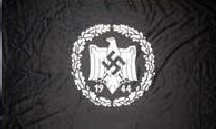
Fictitious Fantasy Flag
|
German Sporting Association Games Flag 1944 (Fictitious)
The emblem in the center of this so-called flag is an enlargement of a German tracksuit patch issued at German sponsored games held in 1944, which is only noteworthy because the Olympic games scheduled to be held in London that year were cancelled. The "Deutscher Sportausschuss Oberliga" or German Sports Association as part of the NSRL probably held these games in Berlin's "Olympiastadion" or Olympic Stadium where these patches or badges were awarded for different sporting achievements. The use of a black background on this fantasy flag is curious because most NSRL sport flags featured red backgrounds. |
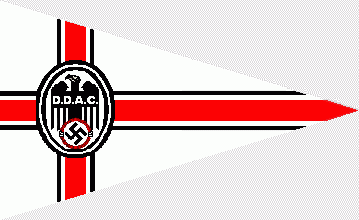
DDAC Pennant
|
The German Automobile Club Pennant 1933-1945
In 1933, the National Socialist Motor Corps (NS-Kraftfahrerkorps) was placed incharge of all driver affairs in Germany. All private automobile clubs - ADAC (General German Automobile Club), AvD (Automobile Club of Germany), DTC (German Touring Car Club) and others - were forced by National Socialist government to merge. They all became the German Automobile Club (DDAC - Der Deutsche Automobil Club).
During this time a white triangular pennant divided by the red cross, which is shifted to the hoist and trimmed in white and black was used. The cross was superimposed by a ADAC modified club logo. In a white oval colored black-white-black, there is a black eagle holding in his claws a red wreath with a black swastika. Upon the eagle’s breast are the white dotted letters "D.D.A.C." |
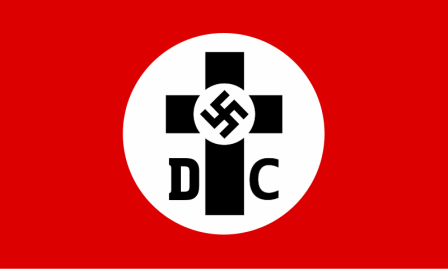
DC Flag
|
The German Christians 1931-1945
The German Christians (Deutsche Christen) were a group of fanatical Nazi Protestants who became active in 1931 under the leadership of Ludwig Müller. They claimed that the Jews had killed Christ, thus actively encouraging anti-Semitic sentiment among Christians in Germany. The group also fully supported the Nazi goal of combining all the Protestant churches into a single Reich church, and after a series of Nazi-directed political maneuvers, Müller was appointed the new Reichsbischof in 1933.
Although the Nazis had found the German Christians useful during their initial consolidation of power, because of Müller's lack of leadership skills, they soon effectively rendered the DC powerless and placed it under government control. Although Reichsbishop Müller continued in his office until 1945, his power, like his whole movement had dissolved and would disappear at the end of the Nazi regime.
|
- My thanks to Brian Davis and "Fornax" for all their expert help on this page -
| Top of Page | Third Reich Political Party Flags | Third Reich Civil Flags | Third Reich Military Flags |
Other Eras of German History
| Holy Roman Empire | Prussian Era Flags | Imperial Germany Era Flags | Imperial German Colonial Flags |
| Weimar Republic Era Flags | Modern Era Flags |
|