Note: If an image ever fails to appear - refresh your page, it really is there
The Historical Flags of Germany Part 3
Military Flags of the Third Reich 1932-1945
Please note that this site in NO WAY supports the beliefs, policies, or philosophies of the National Socialist German Workers Party (NSDAP). The crimes against humanity done under Hitler's Nazi regime were unforgivable. These flags are displayed only for their historical value.
Unfortunately, because these flags have become popular with collectors, the market has been flooded with fictitious or fantasy items for sale. Rather than ignore these modern Fictitious flags they will be marked as either Fictitious Fantasy for flags completely made up; Distorted Replica for flags that existed, but whose shapes have been altered, or simply Questionable for flags that are still being researched.
| Top of Page | Wehrmacht Command | Luftwaffe | Heer | Kriegsmarine |
| Schutzstaffel and SS-Waffen | German Occupied Territories | Political and Civil Flags |
Other Eras of German History
| Prussian Era Flags | Imperial Germany Era Flags | Imperial German Colonial Flags |
| Weimar Republic Era Flags | Modern Era Flags |
German Military High Command (Wehrmacht) Flags
As a point of interest, the term "Wehrmacht" which many mistake for "army," really translates as "Defense Forces." The German for "army" is "Heer." The Wehrmacht was the High Command for all three German branches of service: Heer (Army), Kriegsmarine (Navy), and Luftwaffe (Air Force).
It is also important to remember that in the German military unit flags (Fahnen) were in general square and designed to be carried by foot soldiers when displayed. Any military unit or command flag not square is suspect.
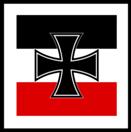
Reich Defense Minister
|
Reich Defense Minister 1933-1935
This was the flag of the German Minister of Defense between 1933 and 1935. The Minister of Defense was a cabinet post. In 1933, Major-General Werner von Blomberg rose to national prominence when he was appointed Minister of Defense in Adolf Hitler's new government. As Minister of Defense, Blomberg worked feverishly to expand the size and power of the army. In 1935, the Ministry of Defense was renamed to Ministry of War; Blomberg became the first Minister of War and Commander-in-Chief of the Armed Forces.
|
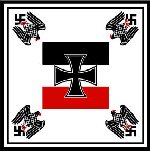
Minister of War and
Commander-in-Chief Flag
July 1935
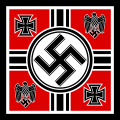
Minister of War and
Commander-in-Chief Flag
November 1935
|
Minister of War/Commander-in-Chief of the Armed Forces 1935-1938
In 1935, the Ministry of Defense was renamed the Ministry of War. Field Marshal General Werner von Blomberg became first Minister of War and Commander-in-Chief of the Armed Forces. He held this position until 1938, when Hitler removed him from office. A short lived command flag for the Minister of War and Commander in Chief of the German Wehrmacht was used between July and October 1935, then replaced by the second design shown here in November. This square flag (approximately 3x3 feet) was used until 1938, when the Ministry of War was abolished and replaced by the Wehrmacht High Command.
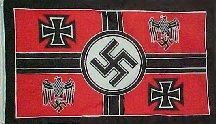 Distorted Replica Flag Distorted Replica Flag
Modern elongated replicas of this flag (usually approximately 3x5 feet) are quite common.
|
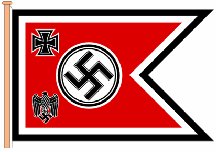
Chief of the High Command
1938-1941
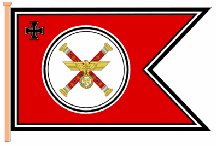
Chief of the High Command
1941-1945
|
Wehrmacht Command Swallow-tailed Flags 1938-1945
These two swallow-tailed flags were the pennants of the Chief of the High Command of the Armed Forces between 1938 and 1945. The most normal use of a pennant like this one was probably as a car flag for the vehicle being used by the Commander-in-Chief of the High Command of the Armed Forces.
Command flag for the Chief of the High Command of the Armed Forces 1938-1941
When Hitler took over the direct command of the Armed Forces in 1938 the War Ministry (Reichskriegsministerium) was dissolved and an OKW (Oberkommando der Wehrmacht - High Command of the Armed Forces) was instituted. From 1938 up to the end of the war in 1945, Wilhelm Keitel held the position of Chief-of-OKW. This swallow-tailed flag was only allowed to be used as car flag.
Command flag for the Chief of the High Command of the Armed Forces 1941-1945
In 1940 Wilhelm Keitel was promoted to "Generalfeldmarschall" (Field Marshal). Because of this promotion the Command Flag was altered in 1941. In order to show this promotion on the Command flag, two marshal batons were added. Moreover the "Wehrmacht" eagle was exchanged by a "Reichsadler" (national insignia), which was moved to the center of the white circle. This flag was also only allowed as car flag. The flag was 30 cm high, 45 cm wide and was cut in by a triangle 15 cm deep. |
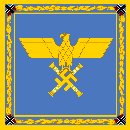
Reichsmarschall's Standard (Front)
.jpg)
Reichsmarschall's Standard (Back)
|
Standard of the Reichsmarschall (Pattern 1) 1939-1941
This square standard (approximately 3x3 feet) was Hermann Göring's personal standard as the Reichsmarschall of the "Greater German Reich" and used between 1939 and 1941. It was replaced by the new "Pattern 2" standard in 1941. The rank of Marshal of Germany (Reichsmarschall) was the highest military rank obtainable in the Third Reich.
.jpg)
Distorted Replica Flag
Modern flag manufacturers are selling this elongated 3x5 foot version of the backside.
|
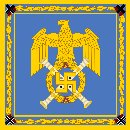
Reichsmarschall's Standard (Front)
ver 2_orig.jpg)
Reichsmarschall's Standard (Back)
|
Standard of the Reichsmarschall (Pattern 2) 1941-1945
This square flag (approximately 3x3 feet) was Hermann Göring's personal Reichsmarschall's Standard of the "Greater German Reich" and used between 1941 and 1945. It replaced the previous "Pattern 1" standard. Hermann Göring was named Reichsmarschall, which made him senior to all other Army and Luftwaffe Field Marshals
.jpg)
Distorted Replica Flag
Modern flag manufacturers are selling this elongated 3x5 foot version of the backside. |
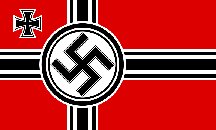
War Ensign 1935-1938
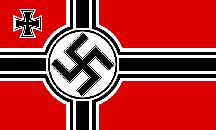
War Ensign 1938-1945
|
German War Ensign 1935-1945
This was the German War Ensign of the Third Reich and used by all military forces of Nazi Germany. It was flown daily at all military installations, preferably at the entrance, otherwise near the guard room or staff building.
It was introduced on November 7, 1935, the day the national military draft was begun in Germany. It was also used as a naval ensign by warships of the Third Reich.
As shown to the left, there were two slightly different versions used. Notice the slightly different design of the circle around the swastika on the two versions. Apparently, for a period of time during the transition, both designs were in use. We have pictures of military ceremonies where both were in use at the same time.
This flag became the standard flag used by all German land and sea military forces. It also became the most common flag used in territories occupied by the German forces. This included most occupational German control governments. |
| Top of Page | Wehrmacht Command | Luftwaffe | Heer | Kriegsmarine |
| Schutzstaffel and SS-Waffen | German Occupied Territories | Political and Civil Flags |
German Air Force (Luftwaffe) Flags
It is important to remember that in the German military unit flags (Fahnen) were in general square and designed to be carried by foot soldiers when displayed. Any military unit or command flag not square is suspect.
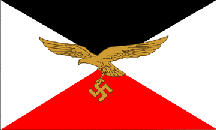
Commanding Generals Flag
|
Commanding Generals of the Luftwaffe Flag 1937-1945
This flag (with black, white and red background) was for a commanding general of a "Fliegerkorps," (Fighter Corps, or Fighter Wing) of the German Luftwaffe.
|
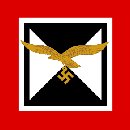
Luftwaffe Chief-of-Staff Flag
|
Luftwaffe Chief-of-Staff Command Flag 1937-1940
This was the Command Flag for the Chief of the Air Force General staff between 1937 and 1940. The original was actually a 3'x3' square, but the fantasy flag manufacturers have been busy reproducing this flag in elongated format.
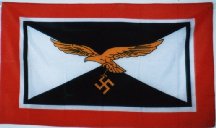 Distorted Replica Flag Distorted Replica Flag
|
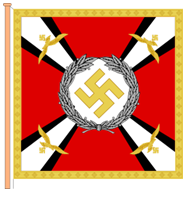
Luftwaffe Commander-in-Chief
1935-1945 (front side)
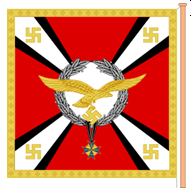
Luftwaffe Commander-in-Chief
1935-1938 (reverse side)
Luftwaffe Commander-in-Chief
1938-1945 (reverse side)
|
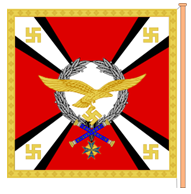
Command flag for the Reich Minister for Air Travel and
Commander-in-Chief of the German Air Force 1938-1945
In 1935, Hitler officially created the "Luftwaffe" (German Air Force) with Hermann Göring as its Commander-in-Chief. Hermann Göring was also Minister for Air Travel. Thus the flag represented both positions. The reason was that Hitler was re-arming Germany and besides the need to manufacture and design war planes, pilots had to be trained. The Treaty of Versailles ending World War I had dismantled the German Air Force and Hitler to partially hide the development of the new Luftwaffe gave it's new commander the misleading title of "Minister for Air Travel."
At the end of the year 1935, a command flag was introduced, which consisted of two different sides. Amongst other things the right side (front) displayed a big golden Luftwaffe-eagle in the center of the flag, whereas the left side (reverse) showed a swastika. The right side also displayed the "Pour le merite," a medal which Göring was awarded during the First World War.
In April of 1938 Hermann Göring was promoted to "Generalfeldmarschall" (Field Marshal). In order to show this promotion on the flag two Luftwaffe-Marshal-batons were added on the right side of the flag. The left side remained unchanged.
In 1940, Göring was promoted to "Reichsmarschall" (Reich Marshal). For this purpose Göring had special standards created, which represented his position as Reich Marshal. Although officially not abolished, the command flag for the Commander-in-Chief was no longer used by Göring from 1940 on. Instead he used the Reich Marshal standard. (shown under "German Military High Command (Wehrmacht) Flags" above)
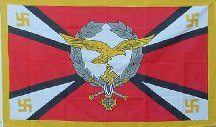 Distorted Replica Flag Distorted Replica Flag
The original (real) versions of these flags were square, but most modern replica flags being sold are being produced in the modern 3x5 foot size format. |
Fictitious Fantasy Flag
|
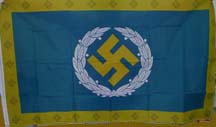
Luftwaffe Southern Command Flag (Fictitious)
This questionable replica flag claims to be a based on one of the Luftwaffe parade standards that Goering used. This is supposed to be the back side of the standard and used by either a southern or Italian theatre command. Another possible source is the parade dress uniform buckles of the Herman Goering Panzer unit. Modern replica flag manufacturers have released it and mistakenly calling it the "German Blue Ruck" and even as a "Slavic Officers Flag" in the modern 3x5' format. No real proof can be found that it ever really existed.
|
Field Marshall Car Flag
(Side one)
Field Marshall Car Flag
(Side two)
|
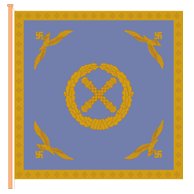
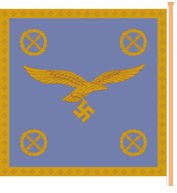
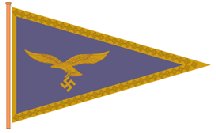
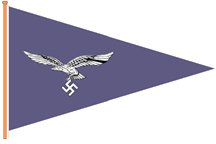
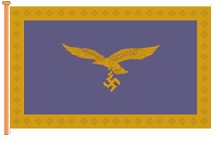
Rank car flags/Insignia of the Air Force 1941-1945
Here is the complete series of rank flags used by the German Air Force. All these flags were introduced in 1941 and used until 1945. The flag for a Field Marshal was called a "flag," whereas the remaining flags were called "Hoheitszeichen" (insignia). If a Command flag was flown, then the Rank flag had to be also used at the same time. All rank flags were only allowed as vehicle flags. The ground of the flags were light blue, the borders and eagles were gold, except for the "lesser ranked officers" flag (not field marshall or general) where silver was used instead of gold.
 |
|
 |
| Air Force General's Car Insignia |
|
Air Force Officer's Car Insignia |
 Air Force Commanding General's Car Insignia |
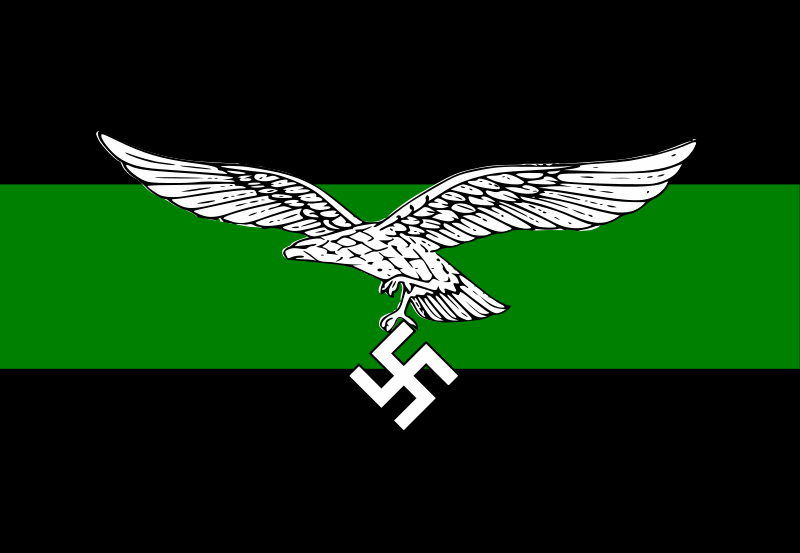
Luftwaffe Regiment
Presumed non-motorized rifle and mountain infantry
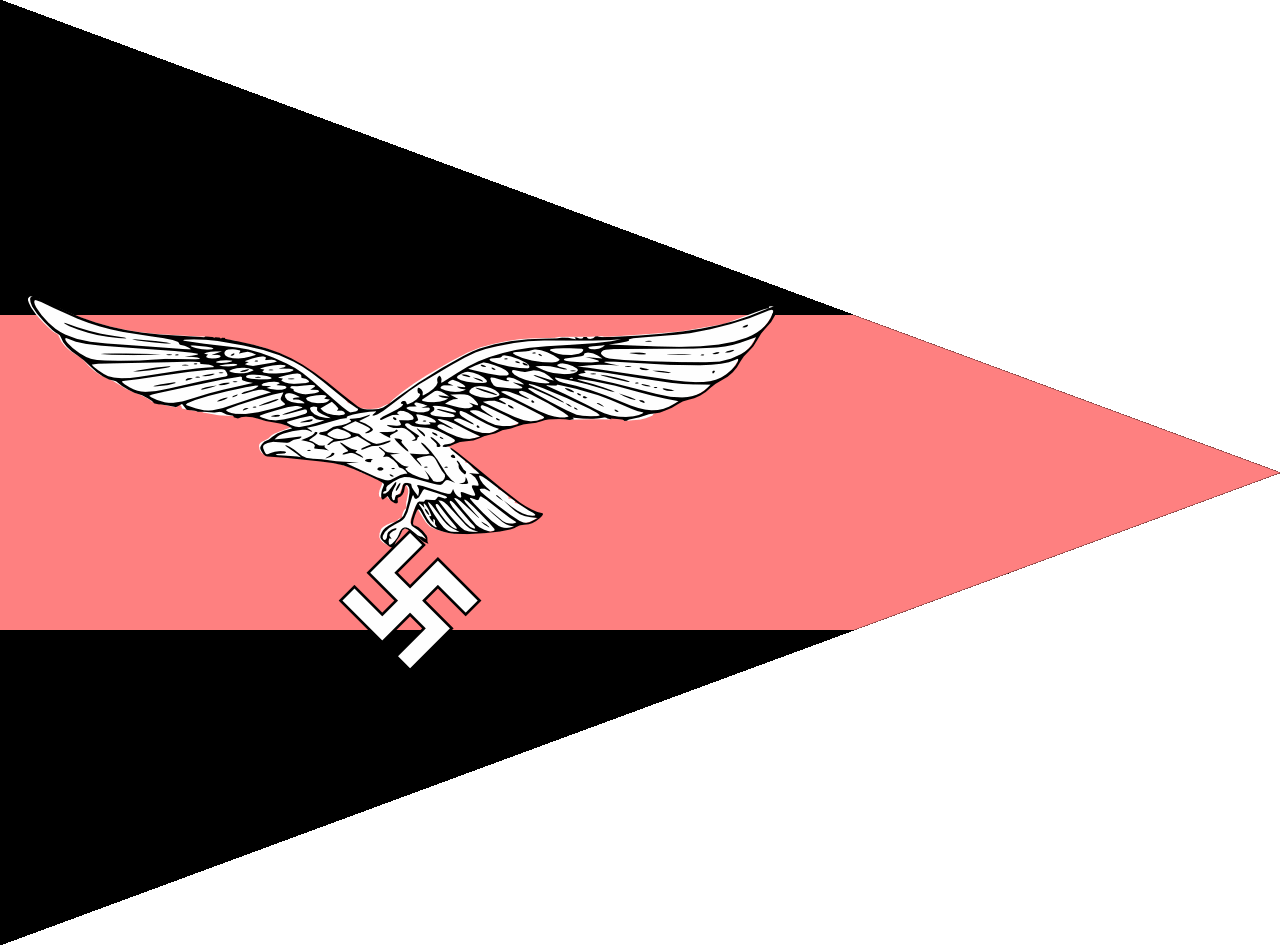
Luftwaffe Battalion
Presumed Luftwaffe Antitank Battalion Command Flag
|
Luftwaffe Regiment and Division Vehicle Command Flags 1942-1945
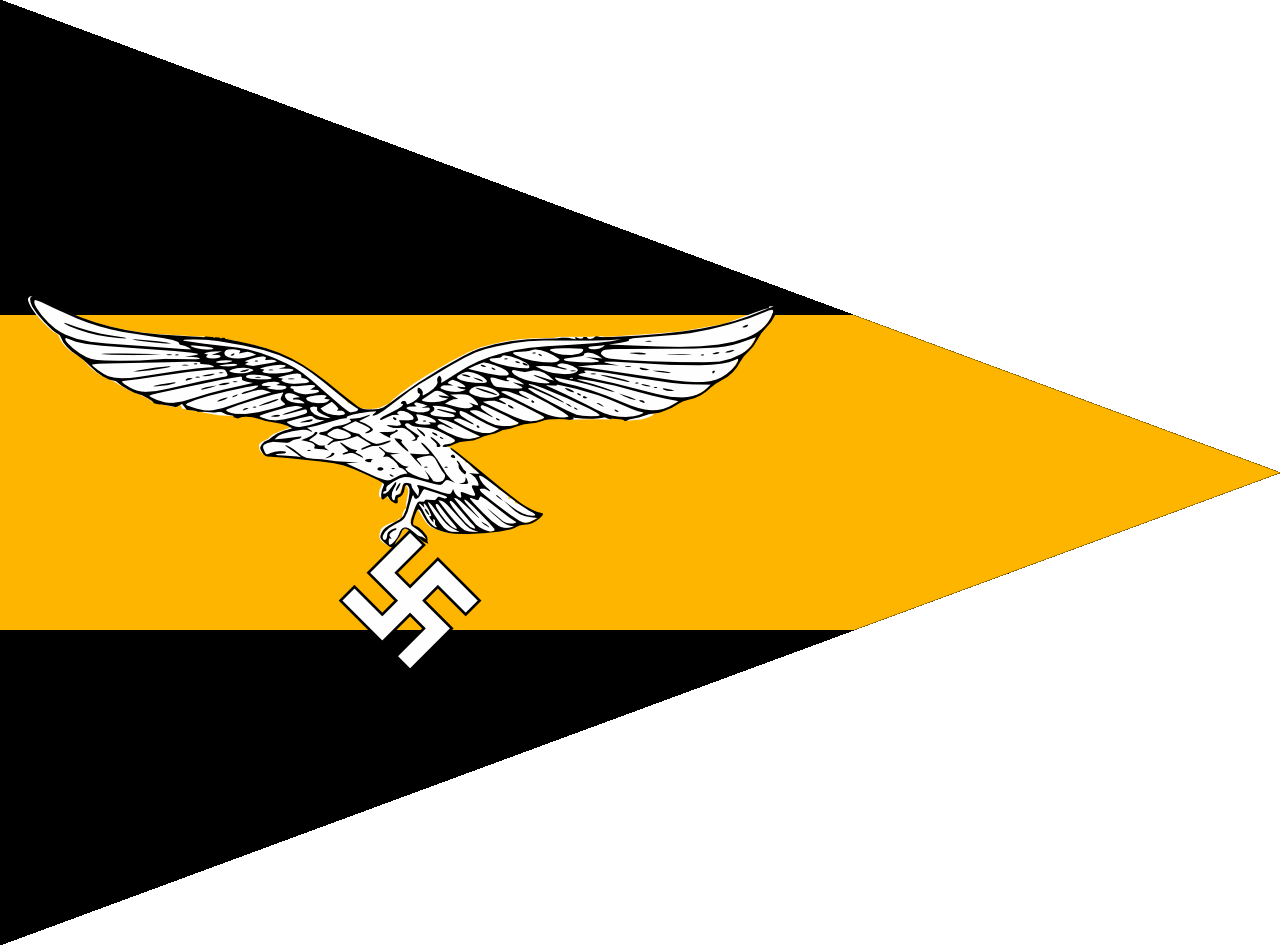
In 1942, as ground combat divisions were form from surplus Luftwaffe personnel, new vehicle commander's flags and pennants were introduced. They were similar to the Army pattern, but with the stripe color scheme reversed: a black field with a single broad horizontal Waffenfarbe (branch color) stripe. Centered on the pennant was a silver Luftwaffe eagle. This helped to distinguish these Luftwaffe Field Divisions from Army divisions. Regiment command flags were rectangular, and battalions used pennant-shaped command flags.
|
|
|
Presumed Luftwaffe Artillery Regiment
Command Flag |
|
Presumed Luftwaffe Reconnaissance Battalion
Command Flag |
Command flags which were flown by the leader of a military unit were mainly used by commanders of units as car and/or vehicle flags. They never replaced unit colours and represented only the commanding officer as his personal vehicle flag.
|
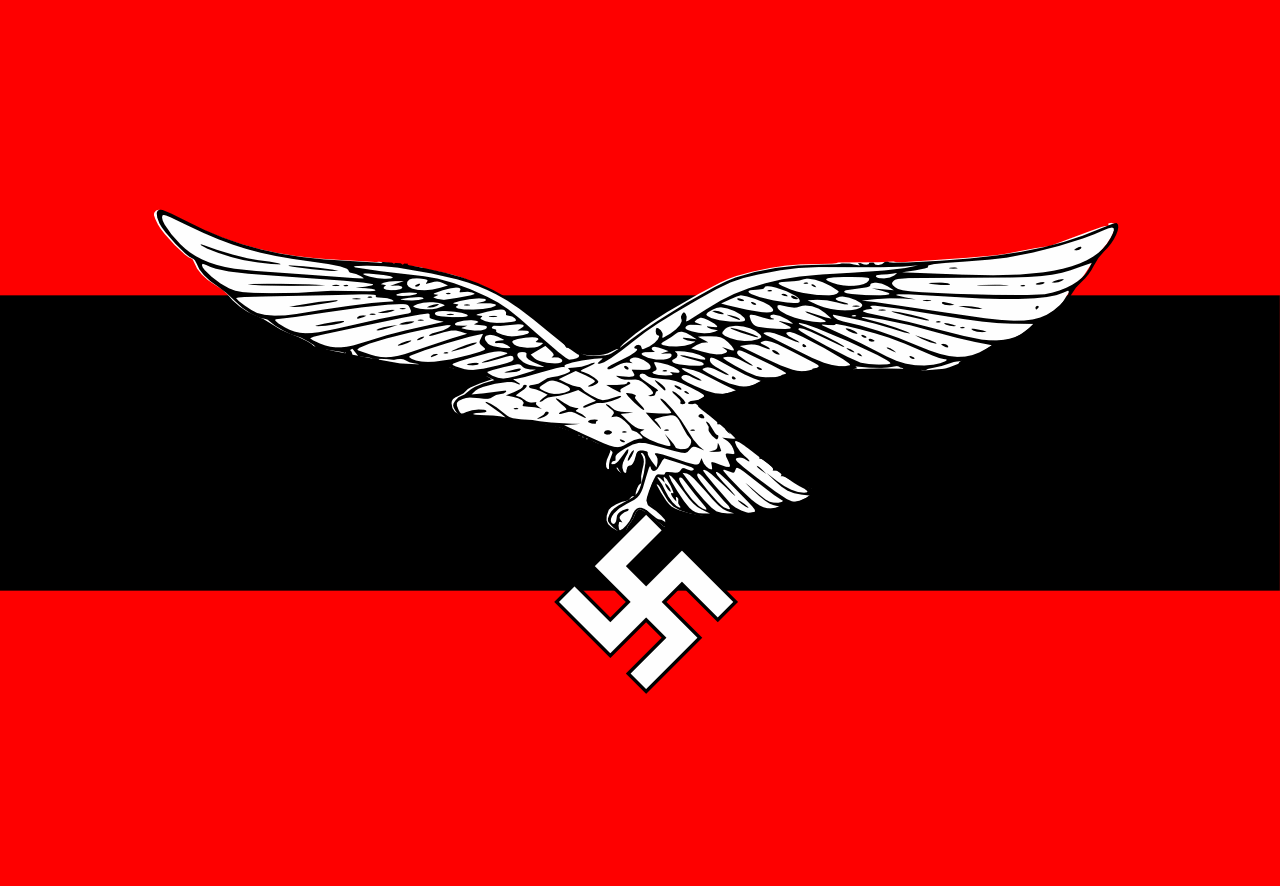
FLAK Regiment
|
Luftwaffe FLAK Regiment Vehicle Command Flag
Flak was an abbreviation for Fliegerabwehrkanonen (anti-aircraft guns). At the beginning of World War II the Luftwaffe had nearly a million men trained for anti-aircraft batteries for static home defense. As the war progressed able-bodied men were moved to mobile field Flak units and their positions on the home defence batteries were replaced by crews consisting of older men, school age boys, women auxiliaries, Italian and Hungarian volunteers, and even some Russian prisoners of war.
The Waffenfarbe (branch color) stripe pattern was identical to the Army pattern with the addition of the Luftwaffe silver eagle. |
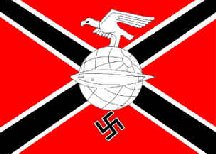
Zeppelin Corps Flag |
Zeppelin Corps Flag
A flag used at pre-war Zeppelin bases and installations, and because the Zeppelin itself was already obsolete, the Zeppelin Corps became one of the shortest-lived German service branches of World War II. After the German invasion of Poland in 1939, the Luftwaffe ordered the last two Zeppelin airships moved to a large Zeppelin hangar in Frankfurt. In March of 1940 Göring ordered their destruction and the aluminum fed into the Nazi war industry. In May a fire broke out in the Zeppelin facility which destroyed most of the remaining parts. The rest of the parts and materials were soon scrapped with almost no trace of the German "Giants of the Air" remaining by the end of the year. |
| Top of Page | Wehrmacht Command | Luftwaffe | Heer | Kriegsmarine |
| Schutzstaffel and SS-Waffen | German Occupied Territories | Political and Civil Flags |
German Army (Heer) Flags
It is important to remember that in the German military unit flags (Fahnen) were in general square and designed to be carried by foot soldiers when displayed. Any military unit or command flag not square is suspect.
German War Flag (type 2)
|
Germany War Ensign 1935-1945
This was the German War Ensign of the Third Reich and used by the all military forces of Nazi Germany. It was flown daily at all military installations, preferably at the entrance, otherwise near the guard room or staff building. It was introduced on November 7, 1935, the day the national military draft was begun in Germany.
|
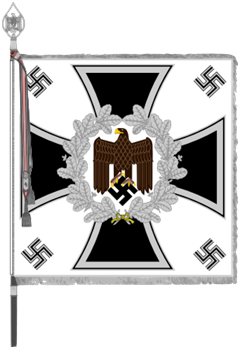
German Infantry Flag
|
German Infantry Flag
This Heer (Army) Infantry flag (the original was square) has at its center a white disk surrounded by a silver wreath and containing a brown "Army type" (with wings directed downward) eagle grasping a black swastika similar to the eagle that frequently appeared on Army steel helmets. The German Army standards were also sometimes swallow-tailed (split-tailed) with fringes, and their background color was used to indicate their branch of service. For example, white was used for infantry (as shown), pink for armor, black for engineers, and red for Artillery units.
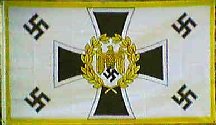 Distorted Replica Flag Distorted Replica Flag
|
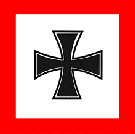
Army Commander-in-Chief
|
Command Flag of the Commander-in-Chief 1935-1941
This square flag Command Flag was used by the Commander-in-Chief (Oberbefehlshaber des Heeres) of the German Army between 1935 and 1941.
Wehrmacht (Defense Force) was a term that encompassed the three German armed forces (army, navy, and air force).
|
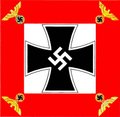
Chief of the General Staff
|
Chief of the German Army General Staff 1944-1945
This square command flag, introduced in September of 1944, was used by the Army Chief of the General Staff Heinz Guderian until his dismissal in 1945.
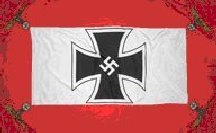 Distorted Replica Flag Distorted Replica Flag
Since Heinz Guderian was the only holder of this appointment, this flag has been closely associated with him. He was dismissed 38 days before the end of the war in Europe, when he was sent home on leave by Hitler. |
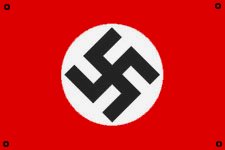
Swastika Vehicle Drape
(Most Commonly Used Drape)
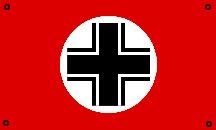
Vehicle Recognition Drape
(Limited Late War Use)
|
German Vehicle Recognition Drapes
These flag/drapes were supposedly placed on vehicles so that German planes could tell where the German frontline was, but according to some German flag experts the second design, commonly (and incorrectly) called the "Balkan Cross" (from "Balkenkreutz"), is merely a postwar invention that was never actually used by the German Armed Forces during the war. Others claim that it was used for a very short time by German "SS-Totenkopf" units on the Eastern Front, but soon abolished because it was too noticeable by the enemy. The Germans did, early in the war, use signal drapes to identify German armor for the Luftwaffe, but the only officially documented ones were simply the national flag with the swastika emblem. These drapes could be identified because they lacked loops for hoisting and had loops on all four corners making them suitable for fixing on tanks and even on the front deck of warships.
The Balkan Cross version (Balkenkreutz), meaning that the cross consists of two "Balken," the German word for bars or "balks," may also have been manufactured, but apparently was never widely distributed before the war's end. One suggestion was that they had been warehoused, and Allied occupation troops found them and brought them home as souvenirs. However, several compelling period photos do exist with what appears to be Balkan Cross versions of the German Vehicle drape being used on the Eastern Front during 1944, and there are reports of its use during the Battle of the Bulge in 1945, both late in the war. Since most Allied troops picked up the majority of their souvenirs at the end of the war or immediately after its end (it is unwise to carry items looted from your enemy when there is danger of being captured yourself), the extent and use, of this drape is hard to determine. |
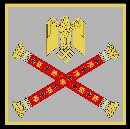
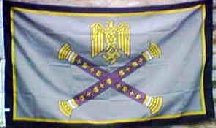
Field Marshal's Car Flag
|
Field Marshal's Car Flag 1941-1945
This square vehicle insignia for an Army Generalfeldmarschall's car (Hoheitszeichen eines Generalsfeldmarschalls des Heeres) was used as a car flag by German Heer (German Army) Field Marshals.
 Distorted Replica Flag Distorted Replica Flag
|
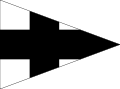
Command staff Infantry Battalion Commander
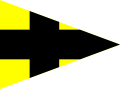
Command staff Signals Battalion Commander
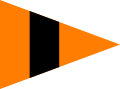
Military Police Company Commander
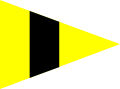
Signal Company Commander
|
Army Vehicle Command Flags and Pennants
Although Command flags were used occasionally by German military units during formations and ceremonies, they were mainly flown by the leader of a military unit as car and/or vehicle flag. They never replaced unit colours.
|
|
|
|
|
|
|
Infantry Regiment Commander |
|
Artillery Regiment Commander |
|
Armor Regiment Commander |
|
Calvary Regiment Commander |
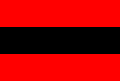
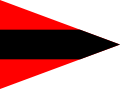
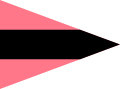
Command flags and pennants of German Army formations had background colors of their branch, or Waffenfarbe, usually with a black stripe in the middle.
|
|
|
|
|
|
|
Engineering Battalion Commander |
|
Artillery Battalion Commander |
|
Armor Battalion Commander |
|
Calvary Battalion Commander |
The list of World War II Waffenfarben in the Army (Heer) was: General Staff, Carmine Red; Armor, Pink; Armored Reconnaissance, Golden Yellow; Artillery, Red; Antiaircraft Artillery, Coral Red; Pioneers (engineers), Black; Signals, Lemon Yellow; Light Infantry (Jäger and Panzergrenadiere), Grass Green; Technical Troops (engineers and logistics), Blue; Army Aviation, Light Gray; Chemical Defense, Crimson; Military Police, Orange; Bands, White; Medical, Dark Blue. |
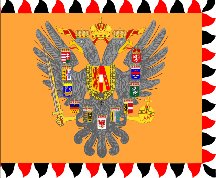
Austrian Grenadier Regiment
Austrian Eagle of Empire
|
Austrian Grenadier Regiment #134 Flag 1938-1945
This is the Flag for the Austrian "Hoch-und Deutschmeister' Grenadier-Regiment 134 which was first formed in 1938 Austria right after the successful occupation by Germany. This unit would take part in the Polish campaign of 1939, fight on the Western Front during 1040, and then be transferred to the Eastern Front in the spring of 1941. In May of 1942, it fought throughout the Caucasus, and then became involved in the disastrous fighting around Stalingrad in 1943, where it was almost completely destroyed. The survivors surrendered to the Russians.
A fresh division was re-recruited shortly after the Stalingrad disaster and sent to Italy in December of 1943 where it fought with distinction before being transferred to Hungary in 1945. This unit was honored with a special badge called the "Stalingrad Cross." Their yellow colored flag with it's imperial two-headed eagle was almost, with the exception of its border coloring, identical to the old Austrian Imperial Standard.
|
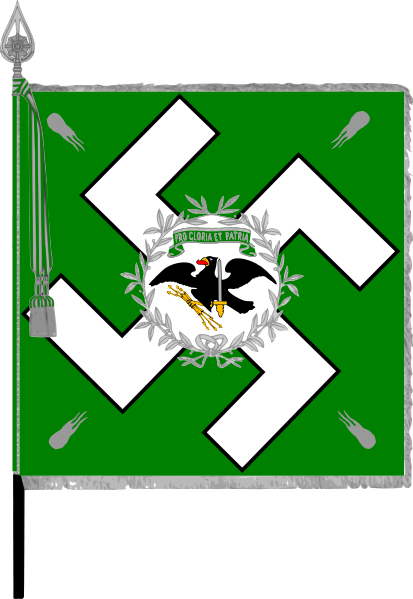
Land Police Group
|
Land Police Group "General Göring" 1st Battalion Regimental Flag
After World War I, the Treaty of Versailles had established a demilitarized zone in Germany that followed the Rhine River. No German military forces were permitted to enter this zone. This restriction did not apply to Police Units. When Hitler began rebuilding the German army, certain troops were called "Land Police" to get around this restriction, and stationed in the demilitarized zone. In March of 1936, the military forces of Germany reoccupied the demilitarized zone and the Landespolizei were converted into infantry battalions, but were allowed to keep their Land Police Colors.
This flag was for the Land Police Group "General Göring," one of those which were converted into a regular Army Infantry Regiment. These colors have also been identified as the flag of the State Protection Police of Prussia and also the Police Praesidium in Berlin. |
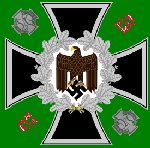
Finnish Volunteers Flag
|
Colors of the Jägerbataillon Finnland
(German III Battalion, Infantry Regiment 92)
These colors have had an interesting journey. After the war the British army found a them in the northern part of Germany and mistakenly identified them as the colors of the Deutsch-Arabischen Legion (German-Arabic legion). Because of this, in 1965, they were sent to Egypt and presented to the museum in El Alamein where they remain on display to this very day. More recent research has identified them as the colors of the "Jägerbataillon Finnland," or the German III Battalion, Infantry Regiment 92.
It seems that in 1941, the Third Battalion of German Infantry, Regiment 92, was renamed the "Jägerbataillon Finnland," a traditional name from the First World War. The flag is interesting because it displays in the four corners the Finnish Coat of arms surrounded by a wreath of pine neadles and representations of the Finnisches Jägerkreuz, instead of the normal swastikas. It is also assumed that this flag was never presented to the Third Battalion, Infantry Regiment 92, because it has never been mounted.
|
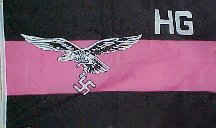
Göring Panzer Division
(Questionable)
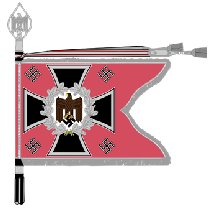
"Panzer" Battalion Standard
(Typical Design)
|
Presumed "General-Göring" Division Command flag
It is true Panzer units all used the color pink as their color designation, But the rational for this replica army flag was that this division was named after the Reichmarshall Hermann Göring, and apparently one of the duties of this Division HG ("HG" for Hermann Göring) was to protect Luftwaffe ground installations and air fields from ground assault.
We do know that historically there was an élite German Luftwaffe armored division named the Fallschirm-Panzer-Div 1 HG (1st Paratroop Panzer Division - Hermann Göring) which saw action in North Africa, Sicily, Italy and in the East. However, this particular modern flag design's existence is presently unconfirmed with any historical documentation.
We know some German regiments did use rectangular "command flags" with three equal stripes, and after 1942, certain Air Force units reportedly used flags and pennants on which the center stripe was black, and the upper and lower stripes consisted of their "Waffenfarbe" (color of the type of the unit) to differentiae them from similar Army Command flags. These Luftwaffe command flags also had a big Luftwaffe eagle in silver displayed on them. See Luftwaffe Regiment and Division Vehicle Command Flags 1942-1945.
You should also understand the differences between command flags, which were flown by the leader of a military unit, and the unique standards which represented the unit itself. Command flags were only used on a vehicle during the battle, whereas the swallow-tailed standards for a unit were carried on a vehicle, but held by a soldier, and not during a battle. For example, during a victory parade, but remember, they were never attached to a vehicle or used as a command flag.
In reference to the top flag design, it might be possible, although no reliable source confirms the supposition, that a special armor unit which had some connection to the name "Göring" had an unofficial flag made and the letters "HG" might also have been added by the unit without official permission. Most current evidence, however, still suggests this flag is only a modern fantasy replica flag. |
| Top of Page | Wehrmacht Command | Luftwaffe | Heer | Kriegsmarine |
| Schutzstaffel and SS-Waffen | German Occupied Territories | Political and Civil Flags |
German Naval (Kriegsmarine) Flags
It is important to remember that in the German military unit flags (Fahnen) were in general square and designed to be carried by foot soldiers when displayed. Any military unit or command flag not square is suspect.
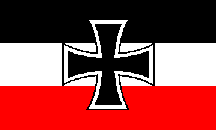
German Naval Jack 1933-35
|
German War Ensign and Naval Jack 1933-1935
This was the flag used by all Imperial German warships between 1903 and 1919 and later briefly reintroduced between 1933 and 1935. It was replaced by the swastika type in 1935 (see below).
On warships, the jack is flown from a flag pole (jack-staff) located on the vessel's front end (bow) when at anchor or in port. In the case of this flag it was also used as a regular ensign, or flag to be flown while at sea.
|
German War Flag (type 2)
|
German War Ensign and Naval Jack 1935-1945
This was the German War Ensign of the Third Reich and used by the all military forces of Nazi Germany. War Vessels of the German Kriegsmarine (German Navy) flew the National War Flag.
|
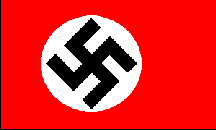
German Naval Ensign 1933-45
|
The German Merchant Flag 1933-1945
This was the flag flown at sea by all Third Reich mercantile ships and non-warships after 1935.
Although similar to the NSDAP Party and national flag, after 1933 the Merchant Flag had the white circle slightly off center and closer to the hoist. The swastika on the reverse side was "left-facing" or a mirror image of the one on the obverse (front) side.
( Click here to learn more about the different versions of the swastika flag ) |
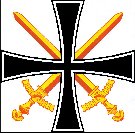
Commander-in-Chief Flag 1936-1939
|
Commander-in-Chief of the German Navy Command Flag 1936-39
This was the flag of the Commander-in-Chief of the Navy, if not a Grand Admiral. This was sometimes referred to as the first pattern Command flag.
Erich Raeder was commander-in-Chief of the German Navy from 1928 to January 1943. He was promoted in 1936 to Grossadmiral. Karl Dönitz took Erich Raeder's place as Commander-in-Chief and as Grossadmiral in 1943.
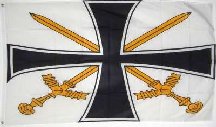 Distorted Replica Flag Distorted Replica Flag
|
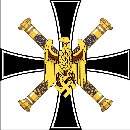
Grossadmiralsflagge Flag
|
Grand Admiral's (Grossadmiralsflagge) Command Flag 1939-1945
This is the flag (approximately 3x3 feet) of the Grand Admiral of the German Navy. This was sometimes referred to as the second pattern Command flag.
Erich Raeder was promoted to the rank of Grossadmiral in April of 1939. His served in this position until January of 1943 when he resigned his commission on grounds of ill health. His position was taken over by Karl Dönitz who held the position until the end of the war in Europe.
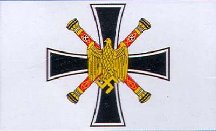 Distorted Replica Flag Distorted Replica Flag
|
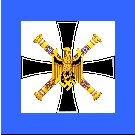
Admiralinspekteur 1943-45
|
Inspector Admiral (Admiralinspekteur) Flag 1943-45
This flag (approximately 3x3 feet) was used for the Inspector Admiral of the Navy of the Greater German Reich. Admiral Erich Raeder was Commander-in-Chief of the German Navy from 1935 until 1943, and then appointed Inspector Grand Admiral of the German Navy in 1943, a rank he held until 1945.
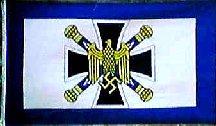 Distorted Replica Flag Distorted Replica Flag
|
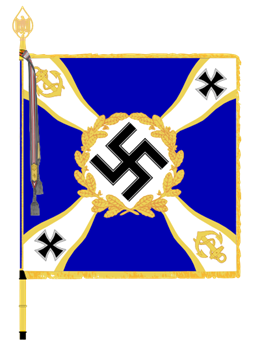
Naval Land Unit (obverse)
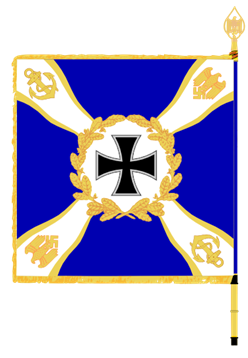
Naval Land Unit (reverse)
|
Flag for Naval Land units 1936-1945
Not all units of the German navy did their service on ships and boats. During World War II, the Kriegsmarine maintained a large number of land based formations of which many were required to wear standard combat helmets and uniforms as part of issued equipment.
Because they were stationed on land and were organized in battalions like units of the Wehrmacht, these Marine sections on land were given special colors. They were presented to them the first time in September of 1936 in Nuremberg. As the German Navy grew, more than 1.5 million men would eventually see service with the Kriegsmarine between 1939 and 1945.
A number of these units fought on the ground during key battles throughout the war. During the crucial battles on the Western Front German Naval personnel were often organized into ad hoc units that served as replacement battalions for line infantry.
Their flags consisted of a square of blue background and was sized according to the usual German flag regulations, i.e. it measured 126 x 126 cm. The left side displayed a centered swastika enclosed by a wreath of oak-leaves. Extending from the center to the four corners of the flag there were four stylized, white, gold-edged wedges which were to symbolize a ship propeller.
Set in the four corners of the flag there were two Iron crosses and two gold colored anchors, respectively. The right side of the flag was similar, but showed the Iron Cross in the center, whereas the Crosses in the corner were replaced by a gold colored Wehrmacht eagle. The color was edged on three sides with a gold colored fringe. |
| Top of Page | Wehrmacht Command | Luftwaffe | Heer | Kriegsmarine |
| Schutzstaffel and SS-Waffen | German Occupied Territories | Political and Civil Flags |
Schutzstaffel (SS), SS-Waffen & Foreign Volunteer Groups
The Schutzstaffel (SS - Shield Squadron, or Storm Troopers) was part political, part military. They began as Hitler's paramilitary bodyguards and the private army of the NSDAP Party, replacing the SA in the infamous "Night of the Knives" purge, to become Hitler's chief enforcers. As the movement grew into an international force, special schools were formed by their fanatical commander Heinrich Himmler, and special domestic and foreign volunteer units called SS-Waffen were organized to fight in the field and run the infamous death camps of the Third Reich. They were the Führer's "Praetorian Guard." Hated by all, including the regular army, the Nazis considered them the "Best of the Best," and the rest of the world considered them the "Worst of the Worst."
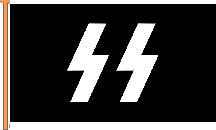
SS House Flag
|
Hausfahne SS Flag
This was the house flag of Schutzstaffel (SS) which is German for "protection squads." The SS was originally formed within the German Nazi party as a personal bodyguard for Adolf Hitler and other Nazi leaders. It replaced the Sturmabteilung (SA) bodyguard after the "Night of the Long Knives." (June 30 to July 2, 1934)
The SS itself was made up of three separate branches - The Allgemeine-SS (General SS) was the main branch and it served a political and administrative role. The SS-Totenkopfverbande (SS Deaths Head Organization) administered and ran Hitler's work and death camps. The Waffen-SS (Armed SS) was the third branch which provided combat troops, many drafted from conquered or allied countries. |
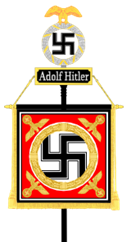
Leibstandarte SS Adolf Hitler
Front Side
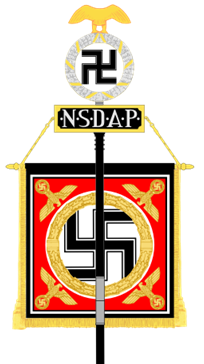
Leibstandarte SS Adolf Hitler
Rear Side
|
Standard for the "Leibstandarte SS Adolf Hitler" 1940-1945
The Leibstandarte SS Adolf Hitler (LSSAH) was Adolf Hitler's personal Bodyguard Regiment ("Leibstandarte" being a somewhat archaic German expression for the personal bodyguard of a military leader).
By the end of World War II it had been increased in size from a regiment to a Panzer division. The elite division was a component of the Waffen-SS which was found guilty of war crimes in the Nuremberg Trials.
The depicted second model of the LSSAH-standard was a unique model. The front resembled closely the personal standard of Adolf Hitler. After World War II it was taken by the Soviet Red Army to Moscow where it is still exhibited in a museum of the Red Army.
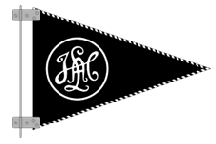
Vehicle-pennant for members of the LSSAH
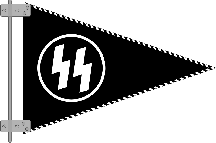
General vehicle-pennant for the SS |
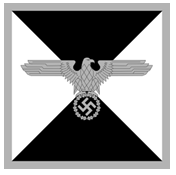
Reichsführer SS Pennant
|
Personal Standard for the Reichsführer SS Heinrich Himmler
Heinrich Himmler was considered one of the most powerful men in Nazi Germany. Himmler served as Chief of the German Police and Minister of the Interior. As Reichsführer-SS, he oversaw all internal and external police and security forces, including the Gestapo.
Shortly before the end of the war, he offered to surrender both Germany and himself to the Western Allies, if he were spared prosecution. After being arrested by British forces, he committed suicide before he could be questioned.
The question about this flag is wether or not it should it be called a "personal standard," or a "command" flag. It was seen used like a regular vehicle command flag, but also carried, fixed to a pole, by a soldier accompanying Himmler like it was his personal standard. Interestingly, when seen used fixed to a pole, the flag appeared to be manufactured of soft material (no metal) and was about about 1x1 meter square. |
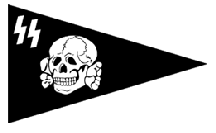
SS-Totenkopf pennant
|
Vehicle pennant for Members of SS-Totenkopf Units
Initially SS-Totenkopfverbände (SS-TV) was the SS organization responsible for administering the Nazi concentration camps for the Third Reich. At the outbreak of WWII one of the first combat units of the Waffen-SS, the SS Division Totenkopf, was formed from SS-TV personnel.
IIt soon developed a reputation for ferocity and fanaticism, participating in several war crimes such as the Le Paradis massacre in 1940 during the Fall of France and the murder of Russian civilians in Operation Barbarossa. |
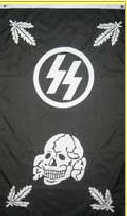
Fictitious Fantasy Flag
|
SS Command Center Wall Flag (Fictitious)
This modern fantasy item claims to be a SS headquarters wall banner designed to hang down a wall with the hoist with the SS runes near the top. No real proof can be found that it ever existed, but the art seems similar to designs of a trumpet banner used by ceremonial LAH unit guards.
|
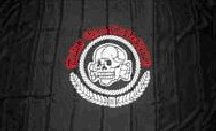
Fictitious Fantasy Flag
|
SS-Totenkopfverbande Flag (Fictitious)
This modern fantasy item claims to be a SS Loyalty Motto flag proclaimed "Mein Ehre Heisst Treue" or "My Honor is Loyalty" that was used by the SS-Totenkopfverbande (SS Deaths Head Organization). No real proof can be found that it ever existed.
Historically, the term Totenkopf (skull), or "death's head," remained in use until the dissolution of the SS in 1945. The SS-Totenkopfverbande was first established to provide the personnel for the manning of the concentration camps, but during the war, the SS-Totenkopfverbande also provided combat troops for SS Division Totenkopf, one of the first combat units of the Waffen-SS. |
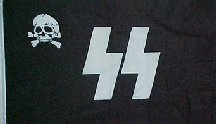
Waffen-SS Panzer Corps
Questionable Flag
|
SS Adolf Hitler Panzer Flag
This questionable flag (still being researched) as the regiment flag of the SS Panzer Corps Leibstandarte SS Adolf Hitler which was a German Waffen-SS panzer corps that saw action on both the Western and Eastern Fronts during World War II. It is obviously based on the vehicle pennant used for Members of SS-Totenkopf Unit.
As a point of interest, a skull that has no lower jawbone is known as a "Panzer skull." This flag is very likely another fantasy flag.
|
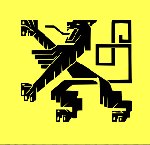
Legion Flandern SS
|
Belgian SS-Freiwilligen Legion Flandern 1941
The Legion Flandern was a unit of the Waffen-SS made up of Belgian volunteers. It was formed in 1941 from Flemish volunteers in Hamburg, Germany. After a short basic training, they were sent to Radom, Poland, and then to Debica for further training as a reinforced infantry battalion with five motorized companies.
In November of 1941, the Legion marched to the front near the region of Nowgorod. It then had 1112 soldiers, 950 of them were Flemish, and 14 were Flemish officers. The unit first campaigned in the Wolchow-region, and later in fierce trench fighting at Leningrad. After Leningrad, what was left of the unit was broken up and reassigned. |
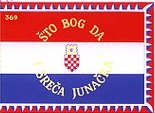
Coatian Volunteer Legion
(Reverse Side)
|
Coatian SS-Volunteer "Black" Legion
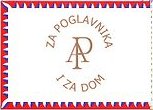
Coatian volunteers took the oath of allegiance to Hitler in the thousands, joining a Croatian legion of the Waffen S.S. The independent State of Croatia was allied to the Axis powers. The young soldiers of the Croatian divisions, with their country's coat of arms (a red and white checkerboarded shield called the "Ustashi" symbol) on their steel helmets fought beside the Germans and the Austrians.
On the front of the flag is the coat-of-arms of the Indenpendent State of Croatia. The Shield is surrounded by the motto "ŠTO BOG DA I SREA JUNAKA" (By the grace of God and the deeds of Heroes). This was the motto of the Croatian national hero Josip Jelacic of Bužim of Croatia, a general in the service of the Habsburgs.
On the backside are the letters "AP" for Ante Pavelic, the Poglavnik (Leader) of the Independent State of Croatia with the motto "ZA POGLAVNIKA I ZA DOM" (For the Leader and the Fatherland). |
Fictitious Fantasy Flag
|
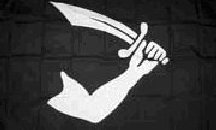
Croatian SS-Handschar Flag (Fictitious)
Although this fantasy flag claims to be the flag of the Croatian SS-Handschar, it is actually based on the emblem carried on the collar patches worn by members of this division. Historically, this flag didn't exist, but the unit did.
The 13th SS Mountain Division was formed in March 1943 from Moslems from the Bosnia-Herzegovina region of Croatia with a core of German troops (Croats were only 10% of its members - mainly officers) from the 7th SS-Freiwillingen-Gebirgs Division. It was called "Croatian" just because the Independent State of Croatia (Nezavisna Drzava Hrvatska) annexed Bosnia and Herzegovina. Many Kosovo Albanians and Muslim from Serbian Sanjak joined the unit also. There was also an Albanian SS-Skanderbeg Division, but besides for collar patches, it doesn't appear to have had a flag.
It is also interesting to note that the emblem of the German 13th SS division Handschar (Kroatische SS-Freiwilligen-Gebirgs-Division) substantially resembles the flag ascribed to the 18th Century Pirate Thomas Tew.
|
Den Norske Legion (DNL)
|
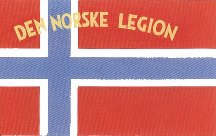
Norwegen Freiwilligen-SS Legion Flag
The Den Norske Legion (DNL), was formed in 1941. Although originally this unit was promised to be fully Norwegian, with Norwegian uniforms, weapons, language and officers, it never was. Its main purpose was to join the Finnish forces in their fight against the Russians. The uniforms used were standard SS, but most men wore the Norwegian Lion instead of the SS runes. They also wore the Raven and St.Olav Cross on their sleeve, with a Norwegian flag on their upper arm. The German decals on the helmets were usually removed.
|
Independent Dutch SS Flag
Questionable Flag
|
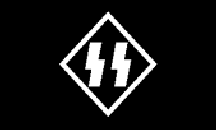
Dutch SS (Germanic SS in the Netherlands) Flag
This flag, reported to be for the independent Dutch SS (renamed "Germanic SS in the Netherlands" in 1942), is questionable. The Germanic SS in the Netherlands was part of the NSB (National Socialist Movement). Although they were technically independent of the German SS, their goal was for Germany to completely annex both the Netherlands and Flanders.
Because this flag uses a design commonly used on armbands and for recruiting posters, it is possible that it was used as a flag, but no real proof exists that it was.
|
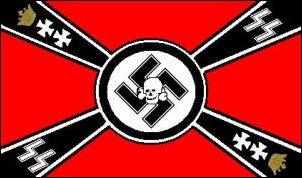
SS-Heimwehr Danzig Flag
|
SS-Heimwehr Danzig (Poland) 1939
The SS Heimwehr Danzig ("Home Defense of Danzig") Battalion was an SS unit established in the free city of Danzig, before the Second World War. It fought with the German army against the Polish Army during the invasion of Poland. After this it became part of the 3rd SS Division Totenkopf and ceased to exist as an independent unit. Basically, this impressive flag represented a unit that existed only between July and November of 1939, then was absorbed into another larger unit, the SS-Totenkompf Division.
It is also a grave error to call this unit "Polish," and extremely offensive to the Poles. They take a great pride in the fact, that while there were naturally a few collaborators, and those usually motivated out of greed or fear, that their numbers were minuscule when compared with those of other occupied countries. This unit, with it's impressive flag, was mainly a propoganda effort on the part of the Nazis to try and show popular support for their take-over of Poland. There were no Poles in the ranks of either the SS Heimwehr Danzig or the later SS-Totenkompf Division.
|
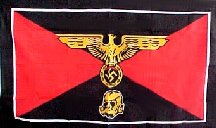
Third SS Totenkompf Division
Questionable Flag
|
SS-Totenkompf Division Flag (Questionable)
This flag is widely distributed, and claims to have been the flag of the SS-Totenkompf Division, but no creditable documentation exists to back the claim. The unit was, however, very real. The 3rd SS Division (one of the 38 divisions fielded by the Waffen-SS during World War II) was formed from the Totenkopf units that took part in the Polish Campaign. It should be noted that although this unit is sometimes called Polish, once again, there were no Poles in the ranks of SS-Totenkompf. The unit served both in France and on the Eastern Front. The Division surrendered to the Americans on May 9, 1945, and the prisoners were handed over to the Soviets.
This particular modern replica of the Totenkopf Flag design seems to be based on a square unit patch or crest. Another similar modern version of this flag follows the same pattern, but doesn't have the skull. |
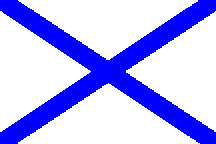
ROA Flag
|
Russian Liberation Army (ROA) Flag
The ROA was a group of predominantly Russian forces allied with Nazi Germany to fight the Soviets. In 1944, ten Russian Liberation Army divisions (750,000 men) were formed under the command of General Andrei Andreievich Vlasov. Previous to this, Vlasov had served in the Soviet Red Army and took part in the defense of Moscow, but after the failed German attempt to take the Soviet capital he was captured by the Germans, became disillusioned with the Soviets, and switched sides to take command of the ROA. He then fought on the side of the Germans against Soviets, but later once again switched sides, and came to the aid of the Czech insurgents supporting the Prague Uprising in 1945 against German occupation.
|

Kaminski's Brigade
Lokot Republic
The Flag of the Lokot Republic featured the cross of RONA and the image of Saint George slaying the Dragon, a traditional Russian symbol. |
Russian National Liberation Army (POHA) Flag
Besides Vlasov's ROA, there was Bronislav Kaminski's Brigade (RONA/POHA - Russian National Liberation Army) which numbered 10,000 men. Kaminski's command was allowed by the Germans to have virtual control over a large chunk of the Russian territory (eventually the size of Belgium) in exchange for fighting the Soviet partisans. This area was known as either the "Lokot Autonmy," or the "Lokot Republic," because it was centered in the small town of Lokot, near the city of Bryansk.
As the released prisoners of the gulags were not allowed to return to the big cities, the towns like Lokot were populated by many of them. Not surprisingly, these people didn't have any liking for the Soviets. Eventually, Kaminski (interestly, of Polish-German extraction) was given the rank of Waffen-Brigadefuhrer (SS General) and his command was renamed the Waffen-Grenadier Division der SS (russische Nr. 1). In 1943, the Soviet offensive forced the Germans and Kaminski to relocate to Lepel, then he was ordered west to help quell the Warsaw Uprising in August of 1944. Kaminski, who hated the Poles for reasons only known to him, allowed his soldiers to commit unbelievable atrocities against the civilian population. They seemed only interested in pillaging, rape and robbery, and by this time his units had little military value. Eventually, he was arrested by the Gestapo, courtmarshalled, and executed. Apparently, his crimes were unimaginable even to the hardcore Nazis. |
| Top of Page | Wehrmacht Command | Luftwaffe | Heer | Kriegsmarine |
| Schutzstaffel and SS-Waffen | German Occupied Territories | Political and Civil Flags |
Flags of German Occupied Territories 1939 to
1945
German Occupied Territories refers to the countries of Europe which were occupied by the military forces of Nazi Germany during World War II. Some of these countries started the war as opponents of Germany, but were subdued and occupied. Some countries occupied by the Nazis had proclaimed themselves neutral to no avail, and others were former members of the Axis. In some cases, their governments went into exile, or governments-in-exile were formed by some of their exiled citizens. In all these countries either puppet governments were established, or military governments called General Governments (Generalgouvernment).
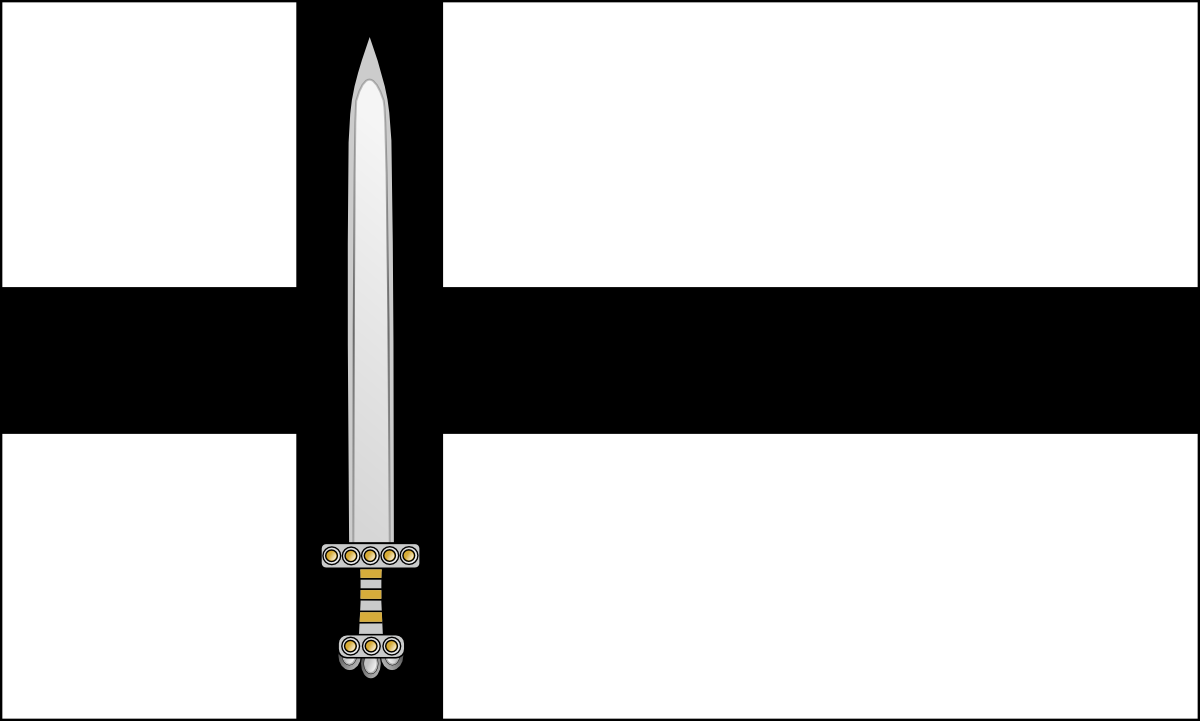
Generalgouvernment Proposal |
Proposed Generalgouvernment (General Government) Flag 1939
Although his proposal was not solicited by anybody, Dr. Ottfried Neubacker (acclaimed as the "father" of vexillology) submitted this flag design for the "General Government of Occupied Territories" right after the successful invasion of Poland. Dr. Hans Frank, the Governor-General of newly conquered Poland, loved the design and wanted to adopt it, but Hitler and Himmler rejected it in favor of the new German War Ensign.
Although his flag proposal for the Generalgouvernment was never used, Dr. Neubacker told Alfred Znamierowski (another "titan" of vexillology) that he considered this proposal being one of the best he had ever done. Indeed, it is a striking design, both in simplicity and symbolism. |
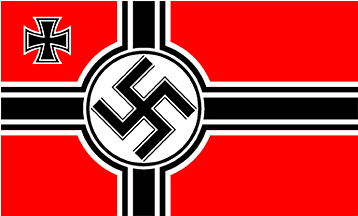
German Occupational Forces
|
Official Generalgouvernment (General Government) Flag 1939-1945
(German War Ensign 1935-1945)
The most common flag used for the different occupational "Generalgouvernments" was the German War Ensign of the Third Reich, the same ensign used by all military forces of Nazi Germany.
In occupied countries, such as Poland, Denmark and Norway, not only was it usually flown daily at all military installations, it was also flown outside all occupied civil buildings. |
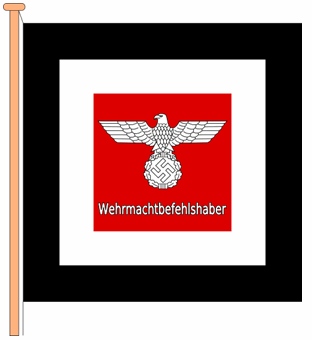
Wehrmachtbefehlshaber Flag
|
Command Flag of a Wehrmachtbefehlshaber 1940
A German "Wehrmachtbefehlshaber" (Commander-in-Chief of Occupied Territory) was a special position in occupied territories. These territories either had a civil administration or were governed by a military administration. A Wehrmachtbefehlshaber only existed in a territory which had a civil administration. He was commanding all military units in this territory. His superior was often only Adolf Hitler himself. The first Wehrmachtbefehlshaber was Friedrich Christiansen who was responsible in Norway.
The command flag, which was introduced in 1940, was a square in the colors black, white, red. On its red colored center it bore the National eagle in white. Below the eagle there could be seen the word "Wehrmachtbefehlshaber," also colored in white. |
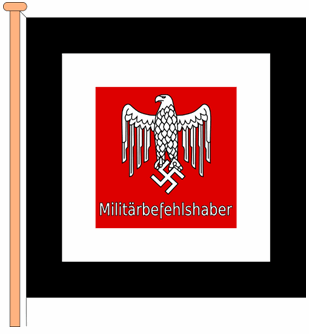
Militärbefehlshaber Flag
|
Flag of a Militärbefehlshaber 1940
A German "Militärbefehlshaber" (Military Governor of Occupied Territory) was a further special position in occupied territories. He was a member of the Wehrmacht, but did not command any military troups. Rather was he responsible for the economy and the government of an occupied territory. A Militärbefehlshaber was put in his position by the Commander-in-chief of the Army. Until 1941 this position was held by von Brauchitsch, then Adolf Hitler himself took over this position as well.
The flag for a Militärbefehlshaber was similar to that of a Wehrmachtbefehlshaber, but had two differences. In the center there was a Wehrmacht eagle instead of the National eagle and below the eagle there was the word "Militärbefehlshaber" in white. The flag was introduced also in 1940. |
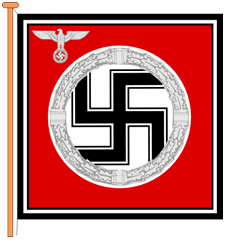
Reichsprotektor Flag
|
Flag for the Reichsprotektor in Böhmen und Mähren
(Reich protector of Bohemia and Moravia)
Bohemia and Moravia was a puppet state, established by the Nazis in March 15, 1939. Bohemia and Moravia were autonomous Nazi-administered territories which the Nazi government considered part of "Greater Germany" and were placed under the supervision of a "Reichsprotektor." The first Reichsprotektor was Konstantin Freiherr von Neurath. In September 1941, he was relieved of his day-to-day powers and SS-hardliner Reinhard Heydrich was appointed Deputy Reichsprotektor. After being assassinated in 1942 he was followed by Kurt Daluege and finally Wilhelm Frick took over the position in 1943 which he held until the end of the war.
The flag for the Reichsprotektor of Bohemia and Moravia was similar to that of the Führerstandarte used by Adolf Hitler, although there were noticeable differences: The ring of oak leaves that surrounded the swastika was silver and so was the national eagle in the top left corner of the flag. Contrary to the Führerstandarte there was only this single eagle shown on the flag. The great similarity to the Führerstandarte obviously had the reason to demonstrate the close connection between the Protectorate and the German "Führerstaat" (leader state). |
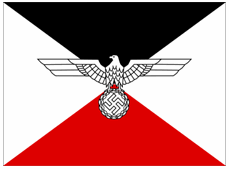
Reichsprotektor Vehicle flag
|
Representative of the Wehrmacht in Bohemia and Moravia Vehicle flag
This command flag was similar to that of a Commanding General of the Army with the difference of an added National Eagle that was placed in the center of the flag in white. The flag was only used as vehicle flag.
It should be remembered that for the Czechs of the Protectorate of Bohemia and Moravia, German occupation was a period of brutal oppression. Czech losses resulting from political persecution and deaths in concentration camps totaled between 36,000 and 55,000. The Jewish population of Bohemia and Moravia (118,000 according to the 1930 census) was virtually annihilated. |
- My thanks to Brian Davis and "Fornax" for all their expert help on this page -
| Top of Page | Wehrmacht Command | Luftwaffe | Heer | Kriegsmarine |
| Schutzstaffel and SS-Waffen | German Occupied Territories | Political and Civil Flags |
Other Eras of German History
| Prussian Era Flags | Imperial Germany Era Flags | Imperial German Colonial Flags |
| Weimar Republic Era Flags | Modern Era Flags |
|